
Facebook Group Growth Strategies for Community Builders
Facebook Group Growth Strategies That Build an Active Community
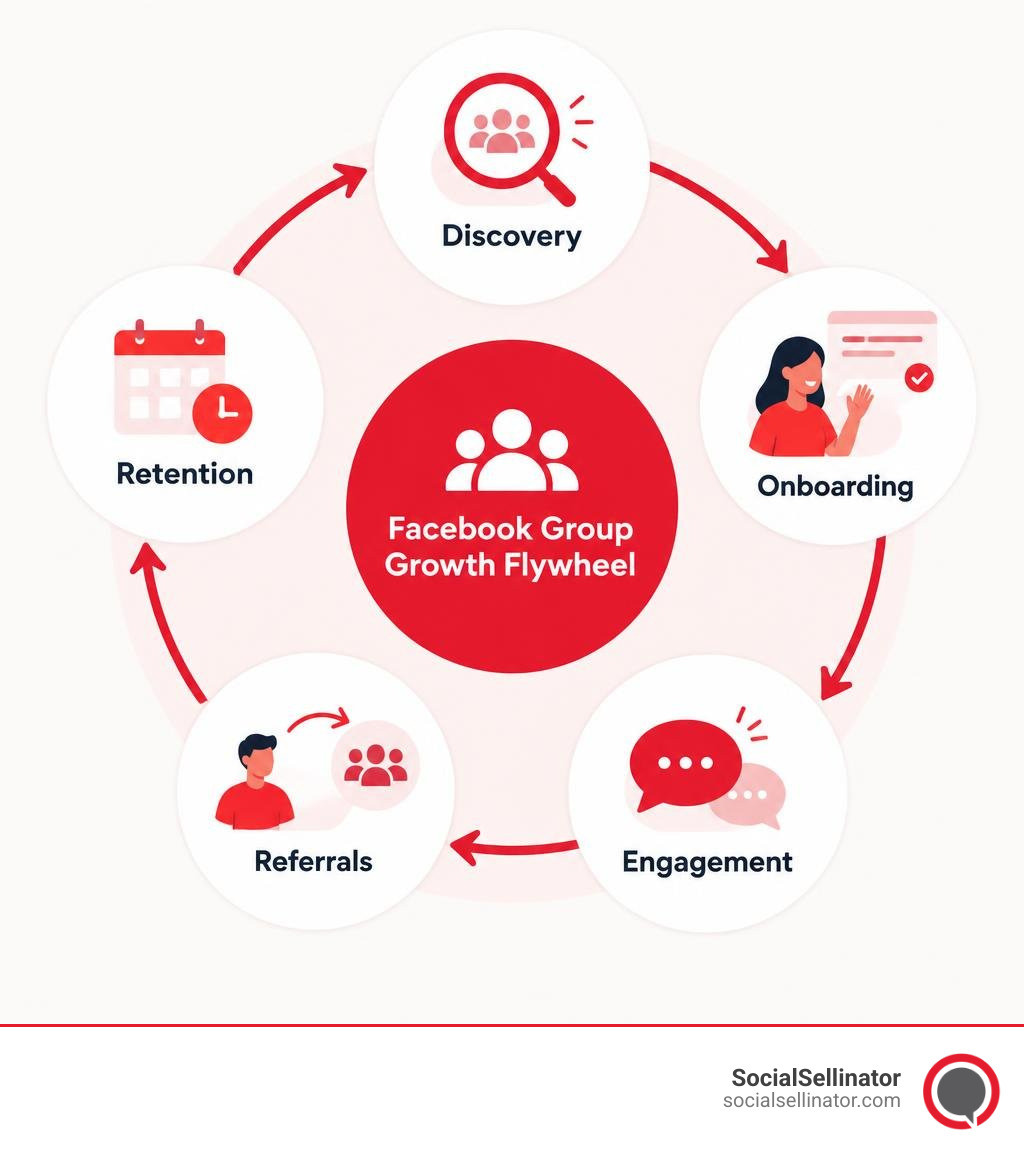
The most effective facebook group growth strategies combine search visibility, a clear member promise, consistent conversation, and targeted promotion. Start by naming the group around a problem your ideal members already search for. Seed it with useful posts before inviting people. Then welcome every new member with a simple next step, such as an introduction thread or a quick poll.
For sustainable growth, focus on these priorities:
- Make the group easy to find with keyword-focused names and descriptions.
- Give members exclusive reasons to join, comment, and invite peers.
- Build weekly content rituals that make participation easy.
- Promote the group through email, social profiles, partners, and relevant communities.
- Use paid campaigns only after your onboarding and engagement systems work.
Facebook Groups give brands a place for real discussion, customer insight, and trust-building that a standard Page cannot always create. With more than 1.8 billion people using Groups monthly, the opportunity is large, but member count alone is not the goal. A smaller group of active, well-matched people can create more leads, loyalty, and useful feedback than a large audience that never participates.
The key is to treat your Group as a community product, not a broadcasting channel. Members should quickly understand who the group serves, what they will gain, and how they can take part. Strong moderation, helpful content, and clear rules protect that value as the community expands.
Want to learn more how we can help you with Social Media Management?
Click here for a quick overview of our Social Media Management programs.
I am Jock Breitwieser, and this guide will help you build a Facebook Group growth system that prioritizes qualified members and measurable engagement.
Discover more about facebook group growth strategies:
Why Invest in Facebook Groups Over Pages in 2026?
Building an audience on social media has shifted dramatically. For years, businesses poured resources into acquiring Likes on public business Pages, only to watch their organic distribution shrink to low single digits. By 2026, standard brand Page posts reach only 2% to 5% of their total followers. In contrast, well-managed Facebook Groups regularly achieve organic reach figures between 20% and 40% per post.
The shift toward private and semi-private communities reflects what users want: genuine connection, peer-to-peer problem solving, and spaces free from repetitive corporate ads. In fact, 77% of internet users report that their most important community operates entirely online. When brands facilitate these spaces, they build durable brand equity that outperforms traditional broadcast feeds and drives long-term social media audience growth.
| Feature / Metric | Facebook Business Page | Facebook Group |
|---|---|---|
| Primary Function | Public brand storefront & directory | Interactive peer-to-peer community hub |
| Average Organic Reach | 2% – 5% of followers | 20% – 40% of active members |
| Communication Flow | One-to-many (broadcast style) | Many-to-many (collaborative dialogue) |
| Algorithmic Priority | Deprioritized in main news feed | Prioritized based on meaningful interactions |
| Lead Qualification | Passive follower engagement | Active screening via membership questions |
| Notification Triggers | Infrequent push notifications | High-priority push & in-app alerts |
| Audience Ownership Feel | Rented transactional surface | High-trust, owned-community ecosystem |
Algorithmic Superiority and Feed Placement
The Meta algorithm rewards what it categorizes as “Meaningful Social Interactions.” Unlike Page posts, which invite passive scrolling, Group posts generate conversational depth. When two members exchange multiple comments in a thread, the algorithm recognizes high utility and pushes that discussion to the top of other members’ personal feeds.
Furthermore, Groups come with built-in notification mechanics that Pages simply cannot replicate. When members join, engage, or react within a group, Meta surfaces in-app notifications, highlight emails, and dedicated community tab badges. This natural algorithmic resistance shields group managers from platform distribution drops, ensuring your valuable announcements get seen without requiring a paid boost every time. By structuring discussions around actionable business questions, community leaders create habitual daily engagement.
Building Front-of-Mind Brand Authority
Running an active group positions your organization as an industry authority and trusted facilitator. Rather than constantly pitching products, you create an environment where your ideal clients help one another solve real operational problems. Over time, members associate your brand with high-level expertise, dependability, and authentic leadership.
This environment produces powerful business dividends:
- Direct Market Research: You gain an unfiltered look into customer pain points, common objections, and emerging industry questions, allowing you to tailor new product launches with pinpoint precision.
- Reduced Customer Support Costs: When active members help answer newcomer questions, community-driven resolution reduces direct support overhead by up to 72%.
- Shorter Sales Cycles: By interacting directly with prospects in an authentic, high-value space, you implement proven social media lead generation strategies that transform passive observers into high-ticket clients.
- Higher Customer Retention: Customers who belong to a brand’s private community renew at higher rates and report stronger brand satisfaction because they feel invested in the ongoing community dialogue.
Core Facebook Group Growth Strategies for Rapid Discovery and Acquisition
Acquiring your first 1,000 members requires a clear, deliberate plan. Many community builders make the mistake of creating a group, inviting a dozen personal friends, and wondering why membership stalls. Systematic growth begins with search optimization, tight positioning, and friction-free screening that captures qualified leads right at the door.
Optimizing Group Name, Description, and Tags for Search
Facebook is one of the largest internal search engines in the world. Thousands of professionals search Meta’s directory daily for industry solutions, local networks, and support hubs. If your group name is purely brand-focused, you miss out on high-intent search traffic.
To maximize search visibility across both Facebook and Google search results:
- Adopt a Keyword-First Name: Place your primary keyword in the first 60 characters of your group name. Instead of “The Acme Agency Lounge”, use “B2B SaaS Growth & Marketing Tactics [by Acme]”. This instantly attracts users searching for specific business topics.
- Draft a 250-Word Search-Optimized Description: Incorporate secondary keywords naturally in the opening 100 words of your About section. State clearly who the community is for, what topics are covered, and what members will learn.
- Select Targeted Category Tags: Tag your group with precise niche categories (such as Marketing, Technology, or Entrepreneurship) to help Meta’s recommendation algorithm suggest your group to lookalike users.
- Claim a Custom URL Slug: Update your group URL in settings to match your primary keyword or clean brand name, making it clean, professional, and easy to link from external platforms.
Qualifying Members and Capturing Leads with Membership Questions
Every join request represents an inbound lead. Allowing members in without qualifying them results in rampant spam, diluted discussions, and missed pipeline opportunities.
Use Facebook’s 3-question membership screening feature to protect culture and build your owned assets:
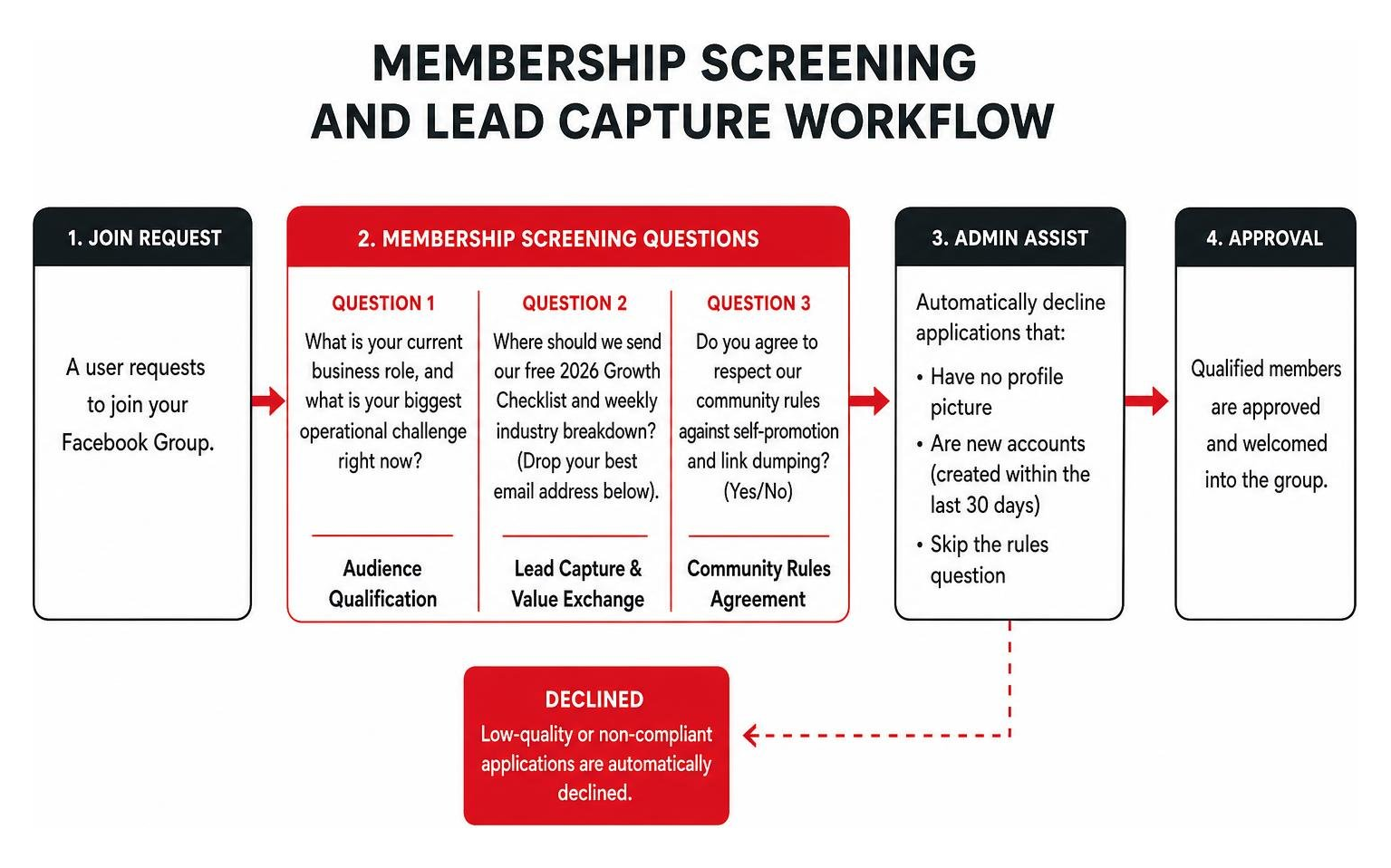
- Question 1 (Audience Qualification): “What is your current business role, and what is your biggest operational challenge right now?” This confirms the applicant matches your ideal customer profile.
- Question 2 (Lead Capture & Value Exchange): “Where should we send our free 2026 Growth Checklist and weekly industry breakdown? (Drop your best email address below).” Email conversion rates on join requests typically hit 8% to 15% when paired with an attractive resource.
- Question 3 (Community Rules Agreement): “Do you agree to respect our community rules against self-promotion and link dumping? (Yes/No)”
Use Facebook’s native Admin Assist to automatically decline profiles without profile pictures, accounts created within the last 30 days, or applicants who skip the rules question. This keeps your community secure while ensuring your team focuses only on meaningful conversations.
Content, Engagement, and Community Onboarding Frameworks
Attracting members is only half the battle; keeping them active is what generates business value. A group full of passive lurkers will quickly drop out of Meta’s algorithmic feed. To build compounding momentum, you must create a predictable environment that rewards consistent social media audience engagement.
Organic Facebook Group Growth Strategies: Content Seeding and Community Rituals
High-performing communities run on structured content rhythms. Rather than wondering what to write each morning, implement our V.A.L.U.E. Framework paired with a comprehensive social media content creation guide.
Signature weekly rituals build community habits. For example:
- Wins & Challenges Monday: Invite members to share their focus for the week.
- Tool & Resource Wednesday: Share a vetted template or productivity asset.
- Feedback Friday: Allow members to ask for peer reviews on active projects.
Pro-Tip for Algorithmic Visibility: When posting discussion questions, do not answer all comments at once. Respond to three or four comments, wait two hours, and reply to another batch. This spaces out engagement signals over a 12-to-24-hour window, keeping your post active in members’ news feeds throughout the day.
Structuring a 48-Hour New Member Onboarding Sequence
The first 48 hours determine whether a new member becomes an active participant or a silent lurker. If users join and see an empty, confusing feed, they will mute the group and never return.
Deploy this structured onboarding process for every new cohort:
- The Automated Batch Welcome Post: Once or twice a week, publish a welcome post tagging new joiners. Instead of a generic greeting, pair it with a low-friction prompt: “Welcome to our newest cohort! Drop a comment below with: 1) Your location, 2) Your business niche, and 3) The single biggest goal you’re tackling this quarter.”
- The Pinned ‘Start Here’ Resource Index: Pin a master announcement post containing links to your top 5 most valuable community discussions, downloadable templates, and group guidelines.
- Admin & Ambassador Outreach: Have community managers like or comment on every new member’s initial introduction. When people feel acknowledged immediately, their likelihood of returning to post within 14 days increases threefold.
Advanced Scaling: Referral Loops, Cross-Promotion, and Paid Funnels
Once your group achieves consistent baseline engagement (typically between 200 and 500 active members), you can deploy advanced scaling mechanisms. By blending owned channels, collaborative partnerships, and strategic paid advertising, you can compress standard growth timelines significantly.
Building Member Referral Loops and Cross-Platform Promotion
Your existing community members represent your most qualified acquisition channel. Groups that establish structured referral programs often see a 30% to 40% monthly growth boost on top of standard organic discovery.
Want to learn more about how we can help you with Social Media Management?
Click here for a quick overview of our programs.
To operationalize your referral loop:
- Incentivize Peer Invitations: Offer exclusive bonus assets (such as an unreleased video training, private template pack, or free consultation seat) when members invite colleagues.
- Gamify Community Growth: Run seasonal invite contests with public leaderboards, highlighting members who help expand the community.
- Leverage Cross-Platform Funnels: Treat your group as the central destination across all marketing touchpoints. Add group invitation links to your email newsletter footers, podcast outro scripts, YouTube descriptions, and team email signatures. When integrated into a broader social media marketing campaign, your group becomes a high-converting hub for all external traffic.
- Host Partner Cross-Postings: Partner with complementary, non-competing group admins. Co-host a live webinar or share a guest training post. A single high-value resource shared inside a partner community of 50,000 members can drive 500 to 2,000 qualified join requests within 48 hours.
- Publish Content Previews on LinkedIn and X: Share screenshots of high-value group discussions on external social platforms, prompting interested professionals to join the private group to read the full breakdown.
Paid Facebook Group Growth Strategies: Targeted Ads and Lead Funnels
While organic tactics build a solid foundation, paid advertising provides reliable, scalable member acquisition. Although Meta does not offer a direct “Join Group” ad objective, you can drive high-intent traffic using targeted lead and conversion funnels.
Here is how to structure a paid member acquisition campaign:
- The Two-Step Lead Magnet Funnel: Run Facebook Traffic or Conversion Ads targeting lookalike audiences and industry interest categories. Direct users to an optimized landing page offering a high-value resource (such as an eBook, template, or diagnostic tool). On the confirmation thank-you page, instruct them: “Your download has been emailed to you. To join the live walkthrough and connect with 3,000+ peers, join our private Facebook Group here.”
- The Video Teaser Funnel: Produce short video ads breaking down a specific industry problem. Include a direct call-to-action in the ad copy directing viewers to join the group to download the accompanying workflow document.
- Cost-Per-Acquisition Benchmarks: Across B2B and professional consumer niches, expect a realistic cost per new member between $0.50 and $3.00, depending on audience competitiveness and the strength of your hook.
- The Hybrid Scaling Model: An organic-only group generally takes 12 to 24 months to reach 10,000 members. By pairing consistent organic content with a modest paid ad budget ($500/month) and strategic partner shoutouts, you can compress that growth trajectory to just 4 to 8 months.
To ensure your campaigns deliver positive ROI, track your performance against established social media marketing metrics and document every step with a reliable social media marketing checklist. For long-term governance, reference our social media management guide 2026 to keep your workflows efficient as your community scales.
Frequently Asked Questions About Facebook Group Growth
How long does it take to grow a Facebook group to 10,000 members?
With consistent organic posting, search optimization, and community outreach, most brands reach 10,000 members within 12 to 24 months. By adopting a hybrid model—combining organic rituals, active cross-promotion, and a modest ad budget—you can achieve the 10,000-member milestone in 4 to 8 months. Key factors influencing velocity include niche saturation, content exclusivity, and the consistency of community moderation.
Should a Facebook group be public or private for faster growth?
For business authority and professional communities, Private (Visible) groups almost always outperform Public groups. While Public groups allow non-members to view content, Private groups create a sense of exclusivity, protect member privacy during candid discussions, and dramatically reduce automated comment spam. Because Private groups remain fully indexable in Facebook search, discoverability remains high, while gating content behind membership questions allows you to qualify every applicant before granting access.
What is the biggest mistake that causes Facebook group growth to stall?
The primary reason groups stall between 200 and 1,000 members is treating the community as a one-way sales channel. When admins post only promotional links and product pitches, members stop engaging, and the algorithm drops the group from the feed. Growth requires an 80/20 balance: 80% educational, conversational, and peer-to-peer value, and no more than 20% soft promotion. Stalled groups also suffer from inconsistent posting schedules and lack of active admin facilitation.
How do you revive a dead or inactive Facebook group?
To re-engage an inactive group, start by purging inactive accounts and spam bots. Next, pin a transparent announcement post from the group founder asking members what specific challenges they are facing today. Follow this up with a high-value live session, a free template drop, and daily interactive conversation starters to trigger Meta’s notification algorithm and re-establish regular member participation.
Conclusion
Scaling a thriving Facebook group requires more than publishing occasional links and hoping for engagement. Sustainable success demands clear positioning, search discoverability, structured onboarding sequences, and engaging content rituals that turn passive readers into active contributors. When managed with intention, a Facebook community becomes one of your most valuable digital assets, generating high-intent leads and lasting customer advocacy.
Executing these community programs while running day-to-day business operations can be challenging. That is where partnering with seasoned digital specialists makes all the difference. Our team at SocialSellinator builds comprehensive growth engines—combining search engine optimization, performance-driven paid advertising, and expert social media management services to help your business meet its overarching social media marketing goals. Whether you are launching a community from scratch or revitalizing an existing audience, we provide the strategic roadmap and hands-on execution you need to scale effectively.
Headquartered in San Jose, in the heart of Silicon Valley and the San Francisco Bay Area, SocialSellinator proudly provides top-tier digital marketing, SEO, PPC, social media management, and content creation services to B2B and B2C SMB companies. While serving businesses across the U.S., SocialSellinator specializes in supporting clients in key cities, including Austin, Boston, Charlotte, Chicago, Dallas, Denver, Kansas City, Los Angeles, New York, Portland, San Diego, San Francisco, and Washington, D.C.
- About the Author
- Latest Posts

Jock Breitwieser is a marketing thought leader, founder of SocialSellinator, Arcserve VP and has 20+ years’ experience in digital marketing & PR. He’s led communications at TriNet (IPO), Dell SonicWALL, CallidusCloud, and top agencies like (Edelman, Havas, Hoffman).
Named a Top 100 Social Selling Influencer, Jock contributes to outlets like Grit Daily, Marketer Magazine, DevX, Euro News, Hootsuite, Morning Lazziness, BacklinkBuilding.io, Under30CEO, and many others. Jock drives $1M+ client revenue outcomes, mentors startups, and lectures at SJSU and UC Berkeley Extension.


