

The Complete Guide to Brand Community Growth
Why Brand Community Growth Is the Smartest Marketing Investment You Can Make Right Now
Brand community growth is the process of building and scaling a network of customers who are emotionally connected to your brand — and to each other.
Here is a quick answer for those who want the essentials:
What drives brand community growth?
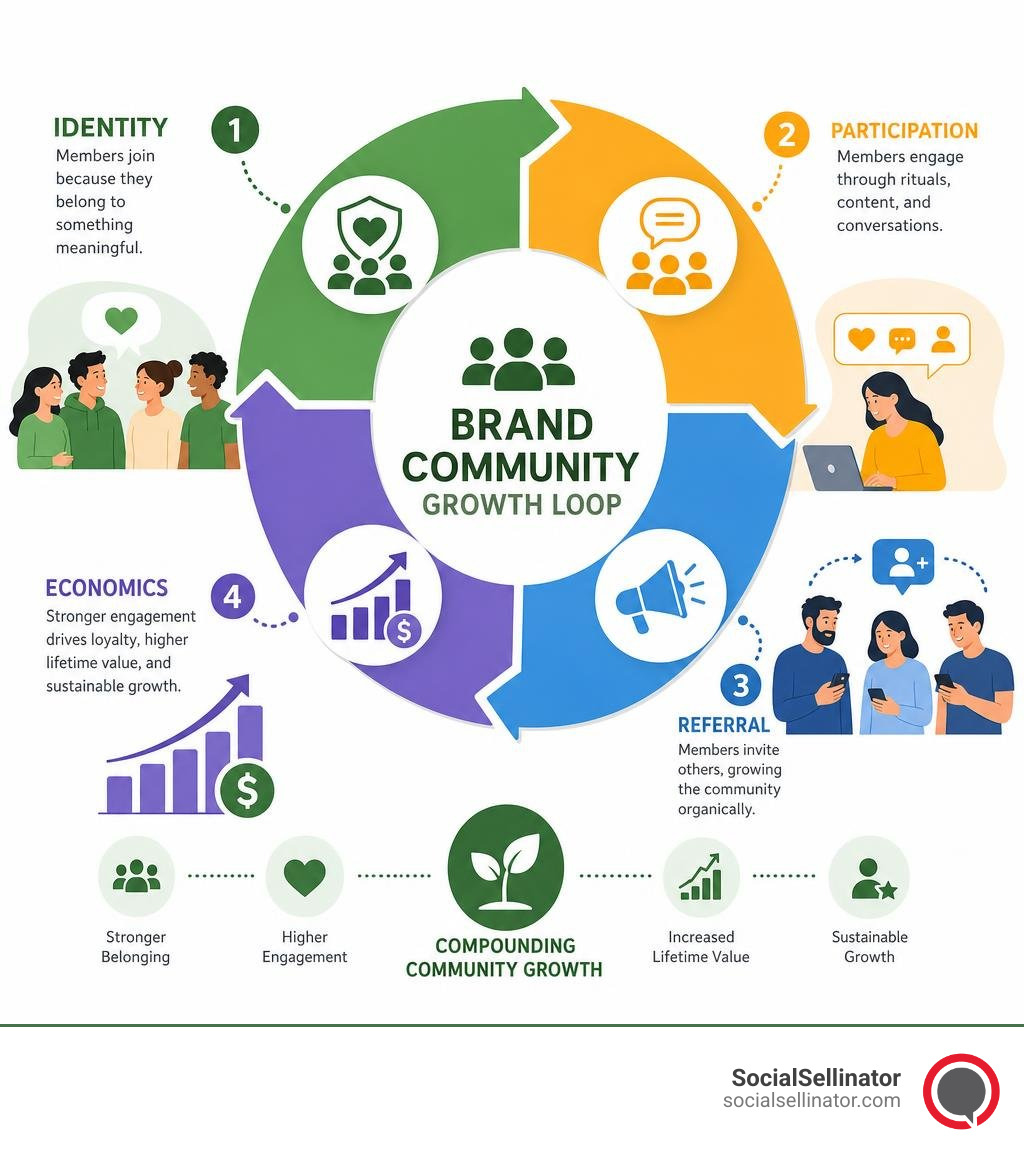
- Define a shared identity — give members a worldview to belong to, not just a product to buy
- Build participation rituals — recurring reasons for members to show up and engage
- Activate referral loops — turn engaged members into your most cost-effective acquisition channel
- Measure what matters — track retention rate, community-referred CAC, and 12-month LTV by cohort
- Avoid over-selling — the top reason communities die is too much promotion, too little relationship
The numbers tell a compelling story. 73.6% of consumers say they would purchase more frequently because of a brand community. Community members can deliver a 306% higher customer lifetime value than non-members. And 80% of startups now invest in community as a primary marketing strategy.
Yet most brands still treat community as an afterthought — a Facebook Group nobody manages, a hashtag campaign that peaks and fades.
That gap between knowing community matters and actually building one that compounds is exactly what this guide closes.
There is also a broader shift happening. As AI-driven interactions flood every digital channel, consumers are actively seeking out human spaces. According to recent trend analysis, the demand for authentic human connection has become the number one topic at major marketing industry events — beating out AI itself. Community is not just a growth tactic. It is a direct response to what the market is asking for right now.
Whether you are a marketing director at a growing B2B company or running digital for a scaling DTC brand, this guide walks you through the frameworks, tools, and unit economics of building a brand community that actually drives revenue.
What is a Brand Community and Why Does It Matter?
To understand how to grow a community, we first must define what it actually is. A true brand community is not just an audience. An audience is a passive group of individuals who listen to a brand broadcast messages. A brand community is a dynamic, multi-directional network of people who share common values, participate in shared rituals, and actively connect with both the brand and one another.
When we look at why communities work so well, we have to look at the psychology of belonging. Decades of consumer behavior research show that people do not just buy products for their functional utility; they buy them to signal who they are and what they care about. By fostering Brand Community Growth, you transition your customer relationships from transactional exchanges to emotional, identity-based partnerships.
This emotional connection yields massive financial returns. A healthy brand community acts as a powerful business asset that:
- Boosts Customer Lifetime Value (LTV): Engaged community members show up to a 306% increase in lifetime value compared to non-members.
- Lowers Customer Acquisition Costs (CAC): When your existing customers become your primary advocates, they perform a meaningful share of your acquisition work, driving down blended marketing costs.
- Accelerates Product Feedback Loops: Instead of spending thousands on isolated focus groups, you gain access to a live research and development panel that can validate new concepts in real time.
- Improves Brand Trust: Consumers naturally trust peer recommendations over corporate advertising. Fostering these connections helps you Unlock Success the Top Advantages of a Seriously Strong Brand.
The Shift Toward Human-Centered Spaces
We are currently witnessing a massive wave of algorithmic fatigue. Consumers are tired of endless, generic, AI-generated content, hyper-personalized but sterile ad campaigns, and feeling like every digital interaction is merely a transaction.
This AI backlash is driving a rapid shift toward human-centered spaces. People can sense when a bot is pretending to be a person, and they actively reject it. Instead, they crave authentic relationships and spaces where real human empathy is the default.
In this landscape, community acts as the ultimate “override” for algorithmic search and recommendation filters. While an AI recommendation engine might suggest a product based on data points, people still act on recommendations from trusted friends. Building a community allows you to nurture those trusted circles, ensuring your brand remains relevant through genuine word-of-mouth rather than relying solely on paid distribution.
Consumer-Run vs. Company-Managed Communities
When planning your community strategy, it is critical to understand the two primary types of brand communities: consumer-run and company-managed. Both play distinct roles in how members experience integration, participation, and commitment.
- Consumer-Run Communities: These are started and managed entirely by passionate fans (e.g., unofficial forums, independent social groups, or fan clubs).
- Company-Managed Communities: These are officially established, moderated, and funded by the brand itself (e.g., official customer portals, hosted forums, or structured brand ambassador programs).
Academic research involving thousands of consumers reveals a fascinating truth: consumer-run communities often stimulate higher levels of integration, participation, and commitment than company-managed spaces. This occurs because official commercial settings can sometimes trigger a customer’s need for privacy and self-preservation, making them hesitant to share openly. In contrast, unofficial spaces feel safe, authentic, and free from corporate sales pitches.
However, consumer-run groups carry the risk of transmitting inaccurate brand information or hosting unmoderated negative discussions. The key is to understand how both models function so you can design a space that feels organic yet aligned with your goals.
| Feature | Consumer-Run Communities | Company-Managed Communities |
|---|---|---|
| Primary Driver | Peer-to-peer passion and shared identity | Brand support, education, and loyalty rewards |
| Level of Integration | Very high; organic and self-sustaining | Moderate; requires structured prompts and events |
| Control Over Messaging | Low; brand has no direct say in content | High; brand sets rules and moderation guidelines |
| Trust Factor | High; perceived as highly authentic | Moderate; can feel transactional if over-commercialized |
| Primary Benefit | Unfiltered feedback and organic advocacy | Direct customer insights and structured support |
Balancing Control and Organic Engagement
The secret to successful official community management is learning to step back. If you try to control every conversation, your community will quickly feel like a sterile broadcast channel. To build a thriving space, you must learn How to Turn Your Brand Community Into a Raving Fanbase by balancing brand safety with organic co-creation.
First, establish clear, respectful moderation rules that protect members from spam and harassment without stifling honest debate. Second, humanize your brand. Do not post under a corporate logo; have real community managers, founders, or product developers engage using their actual names and faces.
Finally, empower your members to co-create the brand experience. Give them a voice in product development, let them vote on upcoming initiatives, and publicly celebrate their contributions. When members feel like active partners rather than passive targets, their loyalty becomes virtually unbreakable.
Strategic Frameworks for Brand Community Growth
To scale your community past early stages, you need a repeatable framework. You cannot rely on a “vibe” or hope that people will magically start talking to each other. You must build a structured, self-reinforcing engine.
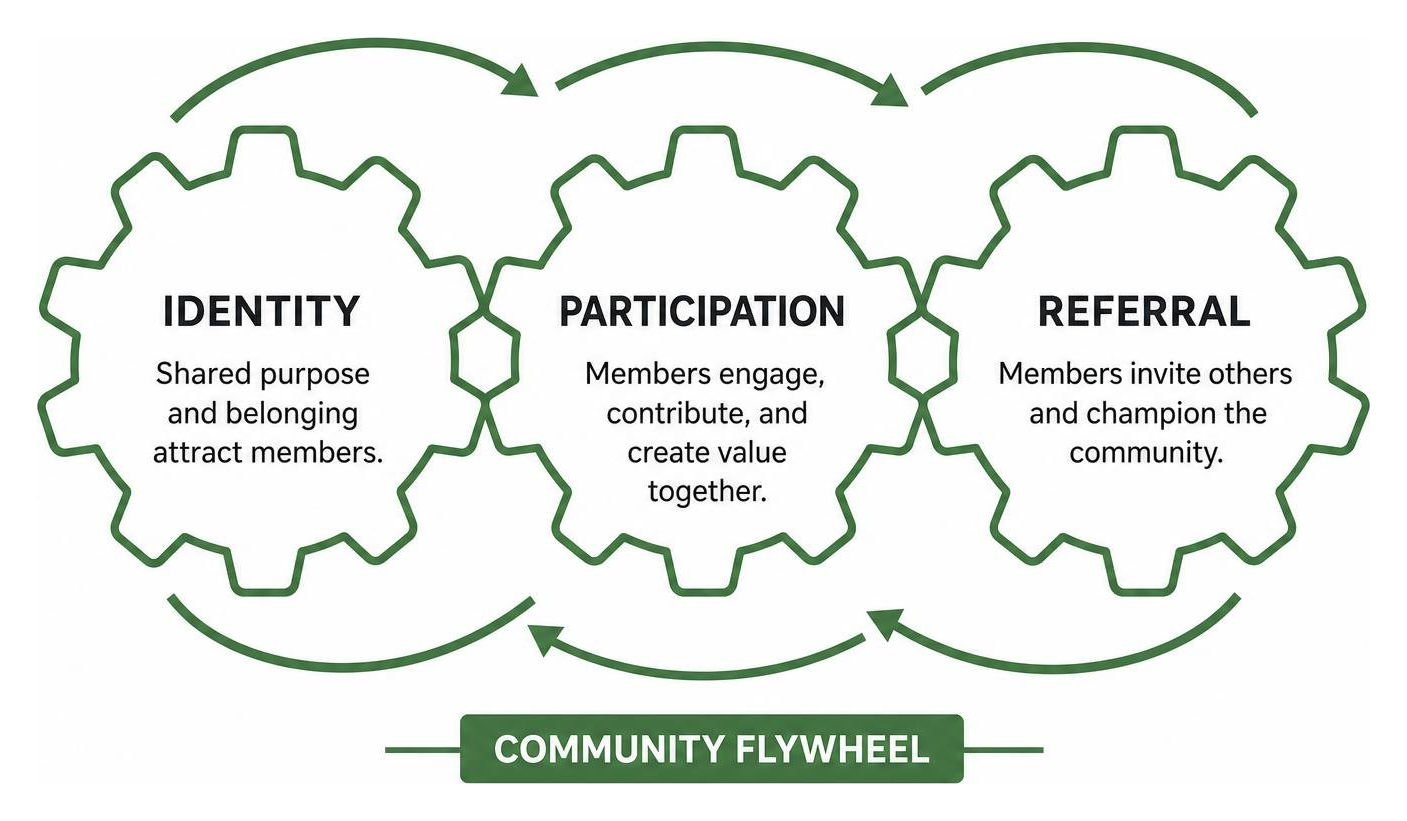
The community flywheel model is a highly effective framework for driving sustainable growth. Unlike traditional linear funnels that require constant paid inputs to produce sales, a flywheel compounds energy. The more members you activate, the faster the wheel spins, lowering your marginal cost of acquisition over time.
A successful community flywheel relies on five core elements:
- Know Your Communities: Move away from broad demographic targeting. Instead, identify highly specific groups of shared relevance (e.g., targeting passionate outdoor hobbyists rather than just “adults aged 25-40”).
- Focus on Hero Products: Cut through digital noise by centering community discussions around a few distinctive, high-quality products. This prevents scrolling fatigue and gives members a clear, shared focal point.
- Tell a Talkable Story: Develop a credible, emotional narrative that members actually want to share with their friends. This connects directly to your overall Branding and Messaging strategy.
- Fuel Active Conversations: Provide consistent, engaging prompts, educational resources, and interactive challenges that give members a reason to communicate daily.
- Enable Effortless Transactions: Ensure the path from community participation to product purchase is completely frictionless. If your website takes too long to load or has a confusing checkout flow, you will lose the momentum your community generated.
The Identity Layer of Brand Community Growth
Before you build a single forum or launch an ambassador program, you must establish the identity layer. This is the foundation of the entire flywheel. If you launch a platform without a shared worldview, it will quickly become a digital ghost town.
To build an authentic identity layer, start by excavating a shared tension or frustration that your target audience feels but the mainstream market ignores. For example, a healthy beverage brand might build its identity around the shared tension of wanting to make nutritious choices without sacrificing a fun, rebellious social aesthetic.
Once you identify this tension, name and codify it. Develop a proprietary visual and verbal vocabulary that members can adopt. This includes unique terms, inside jokes, and shared symbols. When members begin using your brand’s vocabulary in their everyday lives, they are no longer just customers — they have joined your tribe.
The Participation and Referral Loops
With a strong identity layer in place, you can instrument the participation and referral loops that turn belonging into measurable business growth.
- Participation Loops: Design recurring, structured rituals that give members a reason to show up. This could be a weekly win-sharing thread, a monthly educational challenge, or a regular live Q&A session with industry experts. To keep engagement high, implement visible status ladders (e.g., moving from “New Member” to “Advocate” to “Community Ambassador”) that reward active participation with non-monetary recognition and exclusive insider access.
- Referral Loops: A community-embedded referral program succeeds because of social status, not transactional discounts. Instead of offering basic coupon codes, build progress-tracked referral systems where members unlock exclusive community perks, limited-edition merchandise, or direct access to the brand’s founders. This incentivizes organic word-of-mouth and turns your most passionate fans into a highly efficient customer acquisition channel.
Integrating UGC and Influencer Partnerships
A thriving brand community naturally generates a massive volume of user-generated content (UGC). In fact, for brands utilizing a mature community flywheel, more than 75% of all content about the brand is user-generated.
UGC is an incredibly powerful growth tool. Research shows that 90% of consumers consider UGC more authentic than branded marketing, and it is up to 10 times more influential in purchase decisions than traditional influencer campaigns. When prospective customers see real people sharing unpolished, authentic reviews and photos of your products, their trust increases instantly.
To harness this power, you must build a structured content extraction pipeline. This involves:
- Monitoring your community channels daily to identify high-quality, organic posts.
- Implementing a simple, one-click consent flow to secure usage rights from the creator.
- Distributing this authentic content across your website, email campaigns, and paid advertising channels.
- Announcing content performance milestones back to the community to celebrate and incentivize further creation.
For a deeper dive into these strategies, explore our comprehensive guide on User Generated Content on Social Media.
Leveraging Social Proof for Brand Community Growth
To accelerate this process, integrate strategic influencer partnerships into your community growth plan. However, avoid treating influencers as mere billboards. In a community-first model, engagement must feel personal and interactive.
Focus your efforts on micro-influencers and passionate creators who already align with your brand’s worldview. Instead of paying for one-off promotional posts, invite these creators into your community spaces to host exclusive workshops, moderate discussion threads, or co-create limited-edition products.
By positioning influencers as active community leaders rather than distant spokespeople, you build deep, trust-based social proof. This community-sourced creative can then be routed directly into your paid marketing campaigns, consistently outperforming polished studio assets on return on ad spend (ROAS).
Tools, Platforms, and Measurement Metrics
To manage and scale a community effectively, you need the right digital infrastructure. Trying to run a complex community solely through manual social media tracking will quickly lead to operational burnout.
Several platforms are highly effective for hosting and nurturing brand communities:
- Dedicated Community Platforms (e.g., Circle): Ideal for building structured, self-hosted spaces that combine discussions, courses, events, and subgroups under your own brand identity.
- Newsletter Networks (e.g., Substack): Excellent for editorial-focused communities, allowing you to facilitate direct conversations in comment sections and build a deeply engaged subscriber base.
- Private Chat Servers (e.g., Discord): Perfect for high-frequency, real-time interactions, particularly for tech-savvy, gaming, or highly active hobbyist demographics.
- Unified Dashboards: Tools that consolidate social media interactions into a single interface, ensuring your team can respond to comments, tags, and direct messages promptly to maintain Social Media Brand Loyalty.
Key Performance Indicators to Track
To justify your community budget and optimize your strategy, you must move past vanity metrics like raw member count and track hard financial and engagement data.
Focus your community measurement on these key performance indicators:
- Retention Rate: The top priority for 62% of brand communities. Track the subscription churn delta or repeat purchase rate of community members compared to a control group of non-members.
- Monthly Active Engagement Rate: Measure the percentage of members who actively post, comment, or react within a 30-to-90-day window. A healthy community typically maintains a 15% to 25% active engagement rate.
- Community-Referred CAC: Calculate the acquisition cost of customers acquired through community referral loops. Best-in-class brands report community-referred CAC that is 40% to 60% lower than cold paid media acquisition.
- 12-Month Cohort LTV: Track the cumulative revenue generated by community-engaged cohorts over a one-year period. Look for a 1.5x to 2.5x LTV premium over non-community cohorts.
Frequently Asked Questions about Brand Community Growth
How can small businesses compete with larger brands in community building?
Small businesses actually hold a massive competitive advantage when it comes to community building. While global corporations are often slowed down by rigid campaign-based cultures, legal constraints, and massive scale requirements, smaller brands are agile, authentic, and fast.
To compete effectively, focus on these strategies:
- Leverage Founder-Led Authenticity: Have your founders personally invite your first 100 members. Direct access to leadership builds a level of trust that massive corporate entities simply cannot replicate.
- Focus on a Hyper-Niche Audience: Do not try to please everyone. Dominate a small, passionate circle of enthusiasts by addressing their highly specific unmet needs and Building a Strong Online Presence with Social Media Marketing.
- Prioritize Relationship over Scale: It is far better to have 100 deeply committed fans who engage daily than 10,000 passive followers who never interact. Focus on community density and depth first.
What are the biggest scaling mistakes brands make with communities?
The road to community growth is filled with common pitfalls. The most frequent errors include:
- Over-Selling to the Community: If you treat your community as just another advertising channel to blast promotional offers, members will quickly leave. Maintain an 80/20 balance: 80% relationship-building, education, and connection, and only 20% brand promotion.
- Under-Resourcing Community Operations: Brands often make the mistake of treating community management as a low-seniority, part-time task. A compounding community requires a dedicated operator who understands both human psychology and hard unit economics.
- Culture Dilution at Scale: As a community grows past 1,000 members, the original close-knit culture can easily feel diluted. Prevent this by segmenting your community into smaller subgroups based on geography, product use, or specific interests, and utilizing professional Brand Reputation Management Services to maintain a safe, welcoming environment.
How does a community flywheel lower customer acquisition costs?
A community flywheel lowers CAC by turning your existing customer base into an organic distribution channel.
In a traditional paid media model, you must constantly pay to capture attention. If ad costs rise, your customer acquisition costs spike immediately.
With a community flywheel, your engaged members generate user-generated content, share organic word-of-mouth recommendations, and actively recruit new customers through structured referral loops. This organic advocacy creates a self-reinforcing acquisition loop, buffering your brand against rising ad costs and driving down your overall blended CAC.
Conclusion
Building a thriving brand community is not a quick-fix marketing campaign. It is a long-term, highly strategic investment that restructures your unit economics, builds a defensible competitive moat, and turns transactional customers into lifelong advocates.
At SocialSellinator, we specialize in helping businesses design, launch, and scale these compounding growth engines. Whether you need to establish a strong organic foundation through cutting-edge digital marketing, capture high-intent search traffic with expert SEO, drive immediate conversions with targeted PPC, or cultivate deep relationships through professional social media management and content creation, our team of experienced professionals is here to help you succeed.
Ready to transition your audience from silent followers to a highly engaged, revenue-generating fanbase? More info about Social Media Management services is just a click away. Get in touch with us today, and let’s start building a community strategy tailored to your business goals.
Headquartered in San Jose, in the heart of Silicon Valley and the San Francisco Bay Area, SocialSellinator proudly provides top-tier digital marketing, SEO, PPC, social media management, and content creation services to B2B and B2C SMB companies. While serving businesses across the U.S., SocialSellinator specializes in supporting clients in key cities, including Austin, Boston, Charlotte, Chicago, Dallas, Denver, Kansas City, Los Angeles, New York, Portland, San Diego, San Francisco, and Washington, D.C.