

Why Brand Community Growth Strategies Matter
In a community strategy, brand community growth strategies should give people a compelling reason to join, take part, and return consistently over time. Start with a clear shared purpose that aligns member values with your brand mission. Welcome new members with one easy, low-friction action, such as asking a question, introducing themselves, or sharing a practical tip. Then make intentional room for members to help each other solve common challenges. Track repeat participation, referrals and retention separately.

A large passive audience isn’t the same as an active, loyal community. I’m Jock Breitwieser, and I’ll walk you through how to build participation. To understand participation, look at who returns and who helps someone else.
Essential guides and concepts for modern community leaders:
- Read the guide to brand community growth.
- Explore artificial intelligence integrations and future trends in brand engagement.
- Discover operational frameworks to build a loyal brand community.
From Acquisition to Ongoing Participation
A campaign focused on the first purchase asks how to win a customer. A community strategy asks what that customer might want to do next.
A community gives existing customers a place to share what they know with newcomers. It still needs people to welcome members and maintain the space.
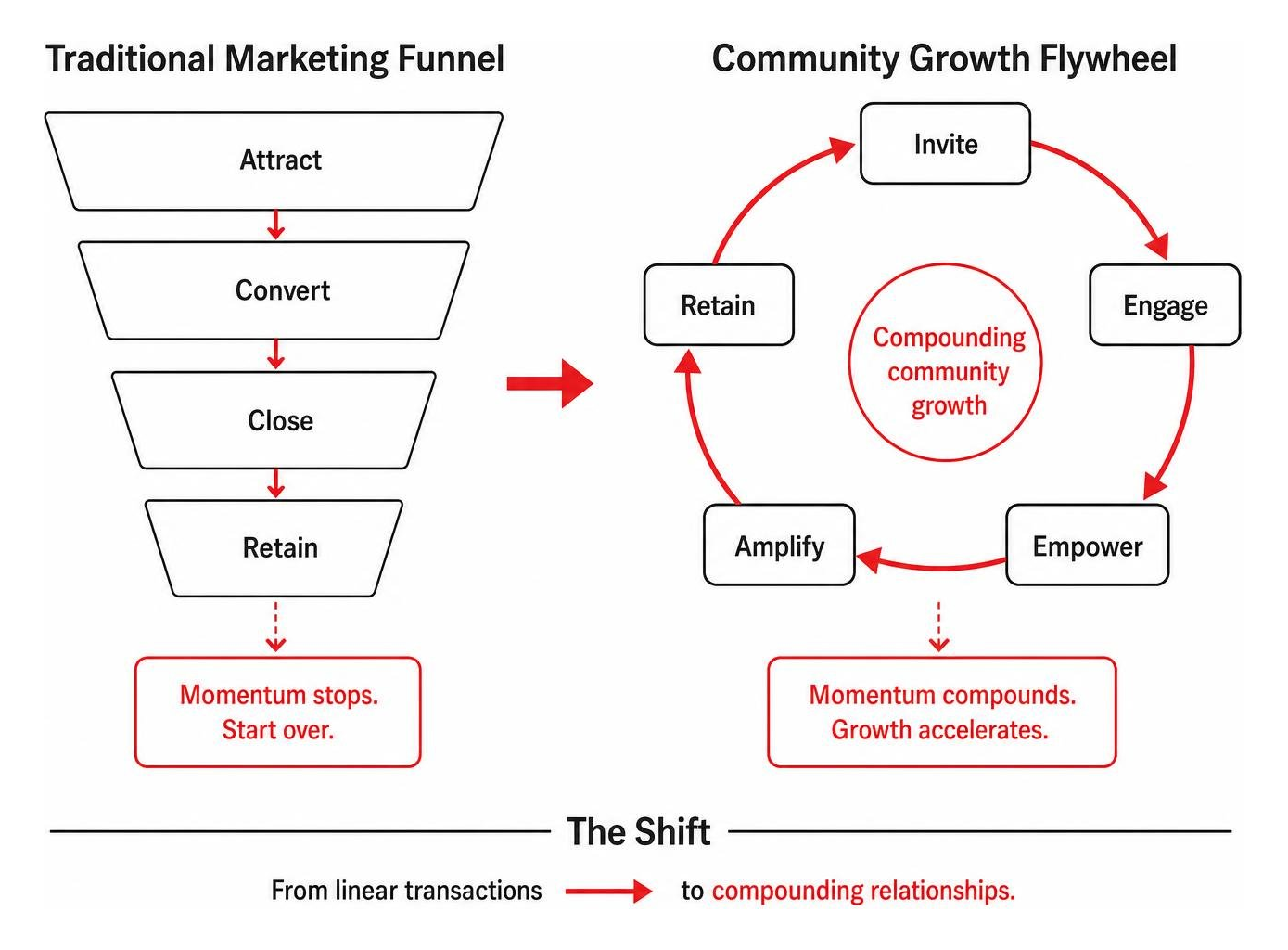
By using a modern guide to digital brand community building, companies can plan a community that treats brand interactions as more than isolated transactions. Invite members to share an example, answer a question or suggest an improvement. Track which invitations prompt a response.
Aligning the Community Flywheel with Modern Brand Community Growth Strategies
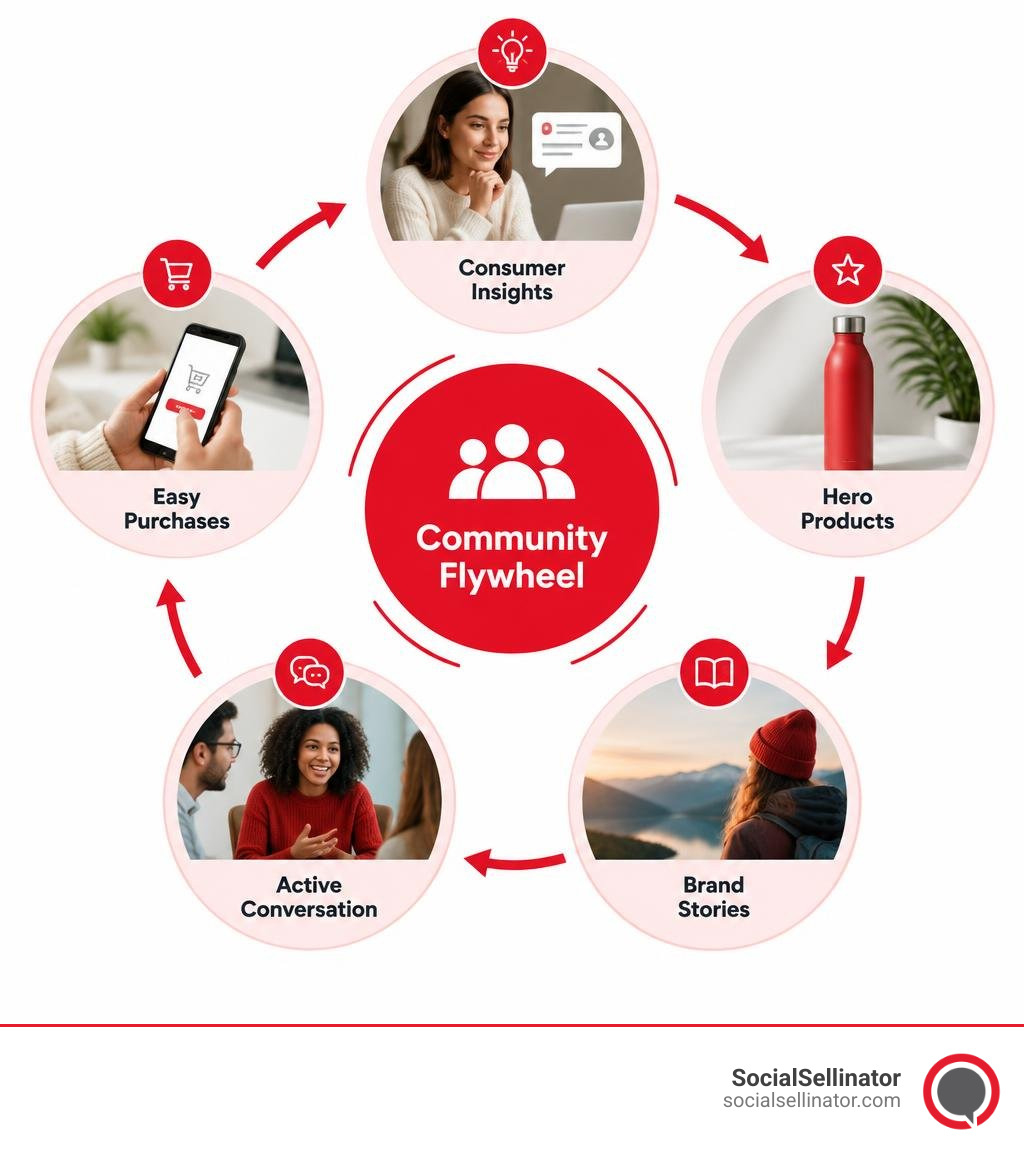
Use these five questions to plan a community program with the community flywheel:
- Community-Informed Consumer Insights: What can members tell you? Gather input from group discussions, member polls, and direct feedback loops, and distinguish what members volunteer from what you infer by reading discussions.
- Focus on Hero Products: Which product or problem would give members a useful starting point for discussion? Consider a signature offering that solves a distinct problem rather than spreading messaging thin across peripheral SKUs or niche services.
- Talkable, Values-Driven Brand Stories: What story could a member share in their own words? Start with a real problem the group cares about.
- Active, Continuous Conversation: Who gets to start a conversation? Facilitate regular discussion prompts, peer-to-peer troubleshooting, structured AMA sessions, and live roundtables rather than relying only on corporate broadcasting.
- Simple Transactions: Can interested members register, redeem a reward or buy without unnecessary steps? Remove friction from purchases, loyalty redemptions, member upgrades, and event registrations.
Restructuring Teams and Governance for Cross-Functional Agility
Avoid treating a community strategy as a minor social media silo or an afterthought. Name an owner for the community and decide which decisions need help from another team. Plan for several key dimensions:
- Growth and Product Alignment: Rather than burying the community manager under generic brand marketing, consider aligning community leadership with growth, product development, digital marketing, and customer success teams.
- Cross-Functional Agile Squads: Companies can assemble multidisciplinary squads (combining content creators, data analysts, customer support leads, copywriters, and product managers) to run test-and-learn sprints within community spaces. For a cross-team test, agree on one question, an owner and a review date.
- Decentralized Moderation and Executive Sponsorship: Executives can provide strategic air cover, while empowered super-users and clearly structured community guidelines support day-to-day governance. Decide which issues volunteer moderators can resolve and which need a staff decision.
When cross-functional teams actively listen to community discussions, product teams can identify feature bugs and usability issues, marketing teams can discover customer language for paid campaigns and SEO content, and sales leaders can spot expansion opportunities. Route bug reports to product, customer-language questions to marketing and sales inquiries to the appropriate owner.
Core Brand Community Growth Strategies for Sustainable Scale
Scaling a digital community requires sustainable systems that reward members without burning out internal managers. Rather than broadcasting aggressive promotions, businesses must nurture social currency, peer-to-peer connection, and genuine reciprocity.
One option is an exclusive “inner circle” of your most engaged customers. Before designing it, ask what recognition they would value; some may prefer insider access, peer recognition, exclusive workshops, or the ability to influence your brand’s future roadmap over discount codes. Invite interested regulars to help welcome newcomers or test an idea.
Learning how to turn your brand community into a raving fanbase can involve subtle “breadcrumb” calls-to-action (CTAs). Rather than demanding immediate purchases or long-term contracts, breadcrumb CTAs invite prospects into low-friction value environments, such as free masterclasses, peer forums, downloadable templates, or community-exclusive resources, before asking someone to buy.
Activating Hero Products and Talkable Brand Narratives
Give your brand community a clear center of gravity. Start with a topic narrow enough for members to recognize how they can contribute, rather than an entire product catalog.
Hero products can serve as entry points for community discussion. For example, ask members who use the same product to share one workflow, troubleshooting tip, creative hack, recipe, or technical customization.
Implementing clear Facebook Group growth strategies for community builders can help structure conversations around common interests, shared challenges, and values. Track whether contributors return.
Harnessing Social-First Advocacy and User-Generated Content
User-generated content (UGC), such as real customer experiences, unpolished video testimonials, and candid peer discussions, gives prospective buyers a way to hear from someone besides the brand.
To support members without adding creative friction, offer your community optional “Creator Kits”: templates, trending prompts, visual assets, and clear guidelines that make posting easier. Ask permission before featuring a member’s work on a brand channel.
Test customer-created material against your existing content in one channel before expanding its use in product touchpoints, email sequences, and paid media funnels.
Platform Selection: Matching Tools to Community Maturity Stages
Choosing a digital platform is an operational decision that can affect member engagement and retention. Before moving platforms, ask members to try a common task and ask moderators what they can’t manage in the current space.
A Minimum Viable Community (MVC) begins with simple tools that allow direct two-way conversations and quick iteration before investing heavily in custom software architectures.
Early-Stage Discovery and Content Hubs
For brands building initial community momentum, tools like Substack, structured email hubs, and curated social feeds allow founders and marketers to establish a distinct point of view and test audience appetite.
Before choosing a publishing platform, check how readers can reply, start discussions and contact moderators. A simple space can help you test ideas, gather reader feedback, and identify early brand advocates before launching complex, standalone community platforms.
Mid-Stage Interaction and Dedicated Spaces
Consider a dedicated community management platform when members struggle to find discussions or moderators cannot organize them in the existing feed.
When evaluating a platform, check whether it can:
- Segment discussions by specific topics, geographic chapters, industry verticals, or membership tiers.
- Embed educational video courses, resource libraries, searchable templates, and onboarding playbooks.
- Host live webinars, community roundtables, masterclasses, and member Q&A sessions.
- Implement gamification badges, member directories, leaderboard recognitions, and direct messaging channels.
If you plan to integrate paid memberships, premium mastermind cohorts, or digital products, test checkout, cancellation and refund handling before choosing a platform.
Enterprise and Association Ecosystems
For a large professional association, B2B enterprise, or global brand ecosystem, compare platforms against the access, moderation and reporting needs of its chapters.
Depending on your organization, requirements to evaluate may include:
- Single Sign-On (SSO) and deep customer relationship management (CRM) and marketing automation data integrations.
- Role-based permissions, privacy controls, data governance, and advanced security protocols.
- Automated moderation tools to identify spam, enforce conduct codes, and escalate urgent member support issues to dedicated service teams.
- Multi-chapter sub-community structures that provide local intimacy within an expansive global network.
Match platform capabilities to organizational maturity, and revisit the platform decision when a member or moderator cannot complete an important task.
Welcoming New Members
Offer newcomers a simple introduction and check whether they return. Compare return rates before and after changing onboarding, noting other changes that might affect them.
Onboarding should set clear behavioral expectations. Explain the rules, provide guided navigation so members know where to ask questions, and personally acknowledge initial contributions. Offer an in-person option, such as localized meetups alongside virtual check-ins, if members want one.
An Example 70–20–10 Content Mix
To avoid turning feeds into promotional billboards, divide planned posts in a trial editorial calendar into three categories:
- 70% educational posts: Guides, peer troubleshooting, industry updates, teardowns, templates, and open-ended conversation prompts that address core member challenges without selling.
- 20% member contributions: Member spotlights, user-submitted case studies, celebrations of personal career or business wins, and curated member-created content, shared with permission.
- 10% promotional posts: Contextual product announcements, event registrations, special customer offers, beta invites, and early-access feature opportunities.
In this example, educational posts and member contributions together account for 90% of planned posts. Review how members respond before repeating the mix.
Structured Mentorship and Moderator Enablement
In 2006, Jakob Nielsen described participation inequality using a 90–9–1 rule of thumb: about 90% read without contributing, 9% contribute a little and 1% account for most contributions. Measure the distribution in your own group.
Rather than trying to force every passive lurker to post daily, invite willing regulars to welcome newcomers. A structured “buddy system” can pair veteran contributors with newcomers; agree on coverage and check for unanswered introductions rather than assuming volunteers will see them all. Consider offering volunteer moderators status badges, access to company leadership, or co-creation opportunities.
Measuring Business Value: CROI, Retention Delta, and Customer Lifetime Value
To discuss value with leadership, look beyond vanity metrics like total member count or emoji reactions, and report participation alongside costs and the business outcomes you are testing.
Compare members with similar nonmembers over the same period. People who choose to join may already be more engaged.
Data-Driven Brand Community Growth Strategies to Measure CROI and Lifetime Value
Two reports from community platform provider Circle illustrate what teams have tracked. Neither is a cross-industry benchmark.
- Engagement and Product Usage: In Circle’s Codecademy customer story, community members were more likely to complete coursework and resubscribe than learners who were not engaged in the community.
- Membership Expansion: Circle reported that Exit Five’s membership grew by more than 100% over the preceding year and that 40% of its community of more than 4,300 people were monthly active users.
By conducting regular cohort analyses comparing community participants against general customer segments, marketing teams can track retention delta, referral velocity, upsell conversion rates, and overall customer lifetime value (LTV). Report the difference between cohorts even if it’s small or negative. Do not attribute it to community participation without accounting for other explanations.
Measuring Support Demand
When members help peers troubleshoot technical challenges, share best practices, and exchange creative product configurations, track repeated questions that receive useful peer answers. Check whether staff still receive tickets about those questions.
Count support savings only when there is evidence that the forum avoided work the support team would otherwise have done.
Furthermore, product and marketing teams can review community discussions to identify feature requests and uncover software bugs. Use discussion themes to identify questions for further research, and check whether quieter members share the same needs before changing the roadmap.
Frequently Asked Questions About Brand Community Growth Strategies
What does a community flywheel mean here?
Here, a community flywheel means using member feedback, a product focus, shared stories, ongoing discussion and simple transactions to plan a program. Members might answer questions or recommend a product; measure those activities rather than assuming they increase sales.
How do you calculate Community ROI (CROI) for an online brand community?
To calculate Community ROI in plain language, sum the financial gains attributed to the community, including incremental contribution from member sales, the value of customer referrals, and operational savings from deflected customer support tickets, and compare that total with the overall program costs (platform software licenses, community personnel salaries, event budgets, and member incentives). Suppose a program produces $500,000 in attributable financial benefits before program costs, and costs $100,000 to run. Its benefit-to-cost ratio is 5:1. Its net ROI is ($500,000 − $100,000) / $100,000 = 400%. Use incremental contribution from sales, not gross member revenue, and avoid counting the same referral or support saving twice.
What can we try during onboarding?
Consider testing these ways to welcome new members:
- Providing an immediate, low-stakes micro-action on Day 1 (such as voting in a quick poll, claiming a badge, or replying to an introduction thread).
- Implementing a structured buddy system that pairs newcomers with active super-users who welcome them personally.
- Establishing clear, positive community guidelines and moderation practices, and showing newcomers where to report a concern.
- Delivering immediate educational value through curated welcome kits, downloadable templates, or exclusive resource libraries.
- Tracking early activity, with a clear explanation of what you collect, and letting newcomers choose whether to receive re-engagement reminders.
Deciding What to Keep
Whether you start with hero products, the software stack or onboarding journeys, pick one member need, test a way to address it and review what changed before expanding the program.
If you connect a community program with paid media, search or content, decide how you will distinguish each channel’s contribution.
SocialSellinator lists San Jose as its headquarters and describes serving Bay Area and nationwide clients. Its service-area page lists SEO, content, paid media and LinkedIn programs for B2B companies.