
A Practical Guide to Google Partner Badges and Certification Tiers
Why a Certified Google Ads Partner Matters
A certified Google Ads partner is an agency or third party that Google recognizes for meeting requirements around ad spend, account performance, and staff certifications. This status can be a useful trust signal when you need help managing paid search, Shopping, YouTube, Display, or Performance Max campaigns.
Before hiring one, verify three things:
- The agency appears in the official Google Partners directory or has a valid dynamic badge.
- Its team has relevant, current Skillshop certifications for the campaign types you plan to run.
- It can explain how it will measure business outcomes such as qualified leads, cost per acquisition (CPA), and return on ad spend (ROAS).

The badge does not guarantee results. Google Ads success still depends on your offer, budget, tracking, landing pages, competition, and the quality of ongoing optimization. But it does show that an agency has met Google’s baseline program standards and maintains a meaningful level of Google Ads activity.
Want to learn more how we can help you with Google Ads?
Click here for a quick overview of our Google Ads programs.
Google has three program tiers: Member, Partner, and Premier Partner. Partner status requires a 90-day managed spend of at least $10,000 USD, a minimum 70% optimization score, and certifications for at least 50% of eligible account strategists. Premier Partner status is more selective: agencies must rank among the top 3% of participating companies in their country.

In this guide, I am Jock Breitwieser, and I will help you understand what each badge means, how to verify it, and how to judge whether an agency is equipped to support your goals.
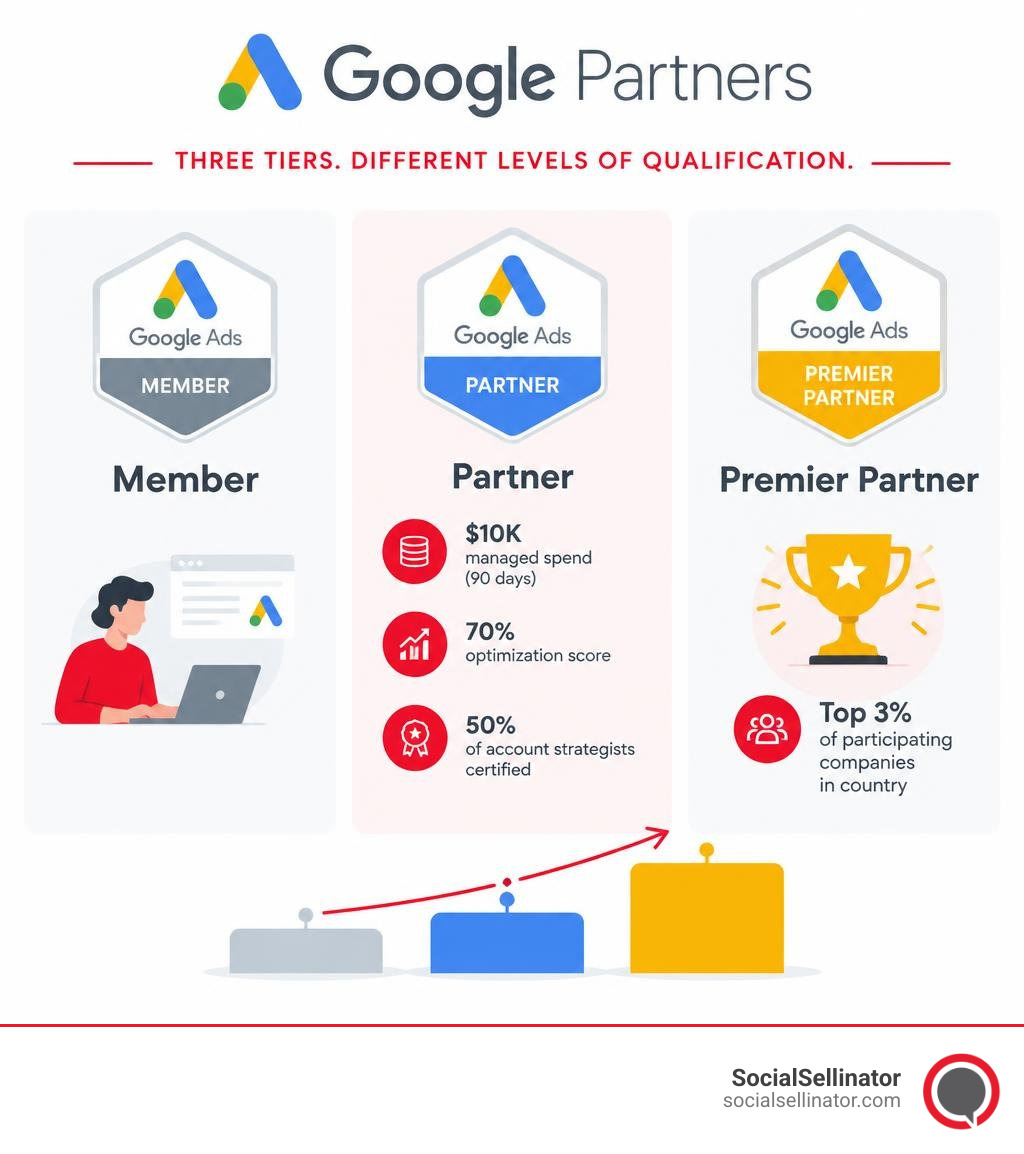
Certified google ads partner terms explained:
Understanding the Google Partners Program and Badge Tiers
The Google Partners program is an international initiative active across more than 60 countries and localized into 43 languages. It is designed to foster agency capability, incentivize technical knowledge, and provide businesses with a verifiable standard when seeking paid media management.
Navigating the landscape of paid search can sometimes feel overwhelming. To bring clarity to this ecosystem, Google categorizes participating organizations into three distinct tiers: Member, Partner, and Premier Partner. Each level represents an increasing degree of operational volume, technical proficiency, and platform alignment.
| Partnership Tier | Ad Spend Requirement | Performance & Optimization | Certification Standard | Key Platform Benefits |
|---|---|---|---|---|
| Member | None required | No baseline minimum | Optional individual certifications | Access to foundational Skillshop training, basic industry insights, and platform setup resources. |
| Google Partner | Minimum $10,000 USD across managed accounts over rolling 90 days | Account optimization score maintained at 70% or higher | At least 50% of account strategists certified (minimum 1 per product area with $500+ spend) | Official Google Partner badge, listing eligibility, promotional client ad credits, and technical support. |
| Premier Partner | Meets and sustains baseline Partner spend criteria | Evaluated on client growth, retention, and annual ad volume | Sustained multi-format individual certifications across product teams | Top 3% agency designation per country, dedicated executive support, invitation to executive roundtables, and early beta access. |
Member vs Partner vs Premier Partner Status
Understanding how these tiers differ in practice helps set realistic expectations for collaboration and technical capability.
- Member Tier: The entry gateway to Google’s partner infrastructure. Any agency or independent practitioner can register an administrative manager account and gain access to community materials. It requires zero managed ad spend and no verified track record. While members can access educational modules, they cannot display an official partner badge.
- Partner Tier: Achieving certified Partner status demands that an agency clear verified hurdles across performance, ad spend, and team knowledge. Agencies in this tier have demonstrated reliable day-to-day management of significant client budgets while sustaining accounts in alignment with Google’s technical best practices.
- Premier Partner Status: This tier is reserved strictly for the top 3% of participating companies in a given country each calendar year. Google calculates this elite bracket using dynamic evaluation criteria, including annual ad spend expansion, existing client growth, client retention percentages, and product diversification across Search, Display, Video, Apps, and Shopping networks. Organizations earning this tier often receive high-touch platform consultations, advanced technical resolution paths, and direct executive roundtables.
What It Takes to Become a Certified Google Ads Partner
Earning and retaining the standard Google Partner badge requires meeting three rigorous criteria monitored daily by Google:
- Performance (Optimization Score): The agency’s registered Google Ads manager account must maintain an overall optimization score of at least 70%. This score reflects how well campaigns are configured to capture platform efficiencies across bidding, keywords, creatives, and conversion actions. Rather than blind compliance, agencies must apply critical strategic thinking to maintain this benchmark. Understanding foundational Google Ads optimization strategies ensures that recommendations are vetted for client ROI rather than platform automation alone.
- Spend Threshold: The agency’s linked manager account must maintain an aggregate 90-day ad spend of at least $10,000 USD across all managed client accounts. This demonstrates active, continuous market engagement.
- Skillshop Certifications: At least 50% of the agency’s identified account strategists must hold active Google Ads certifications mapped directly through Google Skillshop. Additionally, the agency must maintain at least one qualified certification in every product area where campaign spend reaches or exceeds $500 USD within a 90-day window.
Why Working with a Certified Google Ads Partner Can Support Campaign Performance
Navigating pay-per-click advertising without structured expertise often leads to wasted ad spend, improper audience targeting, and broken attribution models. Partnering with a vetted team brings methodical campaign frameworks and specialized workflows. For companies scaling their customer acquisition, reviewing a Google Ads management complete guide clarifies how professional agencies structure accounts for sustained profitability.
Working with an accredited partner unlocks practical advantages:
- Early Access to Beta Features: Certified agencies frequently gain access to closed feature betas, including emerging AI bidding parameters, novel ad creative extensions, and experimental targeting layers before public rollout.
- Direct Technical Escalation: Standard support channels can involve prolonged resolution cycles. Certified partners enjoy prioritized escalation paths to resolve policy disputes, tracking glitches, or account disruptions quickly.
- Promotional Ad Credits: Eligible new advertiser accounts onboarded through certified partners often receive ad spend match credits from Google, providing a financial boost during initial testing phases.
- Disciplined Audit Protocols: Certified practitioners deploy structured auditing procedures that review search query reports, negative keyword lists, audience exclusions, and asset distribution on a recurring cadence.
Performance Metrics, ROAS, and Spend Efficiency
A certified partner focuses on business outcomes rather than vanity metrics like impressions or surface-level click volume. By combining manual strategic oversight with Smart Bidding technology, experienced teams stabilize acquisition costs while scaling conversion volume.
Agency-led performance enhancements frequently yield tangible bottom-line results, such as average CPA reductions reaching up to 40% and campaign return on ad spend (ROAS) exceeding 5.0x. Realizing these results requires benchmarking historical data against current industry standards. Checking verified Google Ads benchmark data helps contextualize cost-per-click expectations across commercial verticals.
Furthermore, certified teams establish robust conversion tracking architectures, integrating Google Analytics 4 (GA4), Google Tag Manager (GTM), Enhanced Conversions, and server-side tracking to ensure accurate data attribution.
Full-Funnel Campaign Specialization Across Google Networks
Modern paid media strategies extend far beyond isolated Search campaigns. A certified team deploys full-funnel architectures across Google’s entire ecosystem:
- Search Campaigns: Capturing high-intent transactional queries with tightly themed ad groups, structured keyword match types, and compelling responsive search ads.
- Performance Max (PMax): Leveraging unified machine-learning campaigns that balance audience signals, negative brand exclusions, and structured creative asset groups across Search, Maps, YouTube, Display, Discover, and Gmail.
- Google Shopping: Structuring optimized product feeds via Google Merchant Center, setting negative tiering strategies, and prioritizing high-margin inventory.
- YouTube & Video: Driving visual engagement and brand consideration through precision-targeted in-stream and shorts formats.
- Dayparting & Bid Adjustments: Implementing tactical Google Ads ad scheduling to allocate budget toward the specific hours and days that generate the highest conversion value.
Key Requirements and Criteria for Agency Partner Certification
Maintaining certified partner status is an active, continuous commitment. Google evaluates agency performance, spend volume, and team accreditations on a daily basis. To ensure compliance, agencies must implement disciplined management standards across all connected client accounts.
How to Verify an Agency is a Certified Google Ads Partner
Because the certified partner distinction carries substantial industry credibility, conducting thorough due diligence is critical before engaging an external marketing partner.
- Verify Dynamic Badge Functionality: Authentic Google Partner badges placed on agency websites are interactive. Clicking an authentic badge opens an official verification page hosted directly on Google domains (
google.com), confirming the agency’s current status and recognized competencies. Static image files without active verification links should be examined cautiously. - Search the Official Partner Directory: Google maintains a searchable directory of certified partners. Prospective clients can search by agency name, location, service focus, and managed budget range to verify active credentials directly.
- Request Skillshop Accreditation Records: Ask the agency to provide proof of current Skillshop certifications for the strategists who will actively manage your campaigns across Search, Display, Video, Shopping, and Measurement. For businesses evaluating independent advisors, reviewing practical Google Ads consultant guidance provides structured criteria for assessing technical proficiency and strategic capability.
Warning Signs and Misrepresentation Risks
When reviewing prospective agencies, watch for these common red flags that indicate inadequate management or misrepresentation:
- Static or Unlinked Badges: Displaying a static badge graphic without a functional verification link often indicates expired or unverified partner claims.
- Automated Recommendation Inflation: Some agencies inflate their optimization score by automatically applying all platform recommendations without strategic evaluation. This can lead to uncontrolled broad-match expansion, unnecessary budget increases, and diluted audience targeting.
- Restricted Account Ownership: Agencies that refuse to grant administrative account access or withhold direct visibility into campaign data present significant operational risks. Legitimate partners operate with full transparency, utilizing customizable Google Ads reporting templates that clearly connect paid media spend to conversions, pipeline value, and return on investment.
Frequently Asked Questions About Google Partner Certification
What is the difference between a Google Partner and a Google Premier Partner?
The primary distinction between a standard Google Partner and a Google Premier Partner centers on scale, performance consistency, and competitive standing. A standard Google Partner meets baseline operational standards: managing at least $10,000 USD in ad spend over 90 rolling days, sustaining a 70% optimization score, and ensuring 50% of account strategists are certified.
Want to learn more about how we can help you with Google Ads?
Click here for a quick overview of our programs.
A Google Premier Partner satisfies these core baseline requirements and also ranks among the top 3% of participating agencies in their country each year. Google awards Premier status based on advanced metrics including annual client ad spend growth, client retention rates, new client acquisition, and multi-product campaign diversification. Premier Partners receive high-touch platform consultations, dedicated Google account team support, executive networking access, and early product beta opportunities.
How much does it cost to become or hire a Google Ads partner?
Participating in the Google Partners program is free for marketing agencies; Google charges no licensing fees or registration costs for partner status. Agency costs consist entirely of the operational and educational investments required to manage client accounts effectively and keep strategists certified.
When hiring an agency, client pricing structures generally fall into three standard commercial models:
- Percentage of Ad Spend: A tiered management fee (typically ranging from 10% to 20% of gross media spend) that scales alongside campaign volume.
- Flat Monthly Retainer: A predictable monthly fee that covers end-to-end account management, ongoing creative testing, bid optimization, keyword sculpting, and reporting.
- Hybrid Performance Structure: A fixed baseline retainer paired with performance bonuses tied to predefined commercial milestones, such as target CPA or ROAS thresholds.
How often are Google Partner requirements evaluated and renewed?
Google continuously evaluates standard Partner criteria—including 90-day spend, optimization score, and active certifications—through daily automated account scans. If an agency’s aggregate spend falls below $10,000 USD or its optimization score drops below 70%, Google triggers a grace period allowing the agency to rectify account metrics before badge privileges are paused.
Premier Partner evaluations take place annually. Google reviews national agency performance data at the beginning of each calendar year to determine which firms qualify for the top 3% tier. Individual Skillshop certifications are valid for 12 months, requiring strategists to retake certification exams annually to maintain active standing.
Conclusion
Achieving consistent profitability through paid search in an increasingly competitive digital marketplace requires technical precision, continuous account optimization, and strategic clarity. Whether deploying high-intent Search campaigns, dynamic Shopping feeds, or full-funnel Performance Max initiatives, partnering with proven digital marketing and PPC specialists safeguards your media budget and drives scalable customer acquisition. We provide integrated digital marketing, SEO, and paid media management solutions designed to help growing businesses achieve measurable commercial success.
Discover how data-driven campaign architecture can transform your paid search acquisition by exploring our expert Google advertising services and scheduling a thorough account audit today.
Headquartered in San Jose, in the heart of Silicon Valley and the San Francisco Bay Area, SocialSellinator proudly provides top-tier digital marketing, SEO, PPC, social media management, and content creation services to B2B and B2C SMB companies. While serving businesses across the U.S., SocialSellinator specializes in supporting clients in key cities, including Austin, Boston, Charlotte, Chicago, Dallas, Denver, Kansas City, Los Angeles, New York, Portland, San Diego, San Francisco, and Washington, D.C.
- About the Author
- Latest Posts

Jock Breitwieser is a marketing thought leader, founder of SocialSellinator, Arcserve VP and has 20+ years’ experience in digital marketing & PR. He’s led communications at TriNet (IPO), Dell SonicWALL, CallidusCloud, and top agencies like (Edelman, Havas, Hoffman).
Named a Top 100 Social Selling Influencer, Jock contributes to outlets like Grit Daily, Marketer Magazine, DevX, Euro News, Hootsuite, Morning Lazziness, BacklinkBuilding.io, Under30CEO, and many others. Jock drives $1M+ client revenue outcomes, mentors startups, and lectures at SJSU and UC Berkeley Extension.


