

Enterprise Google Ads Management Starts With Business Goals
Enterprise Google Ads management is the way large brands plan, run, and measure campaigns across accounts, teams, and markets. When evaluating your options, start with three questions: Can your team control budgets and approvals at scale? Can it connect ad results to sales data? And can it show revenue impact, not just clicks? If the answer to any is no, you may need a stronger account structure, better data connections, or specialist support.
This guide covers the structure, tools, and checks that help you keep campaigns consistent without losing sight of what each market needs. I’m Jock Breitwieser, and I’ll help you assess which parts of that framework your team needs.
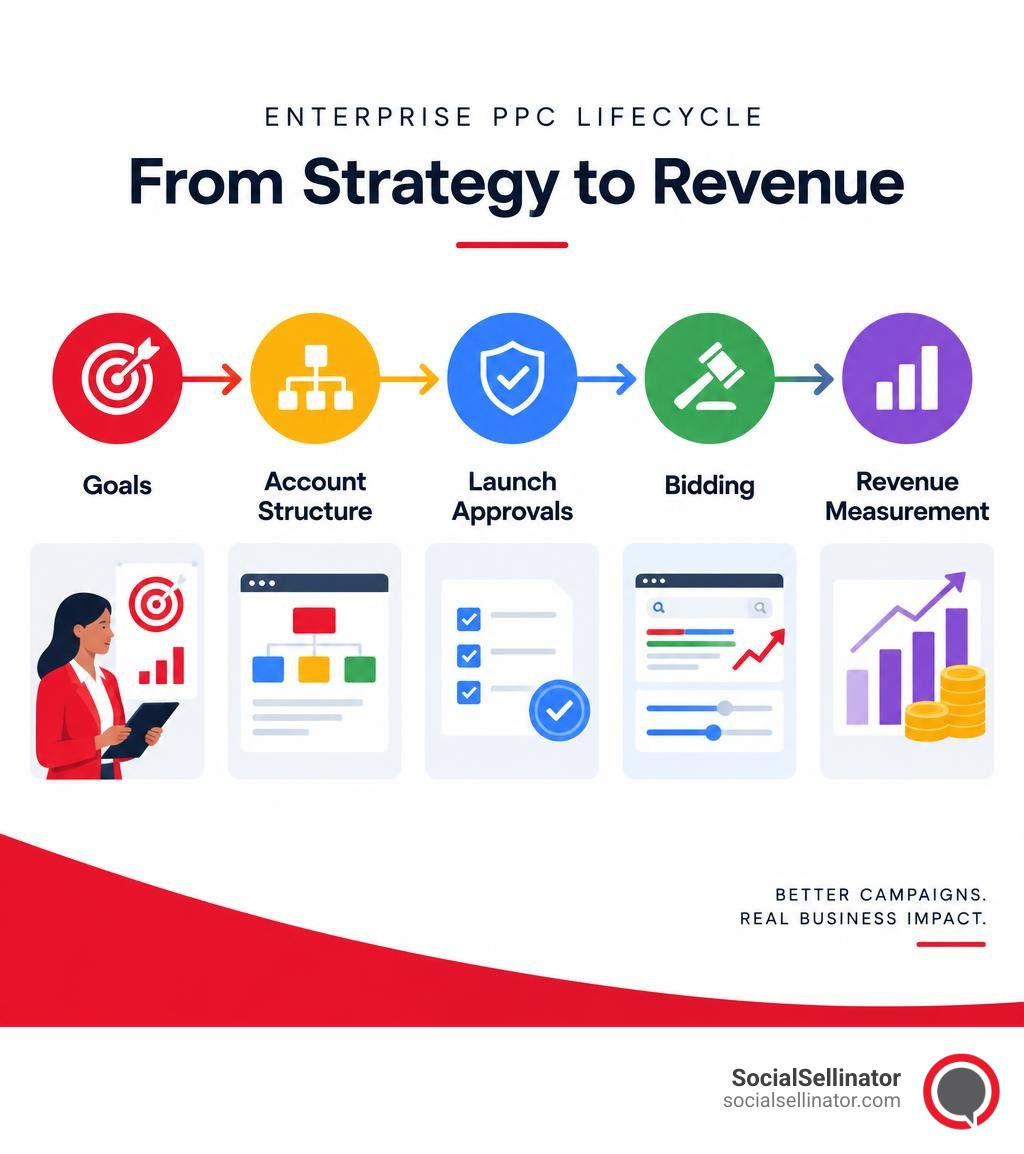
What Distinguishes Enterprise PPC from Standard Campaigns?
What changes when several teams share an advertising budget? A regional manager may need discretion over local campaigns while finance needs a common reporting period and a clear record of approvals. When paid search spans multiple business divisions, diverse product catalogs, international subsidiary brands, or global territories, the focus can shift away from manual, day-to-day keyword bid adjustments toward governing complex business systems, protecting global brand equity, harmonizing cross-channel data, and proving bottom-line financial yield.
Use these questions to decide whether your current setup still fits. The examples aren’t requirements for a business of any size.
| Operational Dimension | One possible setup | Question to review as complexity grows |
|---|---|---|
| Monthly Media Spend | One team owns the media budget. | Who approves transfers between teams or markets? |
| Account Architecture | A single ad account | Would separate accounts clarify ownership? |
| Management Focus | Keyword adjustments and CTR optimization | Who sets shared targets and resolves conflicts? |
| Conversion Tracking | Web browser pixel tracking | Which sales outcomes should be reconciled with ad data? |
| Core Success Metrics | Impressions, clicks, CPC, form fills | Which acquisition costs and revenue measures does finance use? |
| MarTech Integration | Standalone analytics dashboards | Can analysts reconcile reports across teams? |
| Regulatory Scope | A designated policy reviewer | Which markets or products require additional review? |
Advertisers can learn core paid search fundamentals through our comprehensive Google Ads management guide. If divisions share budgets or audiences, agree on who sets targets and who reviews overlapping campaigns.
When to evaluate additional campaign tools
Running search campaigns across separate ad platforms and search engines, such as Google Ads and Microsoft Advertising, can create fragmented reporting, disjointed bidding logic, and duplicated conversion claims. If teams report on several ad platforms, check whether their conversion definitions and reporting windows agree.
Before adding a platform within the Google Marketing Platform (GMP) suite, identify a task your current setup cannot handle. Then test each option:
- Search Ads 360 (SA360): If you are evaluating SA360, ask for a demonstration using the engines, campaign types and budget rules you actually use.
- Campaign Manager 360 (CM360): When evaluating CM360, test how its reports handle a conversion that two platforms both claim.
- Floodlight Conversion Tracking: For each Floodlight activity you plan to use, verify which accounts can receive it, which bidding strategies can use it and how repeat events are counted.
Reconcile a sample of conversions before treating a consolidated report as the source of record.
Multi-Brand, Multi-Region, and Multi-Currency Coordination
For example, a multinational company might oversee five corporate brands across thirty countries, managing ad spend across US Dollars, Euros, British Pounds, and Japanese Yen. Start by assigning a budget owner in each market. Executing campaigns across this environment may also call for a structured framework:
- Shared Asset Governance: Centralized negative keyword lists and brand exclusion rules can help manage keyword overlap between product divisions. Review overlapping keywords and exclusions with each division before changing shared lists.
- Cultural Localization: Enterprise marketing requires genuine localization rather than automated, direct translation. Ad copy, extensions, and landing pages must reflect regional vernacular, local idioms, and distinct consumer search behaviors.
- Currency and Time Zone Harmonization: Choose a reporting currency, exchange-rate convention and time zone before comparing regional budgets.
- Regional Legal Compliance: Ask qualified legal reviewers which privacy and advertising rules, such as GDPR or CCPA, apply to each market and product.
When to review account governance
If two teams can change the same budget, name an approver and record the business target behind each change. Keep enterprise Google Ads account management tied to core business objectives rather than vanity metrics.
Structuring Your Account for Enterprise Google Ads Management
A scalable account architecture can help establish clear operational boundaries for marketing teams and regional business units. Document which team owns each account and which changes need approval.

Consider these options when they address a specific workflow:
- My Client Center (MCC) Multi-Tier Hierarchy: A root manager account can house sub-manager accounts organized by geographical region, subsidiary brand, or business vertical. If you use manager accounts, map regional ownership and test what each role can view and change.
- Bulksheets for Scaled Workflows: Bulksheets let teams make mass updates across many ad groups without manual user-interface edits. Before making bulk edits, test a small batch and review the proposed changes.
- Dynamic Inventory Feeds and Campaign Templates: For organizations with changing product lines or large service catalogs, campaign templates and inventory feeds can generate, pause, or update ad copy and keywords based on stock levels and pricing changes. If you use an inventory feed, test how campaigns respond to stock changes, stale prices and missing records.
- Campaign Labels: Use structured labels to categorize campaigns by business objective, target audience segment, or quarterly marketing priority across your enterprise PPC campaign services. Agree on a common set of campaign labels so regional reports can be compared.
Governance, Compliance, and Multi-Level Approval Workflows
In regulated sectors such as healthcare, financial services, and legal, have an appropriate reviewer check regulated claims before an ad goes live. Operational safeguards can include:
- Role-Based Access Control (RBAC): Limit permissions to the accounts and tasks each person needs, then test access after role changes. This can reduce the risk of accidental global modifications or unintended budget reallocations.
- Policy Checks and Approval Gates: Decide which creative or landing-page changes need legal, brand or product review before publication.
- Detailed Audit Logging: Change logs can help technical leads diagnose anomalies. Check which edits your logs capture, who can review them and how long records are available.
- Asset Library Standardization: Storing approved headlines, descriptions, logos, and imagery in shared asset libraries can support consistent creative messaging across regional subsidiaries. Give teams access to approved creative and assign someone to retire outdated assets.
Advanced Bidding, Automation, and MarTech Stack Integration
Start with the business outcome you want to measure. Integrate advertising platforms with revenue operations (RevOps) systems, customer relationship management (CRM) software, enterprise resource planning (ERP) platforms, or cloud data warehouses only if their data helps your team evaluate that outcome. Then align any advanced PPC bidding strategies with that outcome.
Portfolio Bidding and Algorithmic Automation at Scale
Google Ads offers Target CPA as a standard strategy for one campaign or as a portfolio strategy across multiple campaigns. Consider a portfolio when the campaigns share a cost-per-acquisition goal.
When reviewing a bidding setup, consider the following:
- Cross-Campaign Portfolio Bid Strategies: Before grouping campaigns under a portfolio target, check that their conversion definitions and goals are compatible.
- Auction-Time Bidding: Google Ads Smart Bidding sets a bid for each query using auction-time signals such as device, location, time of day and operating system.
- Budget Pacing and Constraint Setting: Scripts can monitor media pacing against monthly and quarterly allocations. Set a pacing alert and decide who can approve a transfer when spending departs from plan.
- Custom Value Rules: If you assign conversion values, document the business basis for each value and review it with finance.
To explore how these machine learning models function under the hood, teams can reference foundational Google Ads bid strategies, including Google Ads automated-bidding guidance and apply them to wider corporate portfolios.
CRM, Data Warehouse, and Audience Targeting Integration
Relying solely on client-side browser cookies can leave reporting incomplete and miss down-funnel sales outcomes. If a lead closes outside the website, compare ad reports with the sales record before judging lead quality.
Consider which of the following data flows you need:
- First-Party Data Pipelines (BigQuery / Cloud Warehouses): If you combine advertising and sales data in a warehouse such as BigQuery, document the join keys and check how many records match.
- Offline Conversion Tracking (OCT): For offline sales, check which conversion imports your account supports. Test whether a sample of eligible sales matches the intended ads before using the data for bidding.
- Customer Match and Segment Activation: Before using customer lists for advertising, check account eligibility, permissions, consent and applicable platform policies. Do not assume every CRM segment may be uploaded. For detailed guidance on building these segmented lists, explore our guide to Google Ads audience targeting.
- A server-side tag container provides an endpoint you control between the browser or device and downstream services. You can validate or modify events before forwarding them; consent settings still need to be configured.
Attribution Modeling and Revenue Measurement Beyond Clicks
Clicks, impressions, and even raw cost-per-lead (CPL) figures don’t show whether paid search drives profitable business growth. Pair click and lead reports with a financial measure, such as acquisition cost, when you need to assess profitability.
Multi-Touch Attribution for Complex Enterprise Customer Journeys
If several people take part in a purchase, map the contacts you can observe across search, social, display, and email, and note where the record is incomplete.
Last-click reporting assigns credit to the last eligible click. It does not show what earlier interactions contributed.
Different measurement methods answer different questions:
- Data-driven attribution assigns credit among measured interactions. An assigned share of credit is not the extra revenue an ad caused.
- Marketing mix modeling uses aggregate historical data to estimate how sales relate to media and other factors, such as seasonality. Interpret the estimates in light of the model’s assumptions.
- Cross-Device and Offline Path Analysis: Before reporting a cross-device journey, check whether you have permission and a reliable way to link the records. Mark unmatched activity as unknown.
- Incrementality Testing and Geo-Experiments: A geographic test can compare outcomes in test and comparison markets. Check whether the markets were comparable and report uncertainty in the estimated lift.
Measuring Business Impact: CAC, LTV, and Pipeline Contribution
To maintain executive support and justify media budgets, enterprise PPC leaders must communicate in the financial language of the C-suite.
Critical business-level metrics for enterprise reporting include:
- Customer acquisition cost (CAC): Divide the acquisition costs in scope by the number of new customers acquired for the corresponding cohort. State which sales and marketing costs you included, such as paid media spend, platform licensing fees, agency management retainers, and internal creative production costs.
- Pipeline Sourced vs. Pipeline Influenced: Clearly distinguishing between revenue pipeline initiated by a paid search touchpoint versus existing sales pipeline that engaged with a paid ad during the evaluation cycle.
- LTV-to-CAC ratio: Divide estimated lifetime gross profit per customer by acquisition cost per customer for a comparable cohort. State the time horizon and test how retention and margin assumptions change the result.
- Executive Business Intelligence Dashboards: Choose a reporting cadence that matches the decision. Show budget used, revenue recorded and any reporting lag by territory.
Evaluating Enterprise PPC Solutions: In-House vs. Agency Partners
As organizations scale their paid search initiatives, leadership faces a key strategic choice: should you build an internal team, engage an external agency, or deploy a hybrid model? Compare in-house, agency and hybrid options against the work your team needs. Ask who will run the account, who owns the data and what platform access the partner can document. To make an informed decision, teams can review Google Ads management services to evaluate how external capabilities align with internal resource gaps.
Key Triggers for Transitioning to Enterprise Google Ads Management
Review your setup when you encounter problems such as these:
- Budget oversight: If no one can explain a material variance from plan, review approval limits and reporting frequency.
- Multi-Market or Multi-Engine Fragmentation: Running disjointed Google Ads, Microsoft Advertising, and international search campaigns across siloed teams, where regional teams cannot reconcile campaign goals or explain differences in reported results.
- CRM and Revenue Disconnect: Marketing teams report strong lead volume while executive sales leaders report low lead quality and pipeline shortages.
- Governance and Compliance Bottlenecks: Marketing execution slows down due to complex legal review cycles, or unvetted ad copy causes regulatory concerns.
- Data Silos and Deprecated Tracking: Inability to track cross-channel attribution or leverage first-party customer records due to shifting data privacy regulations and browser tracking restrictions.
- Product Line Proliferation: Managing extensive service catalogs or dynamic inventories across multiple business verticals where manual campaign updates can no longer keep pace with inventory fluctuations.
Criteria for Selecting an Enterprise Growth Partner
If your organization chooses to partner with an external agency to manage enterprise PPC, avoid firms that assign junior generalists to complex accounts. When hiring a Google Ads management company, evaluate prospective partners using these enterprise criteria:
- Senior-Led Strategic Teams: Ensure that day-to-day campaign architecture, data modeling, and optimization are led by senior practitioners with deep enterprise paid search experience.
- Scale and Track Record: Ask for an example of managing a budget and account structure comparable to yours, including how the partner measured results.
- MarTech Integration: Ask the partner to demonstrate the integrations your plan actually requires, for example cloud data pipelines, CRM architectures, server-side tracking, or analytics platforms.
- Compliance and Brand Safety Discipline: In regulated industries, confirm that the agency has established risk mitigation processes, change-control protocols, and a clean compliance history.
- Commercial Transparency and Alignment: The partner should operate with transparent reporting, shared access across all client-owned ad accounts, and a performance model tied directly to business KPIs.
Frequently Asked Questions About Enterprise Google Ads Management
What budget level justifies enterprise Google Ads management?
Spend alone doesn’t determine the right setup. Review whether your team can approve budget changes, reconcile results across markets and connect leads to sales. Address the gaps you find before buying another platform.
When should we evaluate a tool beyond native Google Ads bidding?
If several campaigns share a cost target, first evaluate the portfolio Target CPA option in Google Ads. If you also need to manage other engines, ask a prospective provider to demonstrate the specific integrations, reporting and bidding controls you need.
How do enterprise teams maintain compliance across global campaigns?
The following controls can support review; they do not by themselves establish compliance:
- Role-Based Access Permissions: Restricting user privileges to prevent unauthorized campaign, creative, or billing edits.
- Pre-Publishing Approval Workflows: Routing ad copy, keyword lists, and landing pages through brand, legal, and product marketing review stages.
- Change Logs: Check which changes are recorded and review exceptions regularly.
- Shared Negative Lists and Policy Rules: Review shared exclusions against regional needs and check how they are applied.
How can offline sales data help evaluate Google Ads?
Offline conversion tracking (OCT) connects digital advertising clicks with downstream revenue events recorded in your CRM or ERP system, such as qualified sales opportunities, signed contracts, or recurring subscription renewals. Compare CRM outcomes with the leads reported in Google Ads. Before using imported values for bidding, check permissions, match rates, duplicate records and whether the values represent leads or closed sales.
What role does marketing mix modeling play alongside digital attribution?
Attribution allocates credit to observed interactions. A marketing mix model takes a macro-level, econometric approach, estimating relationships in aggregate data such as historical sales, marketing investments, offline promotions, economic variables, and seasonal demand. If the two disagree, investigate their coverage and assumptions rather than treating agreement as proof of incremental sales.
Conclusion
Start with one unresolved decision: who owns a shared budget, which sales count as conversions, or how to compare markets. Fix that issue before adding another tool.
If your business is ready to modernize its paid search infrastructure, contact SocialSellinator about Google Ads campaign management and conversion tracking.
SocialSellinator is headquartered in San Jose and serves clients nationwide, primarily B2B companies.