
Stop Guessing and Start Tracking Your Google Rankings Today
Start With a Neutral SEO Rankings Check
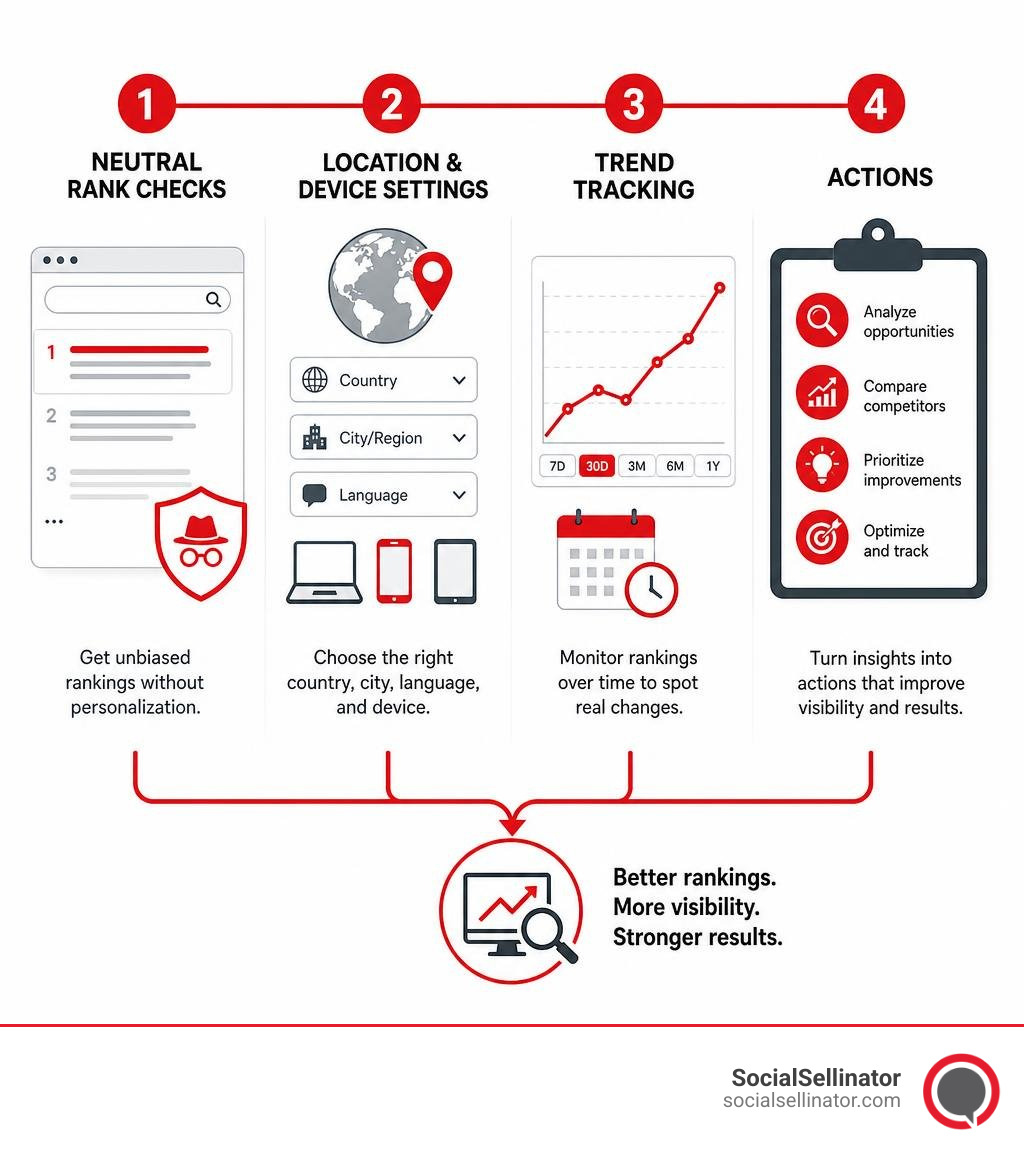
An SEO rankings check shows where your pages appear in Google for the keywords that matter to your business. For useful data, check each keyword with the right country, city, language, and device selected, then record both the organic position and the SERP features taking space above it.
- Use Google Search Console to find queries already earning impressions and clicks.
- Use a depersonalized rank checker to verify positions by location and device.
- Track results over time, not just once, so you can separate normal movement from a real decline.
A top organic position can drive far more traffic than a lower one. Research commonly places the click-through rate for position one near 28%, versus roughly 1% for position 10. But position alone is no longer the whole story: AI Overviews, ads, local packs, and featured snippets can push standard listings farther down the page.

Manual Google searches are a poor benchmark because your account activity, browser history, location, and device can change what you see. A clean, location-specific check gives your team a more reliable baseline for finding quick wins, watching competitors, and connecting search visibility to leads and revenue.

I’m Jock Breitwieser, and I’ll show you how to turn ranking data into focused SEO decisions instead of guesswork.
Explore more about seo rankings check:
Why Conducting an Accurate SEO Rankings Check Matters
Every digital marketing strategy depends on visibility. When prospective buyers run into a challenge or want to purchase a solution, they turn to search engines. If your web pages do not show up where those buyers are looking, your business is effectively invisible. Conducting a routine, accurate check of your keyword placements tells you exactly where you stand in organic search results and whether your optimization efforts are moving the needle.
Search engine results pages (SERPs) are far more dynamic than they used to be. In the past, search engines displayed ten plain blue links against a white background. Today, Google serves a rich, complex layout filled with interactive modules, paid advertisements, map packs, and AI-generated summaries. Understanding everything you need to know about the ranking of web pages in search engines means recognizing that your position is not an isolated number—it operates within a shifting digital ecosystem that directly influences organic search traffic and overall market share.
When you track rankings accurately, you stop making blind assumptions about what your audience sees. You gain actionable intelligence on which pages attract qualified traffic, which content assets require an update, and where your competitors might be quietly taking your market visibility. Regular rank monitoring allows your marketing team to allocate technical, creative, and financial resources where they generate the highest measurable return on investment.
The Flaws of Manual Search: Why Google Personalizes Your Results
Many business owners and marketing managers check their search visibility by opening a browser tab, typing their target keyword into Google, and looking for their website. While this seems straightforward, manual searching is one of the most unreliable ways to gauge your true search performance.
Google personalizes search results for every individual user based on a wide array of signals:
- Browsing history and search patterns: If you visit your own website frequently, Google recognizes this habit and often pushes your domain higher in your personal results, creating a false impression of strong performance.
- Geographical IP location: Google pinpoints your location down to the neighborhood level, serving hyper-local results that a user two towns or states away will never see.
- Account-level preferences: Being logged into your Google account ties your search history, saved maps, YouTube viewing patterns, and past interactions to every query you make.
- Device and browser environment: Search results rendered on a mobile Safari browser differ significantly from those on a desktop Chrome window due to screen dimensions, connection speeds, and location services.
- Data center routing: Google operates massive data centers worldwide. Depending on network traffic and server loads, your query might be processed by a data center serving a slightly different variation of the index than the one serving your prospective customers.
Even opening an incognito or private browsing window does not completely eliminate personalization. While private browsing prevents stored cookies from influencing the search, Google still uses your live IP address, device viewport, and local network signals to tailor the results. Appending the URL parameter &pws=0 to a search query historically disabled personal web search adjustments, but modern algorithmic adjustments and dynamic local packs still skew manual results. Relying on manual searches gives you an anecdotal impression rather than an objective, depersonalized baseline.
The Business Impact of Top Positions and Search Engine Click Distribution
Achieving a first-page ranking is important, but where you land on that first page makes a dramatic difference to your bottom line. Search engine click-through rates (CTR) follow a steep power-law curve. Industry data shows that the number one organic result captures roughly 28% of all clicks. By the time a user scrolls down to position ten at the bottom of page one, the CTR plummets to approximately 1%.
Understanding this steep drop-off explains why search engine optimization is important for long-term revenue growth. Moving a high-value commercial keyword from position eight (earning around 2% of clicks) to position two (earning roughly 15% of clicks) can generate a massive increase in organic traffic without spending an extra dollar on paid ad clicks.
When high-intent commercial keywords reach top organic positions, your conversion rates increase. Visitors who discover your brand organically at the exact moment they need your product or service arrive with built-in intent. When you combine this organic authority with targeted paid campaigns, such as PPC advertising, you dominate both the paid and organic sections of the SERP, capturing maximum market share across the entire search landscape.
How to Perform a Neutral SEO Rankings Check: Manual Workarounds vs. Automated Tools
To build an effective optimization roadmap, you need clean, objective data. You must evaluate your search engine presence without the bias of personal search history, saved browser cache, or accidental geo-targeting distortions.
Step-by-Step Manual Methods for Neutral Search Results
If you need to perform a fast spot-check on a single keyword without logging into an enterprise software platform, you can minimize search bias by taking several deliberate steps:
- Open a fresh private or incognito window: This ensures that existing session cookies, saved logins, and profile caches do not immediately alter the results.
- Clear cached browser assets: Empty your temporary browser files and cache to ensure no legacy scripts or visited URL histories influence page rendering.
- Log out of all user accounts: Make certain that you are not authenticated into any Google Workspace, YouTube, or search-related accounts.
- Append URL depersonalization parameters: When reviewing results in a browser, add
&pws=0to the end of the search result URL string to instruct the engine to suppress personalized web search adjustments. - Adjust regional search settings: Navigate to the search engine’s search settings and manually select the specific country and language target relevant to your target audience.
- Emulate mobile devices: Use browser developer tools to inspect the page under mobile viewports, testing whether mobile-first indexing presents alternative layouts, reduced snippets, or different positions.
While these manual adjustments provide a cleaner view than a standard search, they remain time-consuming, prone to human error, and virtually impossible to scale across hundreds of commercial terms. A business tracking dozens of product categories cannot realistically perform manual spot-checks every week across multiple regional hubs.
Why Automated Rank Checkers Outperform Manual Searching
Automated tracking systems solve the fundamental limitations of manual searches. Instead of querying a search engine through a personal browser, dedicated rank-checking platforms utilize clean proxy networks that query search engine indexes neutrally across designated geographical locations.
Automated tools scrape the top 100 organic search positions without attaching user history, local Wi-Fi cookies, or account data to the request. This provides a true depersonalized view of what an unexposed customer sees. Furthermore, learning how to find your rank without losing your mind comes down to saving time: automated platforms can check thousands of queries simultaneously, logging daily historical movements, highlighting competitor gains, and identifying technical crawl hurdles across every page on your site.
In addition, automated platforms record SERP feature presence, device variances, and ranking volatility over time. This continuous stream of clean data enables marketing leaders to identify emerging keyword trends, evaluate algorithm updates objectively, and communicate performance clearly to stakeholders.
Essential Features to Look for in Modern Rank Tracking Tools
Not all rank tracking solutions offer the same depth of insight. As search engines evolve, modern tools must track dynamic elements well beyond simple desktop lists of ten organic links.
Localized and Device-Specific SEO Rankings Check Capabilities
Search engines treat location and device type as critical ranking factors. A search query performed on a smartphone in downtown Chicago will show a completely different set of results than the exact same query typed into a desktop computer in suburban Dallas.
When evaluating ranking software or working with an agency partner, ensure the tracking infrastructure supports:
- Granular geo-targeting: The capability to monitor rankings at the national, state, metropolitan DMA, city, and individual postal code levels to reflect local buyer journeys.
- Separate device indexes: Dedicated reporting for desktop, smartphone, and tablet queries to reflect the reality of mobile-first indexing and responsive SERP designs.
- Map pack and local citation tracking: Monitoring 3-pack map placements for local queries, which is vital for businesses relying on local SEO to attract customers in specific service territories.
- Multi-language monitoring: Tracking localized variations of queries across different languages and international domains if your business serves a global audience.
Tracking AI Overviews, Featured Snippets, and Rich SERP Features
Search engine results are filled with rich snippets, video carousels, People Also Ask accordions, and generative AI Overviews. These elements take up significant vertical screen space, often pushing the number one organic link well below the fold.
In modern search environments, understanding your visibility requires knowing whether your URL is featured in rich results or cited by generative models. Implementing proper structured data markup is critical here; exploring schema secrets for boosting your SERP presence reveals how technical tags help search engines understand page context and award rich snippet features.
| SERP Element Type | Page Placement | Visual Impact on Organic Listings | Primary CTR Drivers |
|---|---|---|---|
| AI Overview | Top of SERP (Above Organic) | High: Summarizes answers directly, pushing standard links down. | Clear factual answers, entity trust, strong schema markup. |
| Featured Snippet | Position Zero (Top) | High: Occupies large callout box with direct text, lists, or tables. | Concise definition paragraphs, numbered lists, H2/H3 tag alignment. |
| Local 3-Pack | Upper SERP for Local Queries | High: Dominates map-based local searches with ratings and directions. | Proximity, consistent NAP citations, complete business profiles. |
| People Also Ask (PAA) | Interleaved in Top 5 Results | Moderate: Expandable accordions answering related sub-questions. | Q&A formatting, structured headings, targeted FAQs. |
| Standard Organic #1 | Top Organic Listing | High: Captures roughly 28% of total organic click share. | Comprehensive search intent match, domain authority, quality backlinks. |
| Standard Organic #10 | Bottom of Page 1 | Low: Captures roughly 1% of total click share. | Meets basic query relevance but lacks ranking authority signals. |
Point-in-Time Snapshot vs. Continuous Position Tracking
A single ranking check provides a point-in-time snapshot of your visibility. It tells you where your page appeared at that exact moment. However, search engines constantly test content, adjust for seasonality, and roll out algorithmic adjustments.
Continuous rank tracking records daily movements over weeks, months, and years. This historical view allows you to:
- Differentiate normal fluctuations from algorithmic penalties: Small day-to-day shifts of one or two spots are completely normal, whereas an abrupt drop across twenty keywords signals a technical or structural issue.
- Detect keyword cannibalization: If two different pages on your website fluctuate back and forth for the same target query, continuous tracking uncovers this conflict so you can consolidate or re-target the content.
- Receive automated alerts: Automated monitoring flags sharp ranking declines immediately, allowing your team to resolve broken links or server issues before they impact revenue.
- Measure campaign impact: By correlating publishing dates, backlink acquisition campaigns, and site speed optimizations with rank movements, you can attribute growth to specific marketing initiatives.
How to Turn Ranking Data into Actionable Growth Strategies
Collecting ranking data is only valuable if you use it to guide your marketing actions. Once you establish a depersonalized rank monitoring process, you can transform those position metrics into practical optimization steps that outrank competitors.
Uncovering Quick Wins on Pages 2 and 3
The fastest way to generate organic traffic growth is to focus on your “striking-distance” keywords—search queries where your website currently ranks on page two or page three (positions 11 through 30).
These pages have already established relevance and trust with search engines; they simply need an extra push to reach page one. Discovering how to master SEO organic ranking and outshine your competitors starts with prioritizing these quick-win opportunities:
- Refine on-page metadata: Review your title tags and meta descriptions. Ensure your primary keyword sits near the beginning of your title and write meta copy that encourages clicks.
- Fill content gaps: Compare your page with the current top five results. Are competitors answering specific customer questions, including data tables, or addressing subtopics that your content misses?
- Strengthen internal links: Pass authority from your top-performing, high-traffic pages to your striking-distance URLs using descriptive, keyword-rich anchor text. Utilizing an on-page SEO optimization cheat sheet makes it easy to audit these structural elements across key landing pages.
- Enhance user engagement signals: Ensure your page provides fast load times, readable typography, and clear calls to action so visitors stay engaged rather than bouncing back to the search results.
Diagnosing and Resolving Sudden Ranking Drops
If your rank tracking alerts you to an unexpected drop in keyword positions, approach the issue systematically rather than reacting impulsively.
When diagnosing a traffic drop, apply this troubleshooting sequence:
- Determine the scope of the decline: Did a single keyword drop, or did your entire site lose visibility across multiple categories?
- Check single-keyword intent shifts: If only one keyword dropped, search engines may have reinterpreted user intent (e.g., favoring informational how-to guides over transactional product listings). Updating your page layout to match current search intent often recovers lost ground.
- Inspect sitewide technical health: If rankings drop across dozens of unrelated pages simultaneously, check for technical crawl barriers. Use proven strategies for finding what is wrong with your SEO by auditing your robots.txt file, verifying canonical tags, checking for accidental
noindexdirectives, and reviewing server response times. - Review backlink profiles: Check whether key external links pointing to the declining page were moved, redirected, or lost, or if competitors gained significant new authoritative placements.
Integrating Traditional SEO Rankings Check with AI Engine Visibility
Search behavior is shifting rapidly. With an estimated 40% of searches now occurring within conversational AI engines and large language model (LLM) interfaces, tracking organic visibility requires looking beyond traditional search engines alone.
Generative AI engines frequently draw source citations directly from web pages that hold top organic rankings in standard search indexes. However, securing AI citations requires clean entity trust signals and clear factual formatting. Mastering strategies for surviving AI search changes involves structuring your content with direct answer summaries, bulleted takeaways, schema markup, and verifiable data that both standard search crawlers and AI answer engines can easily extract and cite.
Frequently Asked Questions About SEO Rankings
How often should I perform an SEO rankings check on my website?
For active business websites, automated rank tracking should run daily to monitor volatility, detect technical errors, and catch competitor movements early. However, human strategic reviews are best conducted on a weekly or bi-weekly cadence. Reviewing rankings every hour is counterproductive, as search engines naturally fluctuate throughout the day. A weekly review provides a smooth, reliable trendline that separates normal algorithmic testing from meaningful performance shifts.
Why do my keyword rankings differ between mobile and desktop?
Mobile and desktop rankings differ because search engines use mobile-first indexing and tailor the search layout to user context. Mobile searches prioritize fast-loading pages, responsive layouts, and proximity-based local results. Desktop screens accommodate larger displays, different ad placements, and varied search intents. A page that loads slowly on cellular networks or features difficult-to-click buttons may rank lower on mobile devices even if it maintains a respectable desktop position.
Can I check Google keyword rankings for multiple cities or countries without a VPN?
Yes. Dedicated rank checking tools and search APIs query regional data centers using precise geographic coordinates, postal codes, and country domain parameters without requiring a manual VPN connection. This automated approach allows you to view neutral search results for hundreds of target markets worldwide directly from a single centralized dashboard.
How long does it take to see ranking improvements after optimizing a web page?
Ranking improvements typically appear within two to six weeks after re-indexing, depending on crawl frequency, domain authority, and the competitiveness of the keyword. For established pages receiving updates to on-page meta tags or internal links, search engines may reflect changes within days. For newer domains or highly competitive terms requiring fresh backlinks and technical overhauls, significant rank climbs often take three to six months of sustained optimization effort.
Conclusion
Tracking your organic search positions is the foundation of every successful digital growth strategy. When you move past the inaccuracies of manual searching and adopt automated, location-specific rank tracking, you gain the clarity needed to make smart marketing investments. You can protect your highest-converting pages, systematically optimize striking-distance keywords, and adapt your content to both traditional search engines and emerging AI platforms.
At SocialSellinator, our team combines technical expertise, content marketing, paid advertising, and comprehensive search strategies to help your business achieve measurable online growth. Whether you are looking to audit your existing keyword footprint or build a complete organic acquisition engine, partnering with our team gives you the tools and insights to outrank your competition and turn search visibility into lasting business revenue.
Headquartered in San Jose, in the heart of Silicon Valley and the San Francisco Bay Area, SocialSellinator proudly provides top-tier digital marketing, SEO, PPC, social media management, and content creation services to B2B and B2C SMB companies. While serving businesses across the U.S., SocialSellinator specializes in supporting clients in key cities, including Austin, Boston, Charlotte, Chicago, Dallas, Denver, Kansas City, Los Angeles, New York, Portland, San Diego, San Francisco, and Washington, D.C.