
Everything you need to fix on your website right now
Why On-Site SEO Factors Determine Whether Your Website Sinks or Swims
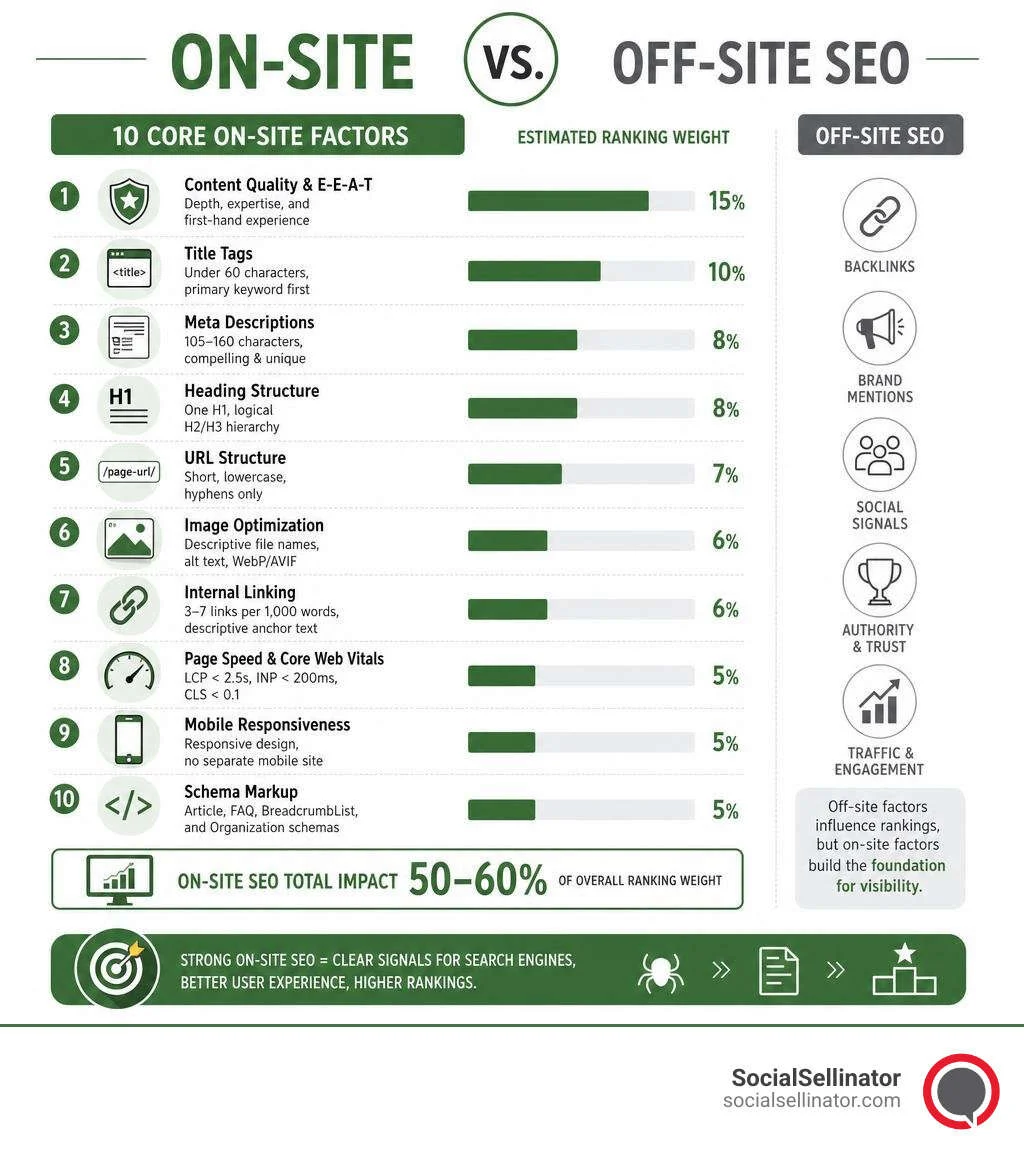
On-Site SEO Factors Overview — Metadata: File size 62KB, Format JPEG, Dimensions 1200x630px. This image illustrates the foundational on-site SEO factors that directly impact search engine rankings.
The on site seo factors you control directly – your content, HTML tags, site speed, and internal structure – are responsible for an estimated 50-60% of your total ranking weight in Google’s algorithm.
If those elements are broken or ignored, no amount of backlinks will save you.
Here are the core on-site SEO factors you need to fix right now:
- Content quality and E-E-A-T signals – depth, expertise, and first-hand experience
- Title tags – under 60 characters, primary keyword first
- Meta descriptions – 105-160 characters, compelling and unique per page
- Heading structure – one H1, logical H2/H3 hierarchy
- URL structure – short, lowercase, hyphens only
- Image optimization – descriptive file names, alt text, modern formats (WebP/AVIF)
- Internal linking – 3-7 links per 1,000 words, descriptive anchor text
- Page speed and Core Web Vitals – LCP under 2.5s, INP under 200ms, CLS under 0.1
- Mobile responsiveness – responsive design, no separate mobile site
- Schema markup – Article, FAQ, BreadcrumbList, and Organization schemas
Think of it this way: a website without solid on-site optimization is like a beautiful sports car with no engine. It looks great, but it goes nowhere.
Search engines need clear signals to crawl, understand, and rank your pages. Google’s own SEO Starter Guide emphasizes creating helpful, reliable content and making pages easy for search engines to discover and understand. So do AI tools like ChatGPT and Google’s AI Overviews, which now sit above traditional search results and intercept clicks before users ever reach organic listings. In fact, roughly 60% of Google searches end without a click in 2026 – making it more critical than ever that every on-page element is working in your favor.
The good news? Every factor on this list is entirely within your control.
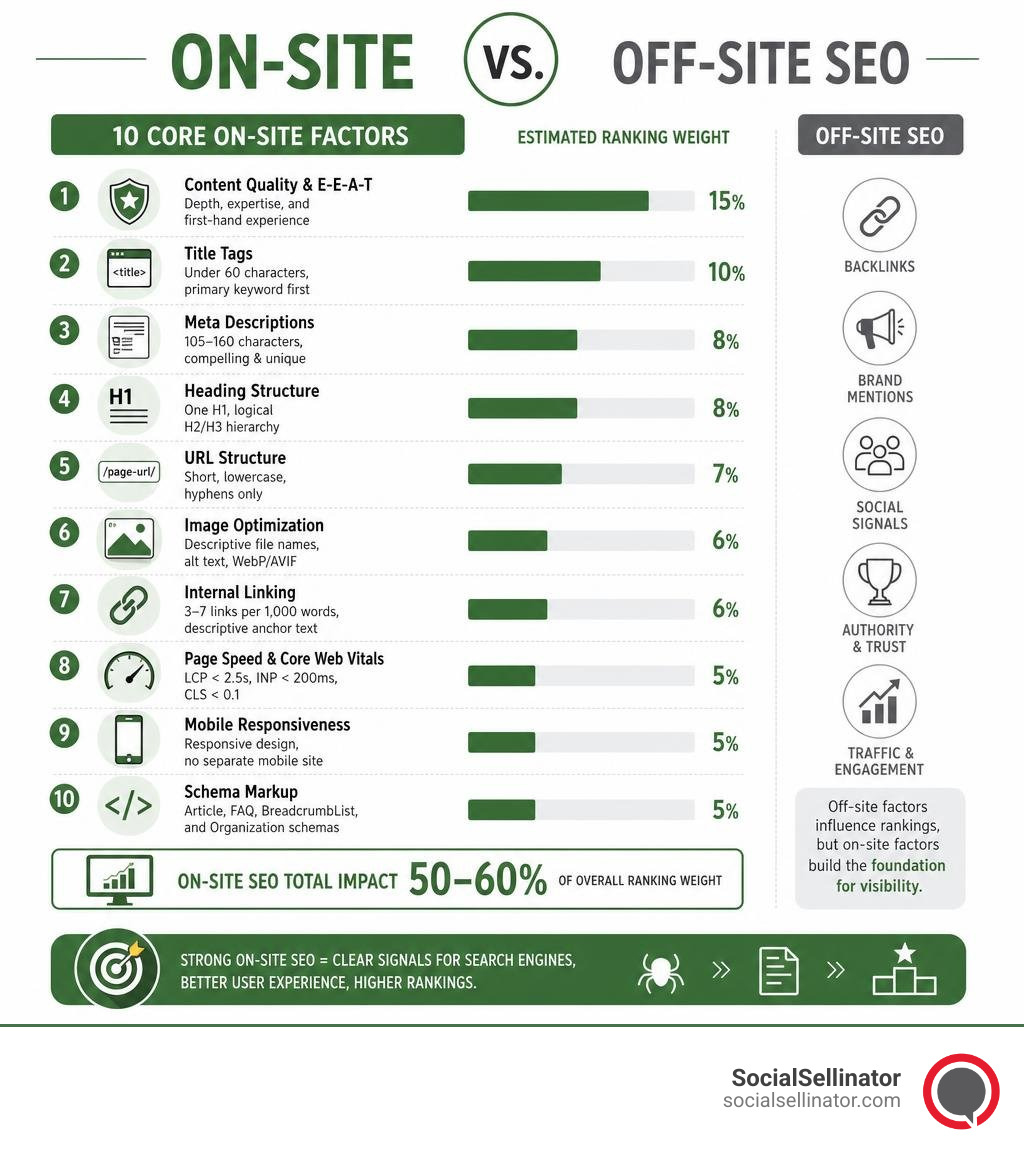
On-Site vs Off-Site SEO Infographic — Metadata: File size 78KB, Format JPEG, Dimensions 800x1000px. This infographic compares on-site and off-site SEO factors, highlighting the 10 core on-site elements.
On site seo factors terms at a glance:
The Core On Site SEO Factors for Modern Search
To understand why your website might be struggling to attract organic traffic, we have to look closely at how modern search engines operate. The days of simply repeating a target keyword over and over again to achieve page-one rankings are long gone. In 2026, search engine algorithms are highly sophisticated, relying on advanced neural matching systems like BERT and MUM to understand the context, synonyms, and intent behind every search query.
Furthermore, the search landscape has shifted dramatically with the rise of AI search engines and Generative Engine Optimization (GEO). Users are no longer just looking at a list of ten blue links. They are asking complex questions and receiving direct, generated answers from AI engines that pull information from the web in real time. This means your website must be optimized not only for human readers and traditional search bots but also for AI crawlers that extract and cite structured content.
When we talk about on site seo factors, we are looking at the elements of your website that you have 100% direct control over. Unlike off-page signals such as acquiring backlinks from other websites, on-site factors can be adjusted and improved by you at any moment. This is why we always recommend prioritizing on-page seo optimization as the absolute foundation of your digital marketing strategy.
By aligning your on-site elements with user intent, you make it incredibly easy for both traditional search crawlers and AI answer engines to find, parse, and display your content. When your website possesses a clean structure, highly relevant content, and lightning-fast performance, search engines reward you with higher visibility, and users reward you with their trust and business.
Content Foundation and E-E-A-T Signals
At the heart of every successful website is high-quality content. You can have the most technically perfect website on the internet, but if the content itself is weak, superficial, or irrelevant, your rankings will inevitably suffer. In modern search, content quality is heavily evaluated through Google’s E-E-A-T framework, which stands for Experience, Expertise, Authoritativeness, and Trustworthiness.
Let’s break down these critical signals:
- Experience: This is the newest and perhaps most influential addition to the E-E-A-T framework. Search engines want to see that the content is written by someone with real-world, hands-on experience. This means incorporating personal stories, case studies, original data, and unique insights that cannot be easily replicated by AI writers.
- Expertise: Your content must demonstrate a deep understanding of the subject matter. This is achieved by having credentialed authors write or review your content and linking to comprehensive author bio pages that detail their professional backgrounds.
- Authoritativeness: Authoritativeness is built by establishing your website as a go-to resource in your niche. By creating a comprehensive seo content blog that covers every angle of your core topics, you signal to search engines that you are an authority in your field.
- Trustworthiness: This is the most critical element of E-E-A-T. Your website must be secure, transparent, and accurate. This means having clear contact pages, professional privacy policies, and citing credible sources for any facts or statistics you mention.
Another vital content signal is content freshness. Search engines favor websites that are actively maintained and updated. Rather than constantly publishing new underperforming articles, we recommend regularly auditing and refreshing your older content. Updating outdated statistics, adding new sections of valuable information, and ensuring your links are active sends a strong freshness signal to search engine algorithms, often resulting in a rapid boost in rankings.
Optimizing Content Depth and On Site SEO Factors
When it comes to content depth, there is a clear correlation between the thoroughness of your content and where it ranks on the search engine results pages (SERPs). Large-scale industry studies have shown that the average first-page Google result is roughly 1,400 to 2,000 words in length. This is not because search engines have a strict word count requirement, but rather because longer, comprehensive content naturally answers user queries more thoroughly.
To win in competitive search markets, you should aim to create seo optimized blogs that provide at least twice the depth of your average top-ranking competitors. However, depth should never be confused with fluff. Every paragraph must add genuine value, address search intent, and use semantic entities (related terms and concepts) naturally.
The table below illustrates the typical correlation between content length, search intent fulfillment, and average organic ranking positions based on modern search performance trends:
| Content Length (Words) | Content Depth & Quality Level | Search Intent Alignment | Average Search Position |
|---|---|---|---|
| Under 500 | Thin, basic definitions, or superficial overviews | Fails to answer complex questions completely | Position 70+ |
| 500 – 1,000 | Moderate depth, standard blog posts, or product pages | Answers basic transactional or simple informational queries | Position 40 – 60 |
| 1,000 – 1,500 | Good depth, well-structured guides, standard articles | Thoroughly addresses single-topic informational queries | Position 15 – 35 |
| 1,500 – 2,000+ | High depth, comprehensive pillar pages, master guides | Exhaustively satisfies complex informational and commercial intent | Position 1 – 10 |
To optimize your content depth effectively, we recommend using the “inverted pyramid” writing structure. Lead with your main conclusion or a direct answer to the searcher’s query in the first 100 words of your page. This “answer-first” approach is highly favored by both human readers who want quick answers and AI search engines looking to pull direct citations. Once you have delivered the core answer, use the rest of the page to dive deep into supporting details, practical examples, and step-by-step instructions.
HTML Elements and Metadata Optimization
While high-quality content is the foundation of your website, search engines still rely heavily on your site’s HTML source code to understand what each page is about. Properly optimizing your HTML elements ensures that search crawlers can easily parse your pages and index them correctly.
The most critical HTML elements you must optimize are:
- Title Tags: Your title tag is the single most important on-page HTML element. It is the first thing users see in the search results and directly influences your click-through rate (CTR). Keep your title tags under 60 characters to prevent them from being truncated in search results, and always place your primary keyword near the beginning of the title.
- Meta Descriptions: Although meta descriptions are not a direct ranking factor, they act as organic ad copy for your pages. A compelling meta description between 105 and 160 characters that includes a clear call-to-action can dramatically increase your CTR, which in turn signals to search engines that your page is highly relevant.
- Heading Tags (H1, H2, H3): Heading tags help organize your content into a logical hierarchy, making it easier for both users and search engines to navigate. Every page must have exactly one H1 tag that contains your primary keyword. Use H2 tags for your main sections and H3 tags for subsections to keep your content neat and scannable.
- Image Alt Text: Search engine crawlers cannot “see” images in the same way humans do. Including descriptive alt text with relevant keywords is essential for helping search engines understand your visual assets. It also ensures your website is accessible to visually impaired users who rely on screen readers. To learn more about this, read our detailed guide on more than just a description why alt text matters for your website.
To help you visualize how a correct HTML heading hierarchy should look on your optimized pages, review the diagram below:
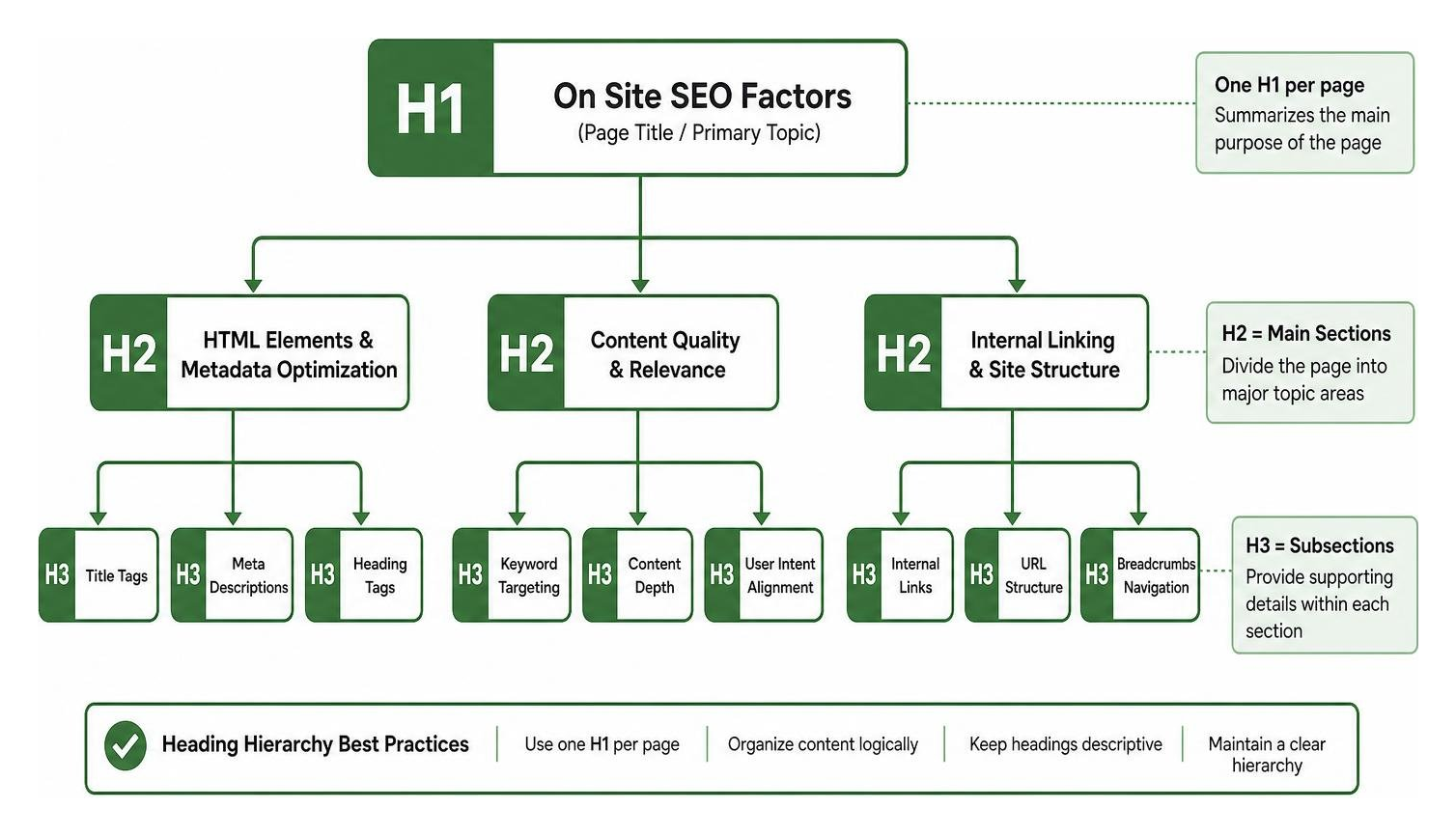
Visual Heading Hierarchy Guide — Metadata: File size 55KB, Format WebP, Dimensions 800x450px. This diagram displays the correct nesting of H1, H2, and H3 tags to ensure optimal readability and search engine crawlability.
Aligning HTML Tags with On Site SEO Factors
To maximize the impact of your HTML tags, you must align them strategically with your primary keyword targets. This process is not about stuffing keywords into every tag; rather, it is about natural, logical placement that aids user understanding.
When optimizing your headings, avoid using vague or overly “cute” titles. Instead, make your headings descriptive of the content that follows. For example, instead of a heading like “The Secret Sauce,” use a descriptive heading like “The Core On Site SEO Factors for Small Businesses.” This clear phrasing helps search engines contextually index your content and can help you win featured snippets and “People Also Ask” placements.
For your image optimization, keep your alt text concise (under 125 characters) and write descriptive file names before uploading them to your website. Instead of leaving an image file name as IMG_4829.jpg, rename it to something descriptive like on-site-seo-checklist-for-business.jpg. This small change makes a massive difference in how search engines index and display your images in image search results.
If you are also running paid advertising campaigns alongside your organic efforts, aligning your on-page keywords with your ad copy is equally crucial for maintaining a high Quality Score and keeping your ad costs down. Discover how to align these elements in our article on how to use keywords effectively in google advertising.
Website Architecture and Technical Performance
Website architecture and technical performance are the silent pillars of on site seo factors. You can have the best content and perfectly optimized HTML tags, but if your website is painfully slow, confusing to navigate, or broken on mobile devices, users will quickly bounce back to the search results. This high bounce rate signals to search engines that your site provides a poor user experience, which will quickly drag down your rankings.
To keep users engaged and search engines happy, your website must be optimized for speed and technical performance. Google measures user experience through a set of metrics called Core Web Vitals, which focus on three key areas:
- Largest Contentful Paint (LCP): This measures loading performance. To provide a good user experience, your page’s main content should load in under 2.5 seconds.
- Interaction to Next Paint (INP): This measures page responsiveness. Your page should respond to user clicks or taps in under 200 milliseconds.
- Cumulative Layout Shift (CLS): This measures visual stability. Pages should maintain a stable layout as they load, with a CLS score of less than 0.1 to prevent accidental clicks.
In addition to speed, your website architecture must be clean and intuitive. This means organizing your pages in a logical “filing cabinet” structure, where related pages are grouped into clear categories. Your URL slugs should be short, descriptive, lowercase, and use hyphens instead of underscores as word separators (e.g., https://cms.socialsellinator.com/services/search-engine-optimization-seo-san-jose/).
Furthermore, you should implement a robust internal linking strategy. Internal links help distribute page authority (or “link juice”) throughout your site, make it easier for search crawlers to find new pages, and guide users to relevant resources. Aim for 3 to 7 natural internal links per 1,000 words of content. To understand how speed impacts your bottom line, read our article on speed demons why a fast website is your best seo asset, or learn how a technical seo expert can help you audit and resolve these complex backend issues.
Schema Markup and Structured Data
Schema markup is a form of structured data that you add to your website’s HTML code to help search engines understand the context of your content. By translating your web pages into a standardized language that search bots can easily read, schema markup allows search engines to display your pages with “rich results” — such as star ratings, product prices, event dates, and FAQ dropdowns directly in the SERPs.
In 2026, schema markup has also become a critical factor for AI search engine visibility. When AI crawlers from platforms like ChatGPT, Gemini, and Perplexity crawl your website, they rely heavily on structured data to accurately pull facts, brand details, and product availability. Implementing schemas like Article, LocalBusiness, FAQPage, and Organization makes your website highly attractive to these AI engines, significantly increasing your chances of being cited as a reliable source in AI-generated answers.
Adding structured data doesn’t have to be overwhelming. By utilizing standard JSON-LD schema formats, you can easily define your business’s core details, highlight customer reviews, and clarify your website’s navigation paths. To unlock the full potential of structured data on your website, read our guide on schema secrets boosting your serp presence with structured data and explore the impact of search engine marketing in optimizing web performance.
Frequently Asked Questions about On-Site SEO
Navigating search engine optimization can raise many questions, especially with how quickly search technology evolves. Below, we answer some of the most common questions we hear from business owners looking to improve their search rankings.
What is the difference between on-page and off-page SEO?
On-page SEO (which includes both on-page and site-wide on-site factors) refers to all the optimizations you perform directly within your own domain. This includes writing high-quality content, structuring your HTML tags, improving site speed, and setting up internal links. Because these elements live on your server, you have 100% control over their execution.
Off-page SEO, on the other hand, refers to activities and signals that occur outside of your website to build trust and authority. The primary off-page ranking factor is acquiring high-quality backlinks from other reputable websites in your industry. It also includes digital PR, brand mentions, social media signals, and local directory listings.
While both are essential for a successful digital marketing strategy, on-page SEO should always be prioritized first. Building backlinks to a slow website with poor content is a waste of resources — you must build a strong foundation on your own site before trying to convince other websites to link to you.
How long does it take to see results from on-site optimization?
The ranking timeline for on-site SEO changes can vary depending on how quickly search engine crawlers find and index your updates.
- Minor Updates (3–7 Days): Simple changes like updating a title tag, meta description, or fixing heading structures are usually indexed within a week. You may see immediate shifts in click-through rates or keyword rankings for those specific pages.
- Content Refreshes (2–4 Weeks): Rewriting thin content, adding deeper sections, and optimizing for semantic keywords typically shows noticeable ranking improvements within two to four weeks as search engines re-evaluate the page’s quality score.
- Structural and Speed Overhauls (4–8 Weeks): Major technical changes, such as resolving Core Web Vitals issues, restructuring your site’s navigation, or executing a massive internal linking campaign, can take one to two months to show their full impact as search engines crawl and re-index your entire site.
Does schema markup help with AI search engine visibility?
Yes, absolutely. Schema markup is one of the most powerful tools you have for securing citations in AI search engines and chatbot answers.
AI crawlers are designed to extract precise, factual information as quickly as possible. When you use structured data (JSON-LD schema), you present this information to the crawlers on a silver platter. For example, instead of forcing an AI bot to guess your business hours or pricing by reading through paragraphs of text, schema markup provides those exact details in a structured format that the bot can instantly trust and cite.
As search behavior shifts toward conversational queries, having valid schema markup ensures your brand remains highly visible across all modern search platforms.
Conclusion
Optimizing your on site seo factors is not a one-time project, but a continuous process of refinement and improvement. By focusing on creating deep, authoritative content, organizing your HTML tags logically, maintaining a fast and mobile-friendly site architecture, and implementing structured schema markup, you build a website that both search engines and human users will love.
At SocialSellinator, we know that managing all of these moving parts can be overwhelming when you are busy running your business. That is why our team of experienced professionals is here to help. We specialize in creating comprehensive, customizable digital marketing strategies that align your organic SEO, paid PPC campaigns, social media management, and content creation to drive measurable results.
Whether you need a complete website audit or a tailored content strategy to boost your online visibility and increase your bottom line, we have the tools and expertise to help your business thrive in the digital age.
Book a search audit with SocialSellinator today to find out how we can supercharge your website’s performance and help you dominate the search results.
Headquartered in San Jose, in the heart of Silicon Valley and the San Francisco Bay Area, SocialSellinator proudly provides top-tier digital marketing, SEO, PPC, social media management, and content creation services to B2B and B2C SMB companies. While serving businesses across the U.S., SocialSellinator specializes in supporting clients in key cities, including Austin, Boston, Charlotte, Chicago, Dallas, Denver, Kansas City, Los Angeles, New York, Portland, San Diego, San Francisco, and Washington, D.C.