
How to Get Your B2B Brand into AI-Generated Answers
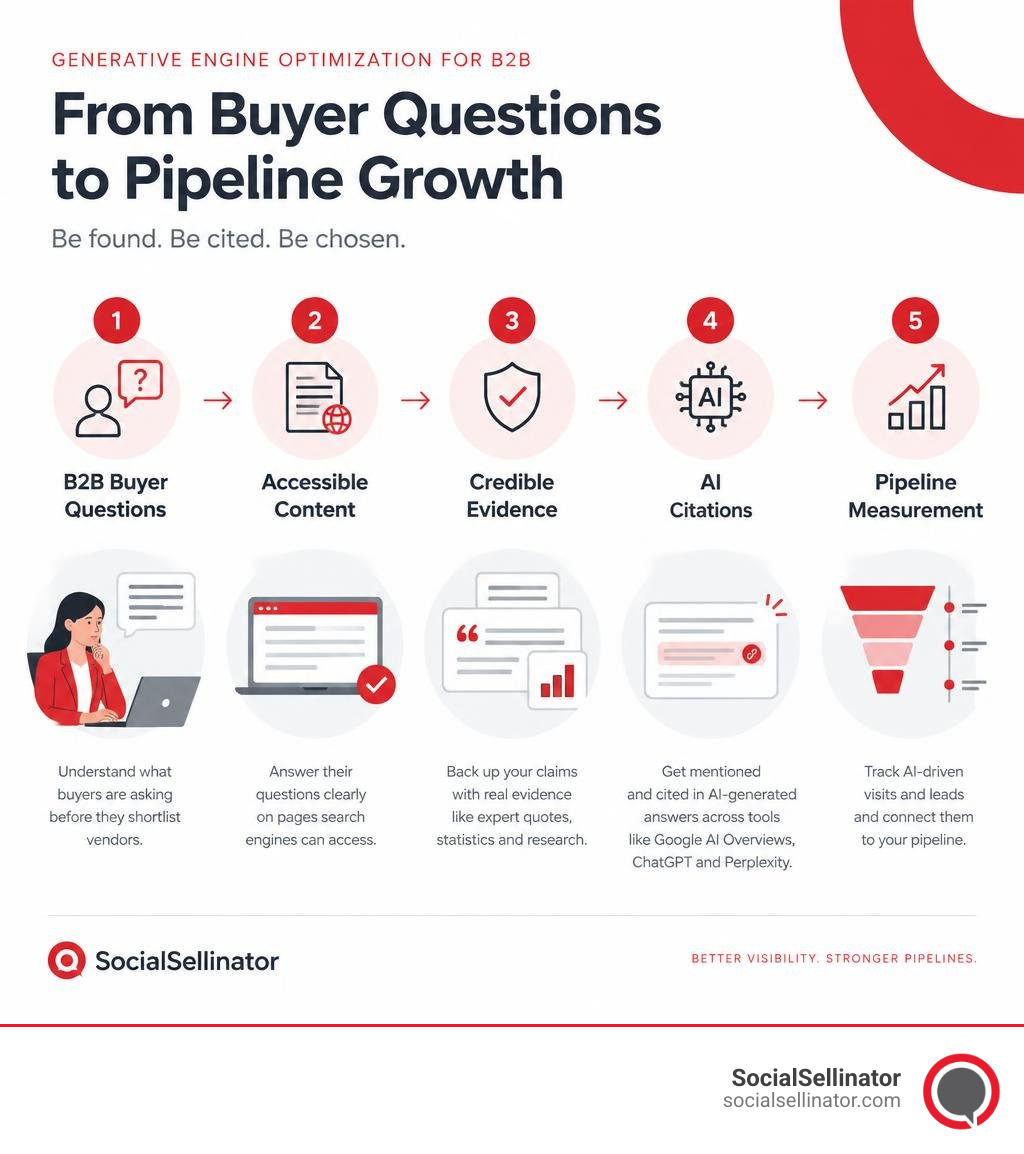
Generative engine optimization for B2B starts with the questions buyers ask before they shortlist vendors. Find those questions, answer them clearly on pages search engines can access, and back up your claims with real evidence. Then check whether AI tools mention or cite your brand, and connect any resulting visits and leads to your pipeline.
This builds on SEO; it does not replace it. Your pages still need to be findable. But a strong search ranking alone does not tell you whether a buyer sees your brand in an AI-generated answer.
I’m Jock Breitwieser, and I’ll walk you through how to make that shift without rebuilding your content program.
Key Takeaways
- Generative Engine Optimization (GEO) focuses on getting your B2B brand synthesized, cited, and recommended in AI-generated answers across tools like Google AI Overviews, ChatGPT, and Perplexity.
- Adding specific citations, expert quotations, and authoritative statistics can boost AI answer visibility by up to 40%, based on research published by a Princeton-led research team at the ACM SIGKDD 2024 conference.
- GEO does not replace technical and foundational search practices; AI answer engines rely directly on traditional search indexes and Retrieval-Augmented Generation (RAG) to locate ground-truth data.
- Establishing external brand consensus across industry trade publications, authoritative third-party reviews, and digital PR is critical for generative engines to validate your claims.
- Measuring GEO success requires shifting focus from traditional keyword rankings to AI brand mentions, referral traffic, self-reported attribution, and qualified sales pipeline.
Table of Contents
- What Is Generative Engine Optimization B2B and Why Does It Matter?
- What Content Structures Get Cited Most Often by AI Engines?
- How Can B2B Brands Build Multi-Channel Authority for AI Engines?
- How Do You Adapt Existing Workflows and Measure B2B GEO Success?
- Frequently Asked Questions About B2B Generative Engine Optimization
- Conclusion: Building Your AI-Era Pipeline Engine
What Is Generative Engine Optimization B2B and Why Does It Matter?
Generative engine optimization B2B is the strategic practice of organizing, writing, and distributing your technical and commercial content so that large language models (LLMs) and conversational search platforms select, summarize, and cite your company as a primary solution. Unlike legacy search methods that focus solely on winning a position in a list of web links, GEO targets inclusion within synthesized answers. As B2B buying committees increasingly turn to AI tools to compress weeks of vendor discovery into minutes, failing to appear in synthesized answers renders your product invisible during high-intent evaluation stages.
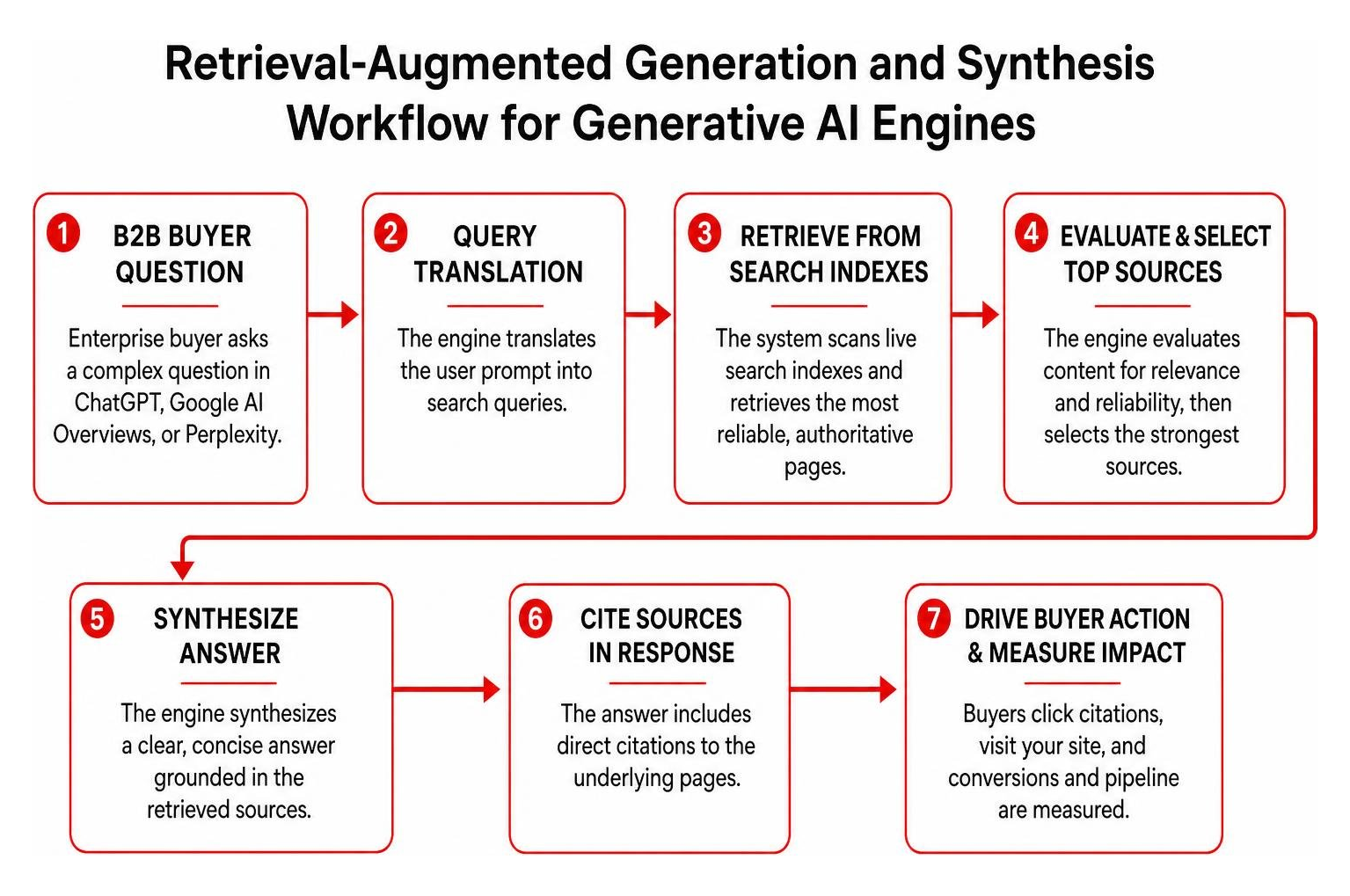
When an enterprise procurement director enters a complex prompt into ChatGPT, Google AI Overviews, or Perplexity, the engine does not write a response purely from memory. Instead, it relies on Retrieval-Augmented Generation (RAG). The system translates the user prompt into search queries, scans live search indexes for authoritative documents, retrieves the most reliable pages, and synthesizes an answer with direct citations.
To win visibility in this environment, your assets must align with modern SEO optimization strategies that deliver sustainable growth. Without clean crawlability and strong topical relevance, AI models will simply cite your competitors instead.
Core Differences Between Traditional SEO and Generative Engine Optimization B2B
Traditional B2B SEO and GEO share the same foundation—high-quality technical indexing and user-focused content—but they optimize for entirely different endpoints. While traditional SEO optimizes for search engine results page (SERP) real estate and direct click-through rates, GEO optimizes for comprehension, entity clarity, and citation inclusion.
| Feature | Traditional B2B SEO | B2B Generative Engine Optimization (GEO) |
|---|---|---|
| Primary Goal | Rank on Page 1 of search engine link lists | Earn citations, quotes, and recommendations in AI answers |
| Target Mechanism | Matching keyword queries and search intent | RAG grounding, semantic entity extraction, and query fan-out |
| User Experience | Browsing multiple blue links and visiting websites | Reading a synthesized answer with source citations |
| Key Metric | Keyword ranking position, organic impressions, clicks | AI Share of Voice, prompt citation frequency, attributed pipeline |
| Content Focus | Keyword placement, page length, standard metadata | Direct answers, unique data, expert insights, structured proof |
Navigating this transition requires effective search ranking strategies tailored for AI platforms. Rather than choosing between the two, modern marketing teams must build a hybrid engine where technical SEO provides index access, while GEO ensures content is selected during real-time AI synthesis.
How B2B Buyers Use Generative AI Tools During Procurement
Enterprise buying committees no longer type single keywords into search bars when evaluating complex software, hardware, or professional services. Today, enterprise buyers use multi-layered prompts to compare vendor capabilities, analyze integration ecosystems, and assess pricing models before ever contacting a sales representative.
Generative engines process these complex prompts using a technique known as “query fan-out.” When a buyer inputs a broad challenge—such as evaluating enterprise data compliance tools—the AI model instantly generates multiple related background queries to gather sub-topic context, such as data sovereignty, SOC 2 certification costs, and implementation timelines.
If your website only publishes generic, top-of-funnel listicles, generative engines will bypass your brand. To capture demand during zero-click research, your content must address specific commercial questions directly and transparently.
What Content Structures Get Cited Most Often by AI Engines?
AI engines prioritize content structured with clear semantic hierarchies, direct answers placed immediately beneath descriptive headings, and concrete evidence supporting every technical claim. In fact, official documentation in Google’s guide to optimizing for generative AI features on Search explains that search systems emphasize clear, reliable, people-first content with non-commodity perspectives rather than generic summaries.

Large language models evaluate content using natural language processing to extract self-contained facts. If an answer to an enterprise question is buried within five introductory paragraphs of marketing jargon, RAG algorithms will struggle to extract it cleanly. Placing immediate, concise answers at the top of each section allows generative engines to parse and quote your material effortlessly.
Formats That Earn High-Frequency AI Citations
According to research published by a Princeton-led research team at the ACM SIGKDD 2024 conference, incorporating relevant citations, quotations from subject-matter experts, and verifiable statistics increased content visibility within AI search answers by up to 40% in best-case scenarios. Conversely, traditional keyword stuffing delivered virtually no measurable improvement in generative answer generation.
To ensure your B2B assets are cited frequently, utilize these high-performing formats:
- Direct Definitions and Answers: Provide a clear, two-to-three-sentence summary immediately under every H2 or H3 question header.
- Comparison Matrices and Tables: Summarize proprietary features, workflows, and technical specifications into clean HTML tables.
- Original Research and Metrics: Publish proprietary survey results, benchmark studies, and hard performance numbers that other platforms must reference.
- Attributed Expert Commentary: Feature named internal leaders and technical architects explaining complex engineering or business decisions.
Structuring Data and Technical Clarity for AI Extraction
While generative engines do not require proprietary AI programming files to read your site, standard technical hygiene is non-negotiable. Clean semantic HTML—including structured Furthermore, implementing standard schema structured data reinforces your brand’s key entities in major knowledge graphs. By applying schema markup to boost SERP presence, you provide machine-readable clarity regarding your organization’s legal name, core solutions, executive leadership, and case studies, reducing the risk that AI engines confuse your offerings with unrelated market products. Generative engines build confidence in their responses by cross-referencing information across multiple independent, credible web properties. When an AI tool assesses whether to recommend an enterprise solution, it looks beyond owned marketing pages to determine whether third-party industry sources validate those claims. Earning inclusion in synthesized answers requires establishing external validation across the web. To understand why third-party signals remain decisive, consider how quality content and backlinks reinforce authority across modern search algorithms. When top trade publications, market analysts, and industry forums repeatedly confirm your technical capabilities, generative engines recognize your brand as a vetted market leader. A comprehensive B2B GEO strategy requires a balance between first-party content and external digital footprint management: Publishing authoritative content is only half the battle; distributing it across targeted channels accelerates the engagement signals that reinforce brand authority. Coordinated distribution across paid social platforms, programmatic advertising networks, and newsletter sponsorships drives immediate traffic from industry professionals. As relevant audiences read, share, and discuss your research papers across social networks and community boards, downstream search signals increase. Generative engines routinely pull context from across the public web, meaning consistent multi-channel visibility directly strengthens your entity relevance within conversational AI models. Measuring generative search success requires shifting away from tracking simple keyword rank positions to tracking brand citations, AI referral traffic, and pipeline creation. Because generative search engines synthesize answers without requiring a user to click every link, legacy metrics alone do not reflect real market influence. Modern marketing teams monitor their visibility using specialized tracking platforms and native analytics tools, including the Generative AI performance reporting features within Google Search Console. Tracking how often your brand appears in AI Overviews, Perplexity answer sources, and ChatGPT responses provides an accurate view of your digital market share. For a deeper look into the underlying algorithms powering these platforms, explore our analysis on Google’s ranking systems. Adapting your current B2B marketing workflow for GEO does not require abandoning your existing SEO setup. Instead, incorporate these five structured phases into your content production pipeline: As generative search has expanded, several ineffective “optimization hacks” have circulated that waste marketing resources without driving results. B2B teams should avoid these common missteps: No. Generative engine optimization builds directly upon traditional SEO fundamentals. AI answer engines rely on live search engine indexes to locate, retrieve, and verify web pages via Retrieval-Augmented Generation before writing an answer. If your site suffers from crawl errors, poor indexing, or slow page load speeds, AI tools will not access your content. Tracking GEO pipeline requires combining web analytics with CRM data. Teams should monitor direct referral traffic from AI platforms (such as Earning consistent citations in AI-generated answers typically takes several weeks to a few months. Generative engines must crawl your updated content, re-index your pages, process your entity relationships, and validate your claims against third-party industry sources. High-authority domains that publish original data and maintain consistent digital PR see citation updates faster than newer websites. The shift toward conversational, generative search has fundamentally reshaped how B2B buyers evaluate solutions and make enterprise purchasing decisions. To maintain market leadership, your brand must evolve beyond legacy keyword targeting and establish an authoritative presence across the platforms where modern buyers conduct research. At SocialSellinator, we help $2M to $50M B2B companies across Silicon Valley and the US solve invisible expertise, optimize content for high-intent commercial prompts, and build direct connections between organic search visibility and qualified sales pipeline. Explore our specialized AI search optimization services to ensure your brand gets found, builds trust, and drives revenue across every search channel. Want results like these for your business?, , , and list markup—helps web scrapers and browser agents map relationships between concepts.
How Can B2B Brands Build Multi-Channel Authority for AI Engines?
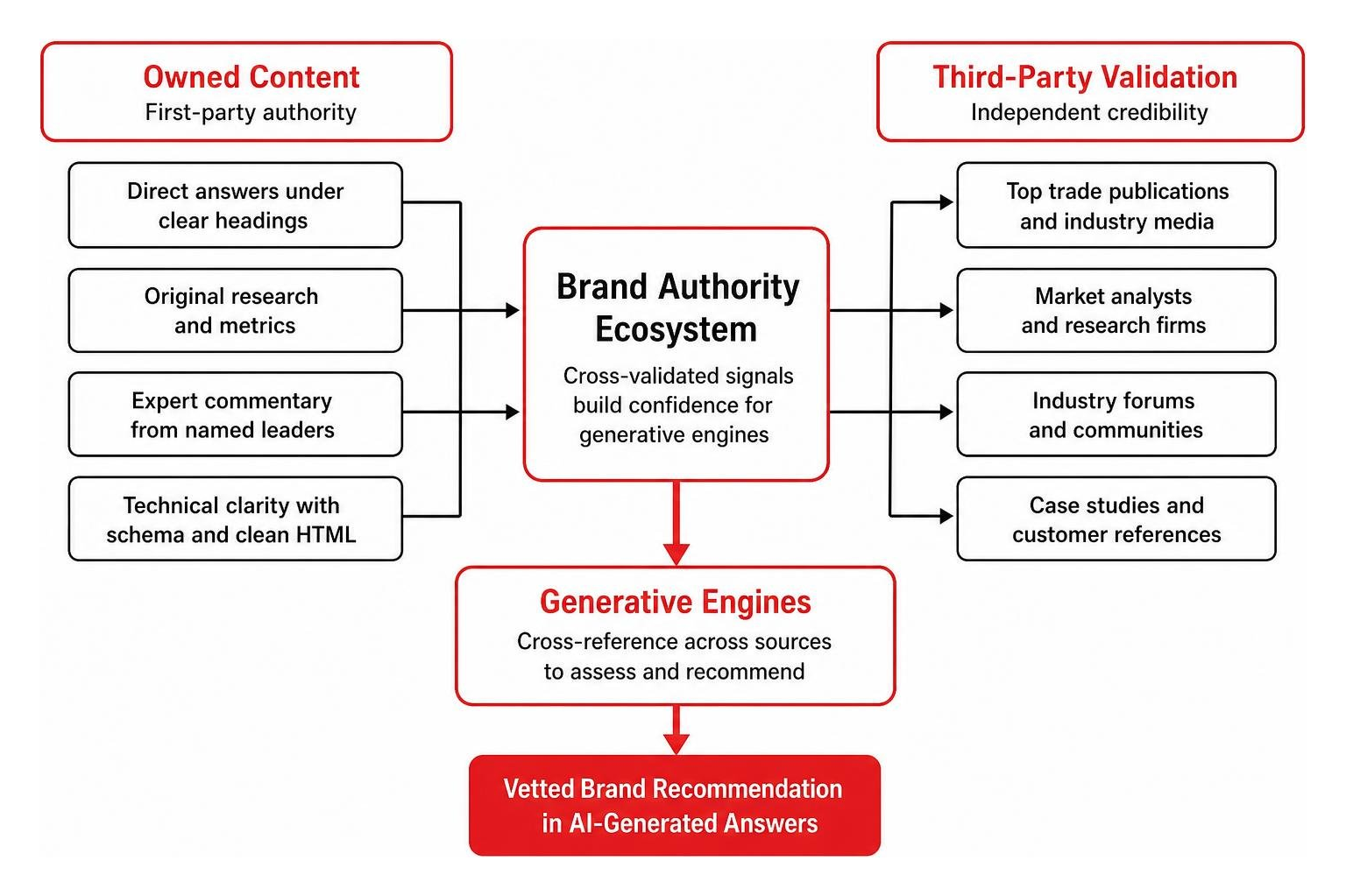
Balancing Owned Content with Third-Party Digital PR
Amplifying Content Authority Through Multi-Channel Distribution
How Do You Adapt Existing Workflows and Measure B2B GEO Success?

Step-by-Step Workflow to Implement Generative Engine Optimization B2B
Debunking Common GEO Myths and Ineffective Hacks
llms.txt Files: Major search engines and enterprise AI grounding systems rely on standard web crawling protocols, robots meta tags, and verified search indexes rather than special text files.Frequently Asked Questions About B2B Generative Engine Optimization
Does generative engine optimization replace traditional B2B SEO?
How do you track ROI and pipeline from AI search citations?
chatgpt.com or perplexity.ai), review generative search metrics in Google Search Console, and use closed-loop CRM tracking. Adding a qualitative “How did you hear about us?” field on lead forms helps capture zero-click buyers who researched your brand via AI tools before navigating directly to your website.How long does it take to see results from B2B GEO?
Conclusion: Building Your AI-Era Pipeline Engine

Keep reading