

How to Choose Generative Engine Optimization Services
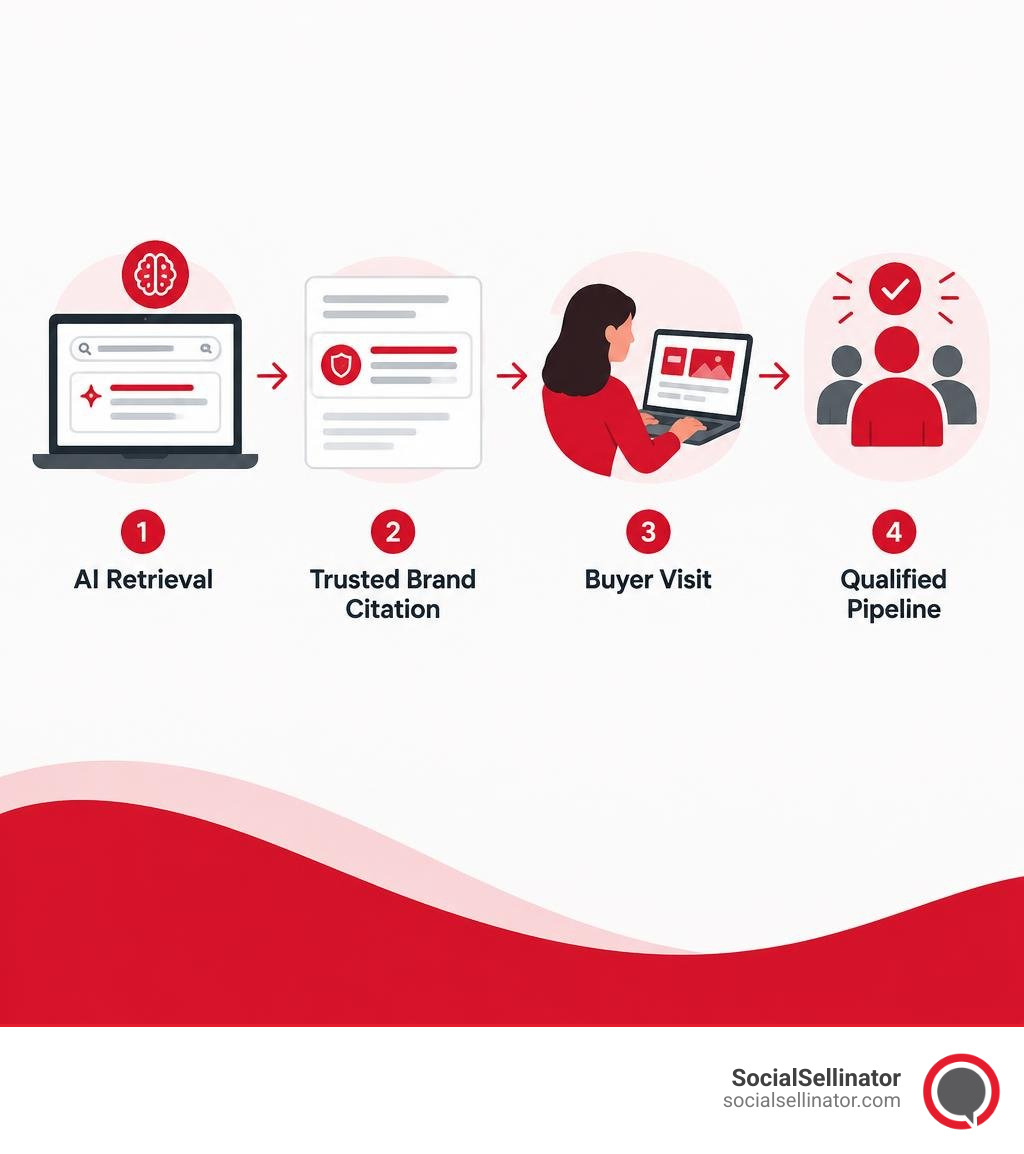
Generative engine optimization services help your company become a source that AI tools can find, trust, and use in answers to buyer questions. When choosing a partner, ask how they will audit your current visibility, improve your site’s technical access and content, check what other sources say about your brand, and connect results to qualified pipeline.
For an enterprise team, a list of AI mentions is not enough. You need to know which buyer questions bring up your company, whether the answers are accurate, and what happens when those buyers reach your site.
I’m Jock Breitwieser, and this guide will help you judge GEO partners by the work they do and the outcomes they measure.
Key Takeaways
- Enterprise GEO is a program, not a report. A strong partner covers audit, technical access, content, source work, governance, and measurement.
- Retrieval readiness comes first. If AI systems cannot crawl and read your pages, they cannot cite you.
- Entity Authority decides who gets used. Models favor brands they clearly understand and consistently see as experts.
- Source diversity matters. Reviews, forums, and verified data shape answers as much as your own site, so one source is a thin safety net.
- Measure pipeline, not just mentions. AI answers can satisfy a query without a click, so you need attribution beyond traffic.
Table of Contents
- What is GEO, and how does it differ from traditional SEO?
- What should enterprise generative engine optimization services include?
- How can you audit AI visibility and connect it to pipeline?
- Which GEO service capabilities fit enterprise, mid-market, and small businesses?
- How can brands build durable AI visibility across the Source Stack?
- Frequently Asked Questions About Generative Engine Optimization Services
- Conclusion
What is GEO, and how does it differ from traditional SEO?
GEO is the practice of making your brand easy for AI systems like ChatGPT, Gemini, Perplexity, and Google AI Overviews to find, understand, and mention in generated answers. Traditional SEO tries to win a ranking position for a page. GEO tries to win a place inside the answer itself.
The difference comes from how the systems work. Organic search is largely deterministic: a query matches an index, and pages are ordered. AI answer engines use probabilistic synthesis. They pull from several sources, weigh them, and write a fresh response. You are no longer the most optimized link; you are aiming to be the most probable answer. Queries are also more conversational. Instead of “CRM software,” a buyer asks, “What is the best CRM for agencies under 50 people?”
The good news is that GEO builds on SEO. Google’s own guide to AI features in Search says that the same foundational practices apply: helpful content, crawlable pages, and good page experience. That is why we treat our SEO services and modern SEO strategies as the foundation, not something to throw away.
| Area | Traditional SEO | GEO |
|---|---|---|
| Discovery | Ranked list of links | Synthesized answer with cited sources |
| Optimization focus | Keywords, pages, backlinks | Entities, facts, source consistency, machine readability |
| Visibility signals | Rankings, impressions, clicks | Mentions, citations, sentiment, share of voice |
| Measurement | Position and traffic | Prompt-level presence, accuracy, assisted pipeline |
What should enterprise generative engine optimization services include?
A credible enterprise engagement follows a lifecycle, not a one-time cleanup. Look for these stages:
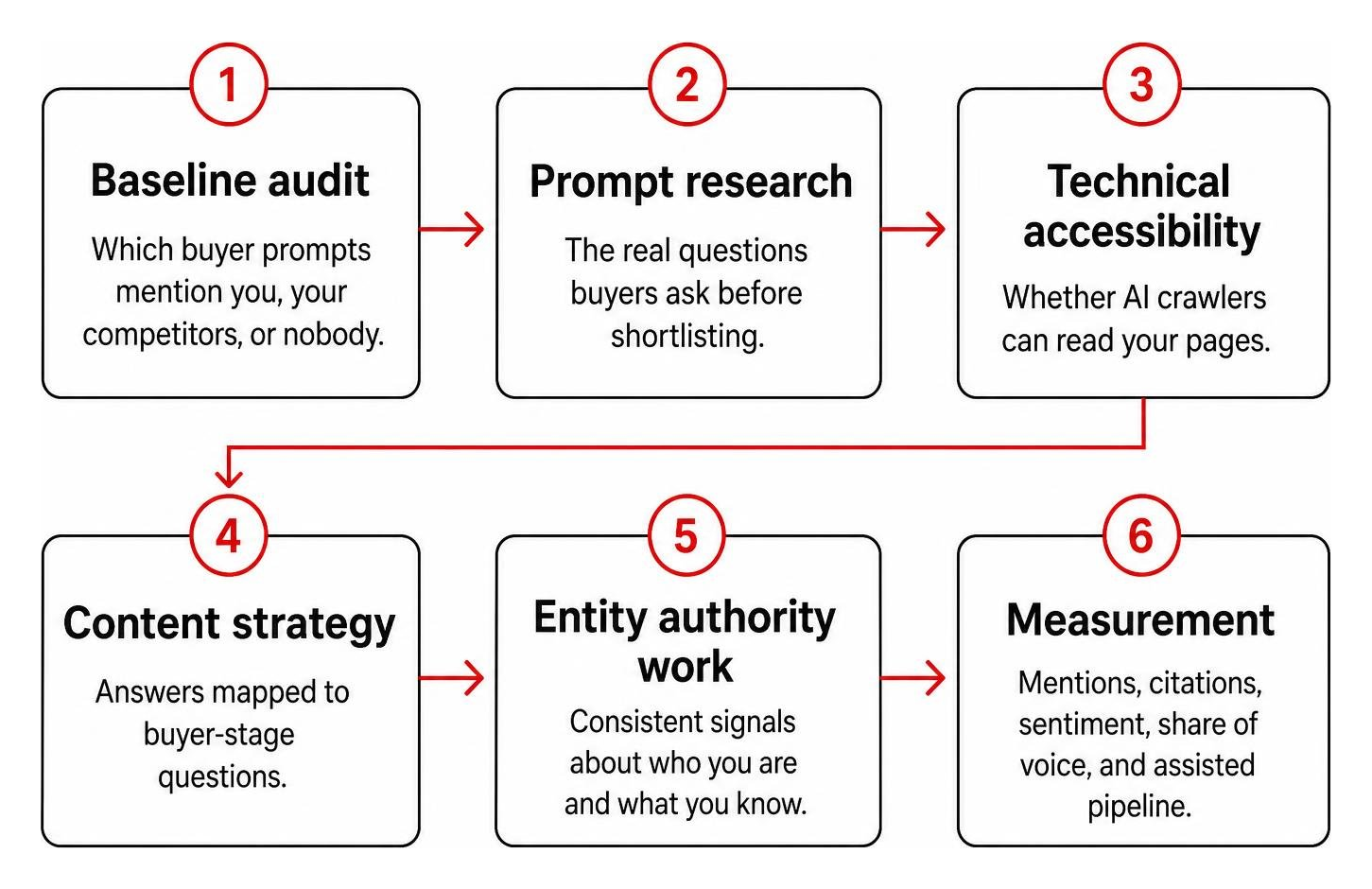
- Baseline audit: which buyer prompts mention you, your competitors, or nobody.
- Prompt research: the real questions buyers ask before shortlisting.
- Technical accessibility: whether AI crawlers can read your pages.
- Content strategy: answers mapped to buyer-stage questions.
- Entity authority work: consistent signals about who you are and what you know.
- Source monitoring: what third-party sites say about you.
- Governance: approvals, accuracy checks, and hallucination correction.
- Measurement: reporting tied to pipeline.
Large organizations also need coordination across regions, product lines, and legal teams, which is where our enterprise SEO services experience carries over.
How do generative engine optimization services improve retrieval eligibility?
They pass what we call the Retrieval Gate. Many AI answers use retrieval-augmented generation (RAG), meaning the system fetches content before writing. If it cannot read you, it cannot mention you. A partner should check:
- Crawlability and indexability: no accidental blocks for the bots that matter.
- Rendering: key content visible without heavy scripts. A page that looks gorgeous to humans can be a mess to a machine.
- Structured data: clean JSON-LD for organization, product, and article details. Google’s introduction to structured data explains how it helps systems understand page content.
- Site architecture: logical hierarchy and internal links.
- Freshness: current pricing, specs, and help content, so models do not repeat stale facts.
- llms.txt: an optional, emerging file, covered below.
Much of this starts with a solid technical SEO analysis.
How do generative engine optimization services build Entity Authority?
They help you clear the Synthesis Gate, where the model decides whether to use you in the final answer. Entity Authority is how well an AI understands your brand’s link to a topic and sees you as a credible expert. A brand might rank for “best moisturizer” yet be tied by knowledge graphs to “budget skincare” instead of “dermatologist-recommended.” That mismatch is an authority problem, not a keyword problem.
Partners build it through consistent naming and descriptions everywhere, topic clusters that show depth, expert-led pages, direct factual answers, and thoughtful internal links. Content should add information gain: something new, such as original data or practitioner detail, rather than a rewrite of what already exists. Our SEO content marketing work follows this approach.
How can you audit AI visibility and connect it to pipeline?
Start with a fixed set of prompts, run them across ChatGPT, Gemini, Google AI Overviews, and Perplexity, and record whether you appear, how you are described, and which sources are cited. Then connect those findings to what happens on your site and in your CRM.
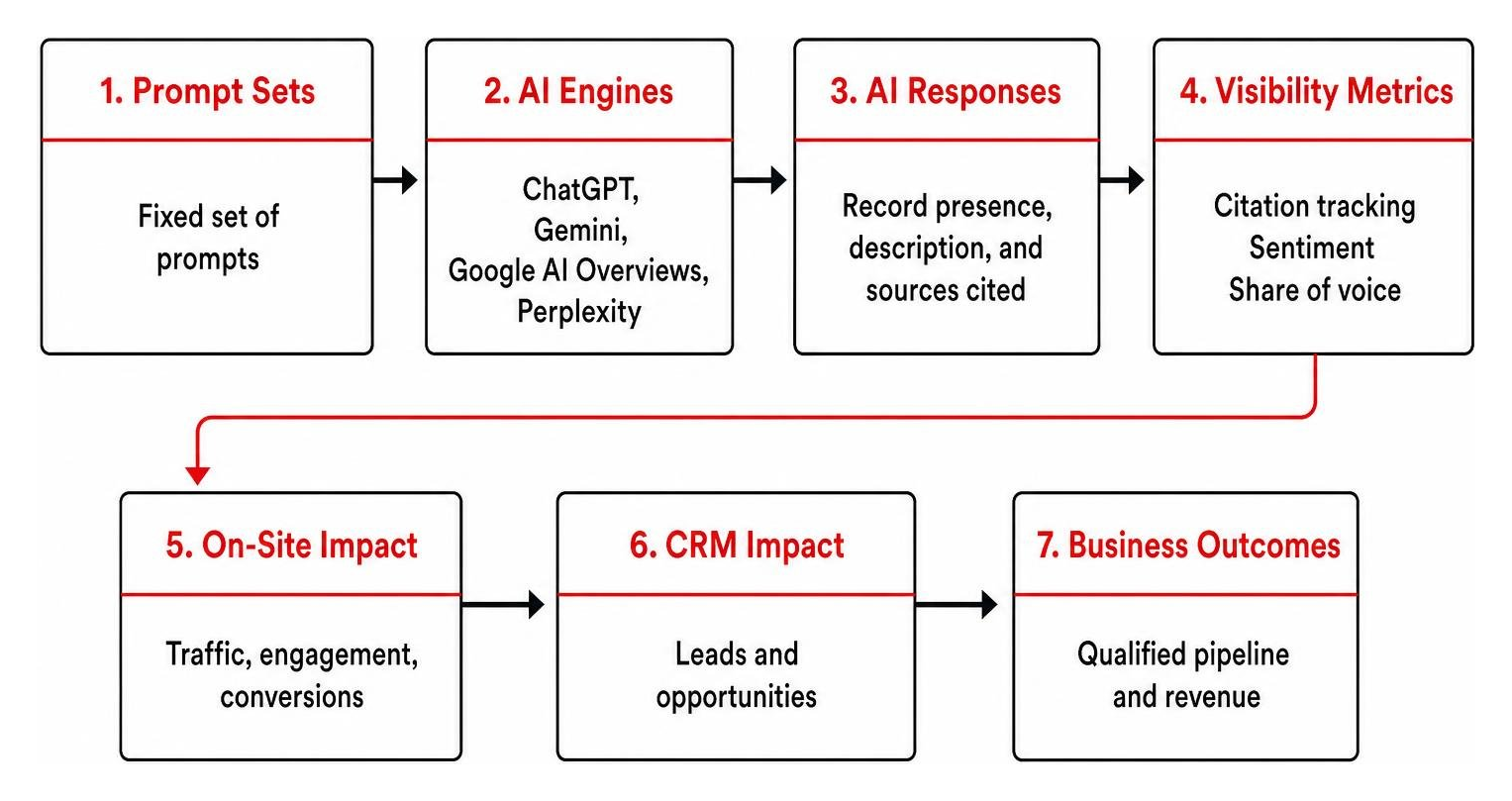
Track these measures:
- Citation tracking: which URLs and third-party sources are named.
- Sentiment: tone matters more than raw mention counts.
- Share of voice: your presence against competitors for the same prompt set.
- Mention velocity: how quickly mentions grow or shrink.
- Branded search and direct traffic: common signs of zero-click influence.
- CRM attribution: self-reported “how did you hear about us” fields, plus assisted conversions and qualified pipeline.
This matters because clicks are shrinking. A Pew Research Center analysis in 2025 found that users were less likely to click links when a Google AI summary appeared. Fewer clicks do not mean zero value, though. AI-referred visitors are often pre-qualified by the answer, and some reports suggest they convert at a much higher rate than classic search traffic. Treat any such figure as directional until your own data confirms it. Honest partners will say that correlation is not proof, and design tests accordingly.
How should e-commerce teams audit AI visibility by SKU and category?
Audit at two levels. Category prompts (“best standing desks for small offices”) show whether you are in the consideration set. SKU prompts show whether the right product, price, and availability appear. Review product feeds, attributes, and product schema, then sample answers and note citation sources and competitor gaps.
| Signal | SKU-level audit | Category-level audit |
|---|---|---|
| Prompt type | Specific product or model questions | Broad “best for” and comparison questions |
| Accuracy checks | Price, availability, specs | Brand positioning and description |
| Sources to review | Product pages, feeds, reviews | Roundups, forums, comparison sites |
| Main gap to find | Wrong or missing product data | Competitors cited instead of you |
Why does AI visibility fluctuate, and how can teams manage it?
AI visibility moves because models update, prompts vary, retrieval picks different sources, and new sentiment gets ingested. Single snapshots mislead.
Manage it like weather, not like a scoreboard:
- Sample each prompt repeatedly, not once.
- Use trend windows, such as four to eight weeks, instead of day-to-day readings.
- Flag anomalies and check whether a model update or source change explains them.
- Review sentiment alongside presence.
- Compare against a fixed baseline.
Which GEO service capabilities fit enterprise, mid-market, and small businesses?
Match the capability to your size and operating needs. GEO tooling generally falls into enterprise intelligence, competitive intelligence, hybrid SEO/GEO suites, technical optimization, reputation monitoring, and content execution.

| Business size | Typical capabilities | Use case | Operating needs |
|---|---|---|---|
| Enterprise | Enterprise intelligence, competitive tracking, governance | Multi-region, multi-product visibility | Dedicated team, approvals, CRM integration |
| Mid-market | Hybrid SEO/GEO suites, technical fixes, reputation monitoring | Category leadership and pipeline growth | Shared owner, monthly reporting |
| Small business | Manual prompt tracking, free platform tools, focused content updates | Local or niche authority | One owner, light weekly routine |
How can brands build durable AI visibility across the Source Stack?
The Source Stack is the set of sources AI models lean on as ground truth. Think of three tiers: verified data banks and knowledge graphs at the top, community and review platforms such as Reddit, forums, and review sites in the middle, and brand-owned documentation and authoritative pages at the base. Models favor high-trust sources to avoid hallucinations and human-first content to avoid training on their own output.
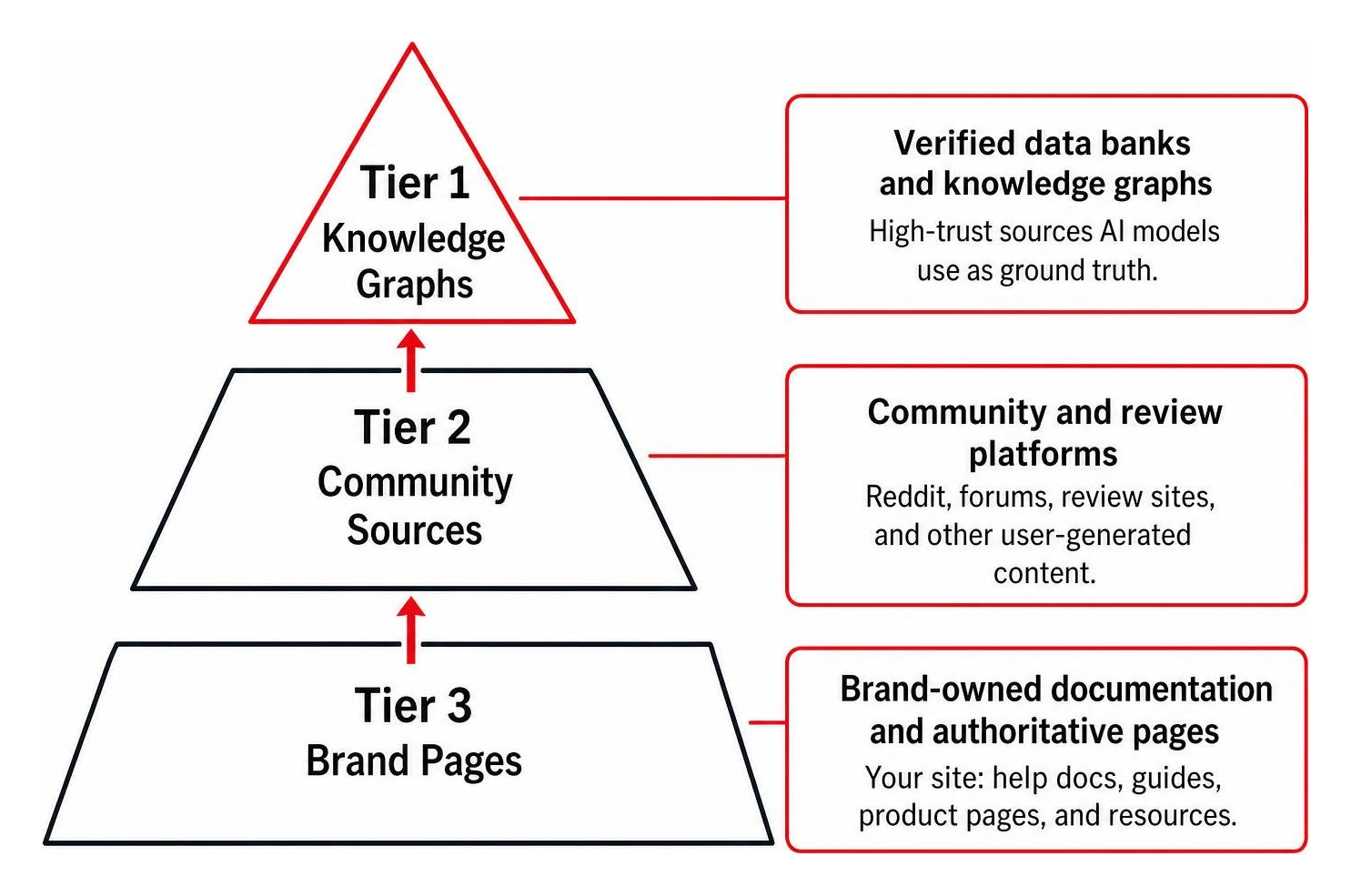
So your own site is only one voice. A good partner traces which forum threads, reviews, and data sources shape answers about you and your competitors. One brand, for example, found a rival’s strength traced to one high-authority Reddit thread and redirected its community effort there. Another caught an AI tool citing outdated pricing and fixed it with a clear, structured help page.
Keep content human-first, factual, and consistent, with conversational answers that respond directly to questions. Our guidance on SEO article writing applies here. As agents begin to shop and research for people, machine-readable product data matters more.
Why do verified reviews and user-generated content matter to AI answers?
Reviews carry experience, which models cannot invent. They reveal product attributes, recurring themes, and sentiment in customers’ own words. Verified-purchase signals add trust. For governance, collect reviews with consent, moderate for authenticity, never fake or incentivize dishonestly, and respond to recurring complaints. Source diversity matters: reviews, forums, and your own pages that agree with each other give models a stronger basis to ground an answer.
What is llms.txt, and should a business implement it?
llms.txt is a proposed markdown file, placed on your site, that lists your most useful pages for language models. Think of it as a tidy directory, not a gatekeeper. Unlike robots.txt, which tells crawlers what they may access, it offers guidance on what to prioritize. Adoption is still emerging, and no major AI provider has promised it boosts citations. Our view: it is cheap, harmless, and useful for agent discovery, so add it after the fundamentals, and test that it loads correctly. Do not pay a premium for it.
Frequently Asked Questions About Generative Engine Optimization Services
How long does it take to see results from GEO services?
Expect a baseline period of several weeks first, because volatility makes early readings noisy. Technical and content changes often take one to three months to implement, and citation changes appear gradually as models re-crawl and sources update. Business outcomes like qualified pipeline usually take longer. Be wary of anyone who promises overnight citations.
Can small businesses improve AI visibility without enterprise tools?
Yes. Manually sample 20 to 30 buyer prompts monthly and record results in a spreadsheet. Keep business profiles accurate, collect genuine customer reviews, publish focused FAQs that show local expertise, and publish consistently. Our guide to digital marketing for small businesses is a good starting point.
How should a business choose a GEO services partner?
Ask for specifics:
- Audit methodology: how prompts are chosen and sampled.
- Platform coverage: ChatGPT, Gemini, Perplexity, and AI Overviews.
- Source analysis: whether they study third-party sources, not just your site.
- Technical capability: can they fix rendering, schema, and architecture?
- Reporting and attribution: do they connect visibility to CRM and pipeline?
- Governance: how they handle accuracy, approvals, and corrections.
- Transparent scope: clear deliverables and no guaranteed rankings.
A consultant’s depth also matters; see what to look for in a search engine optimization consultant.
Conclusion
The right partner helps you get found in AI answers, build trust with sources that agree about you, and tie it all to pipeline. At SocialSellinator, that is our focus: establish your visibility baseline, build buyer-intent content, strengthen Entity Authority, and measure qualified pipeline. If you want to see where you stand, explore our AI search optimization services and let’s find the questions your buyers are already asking.