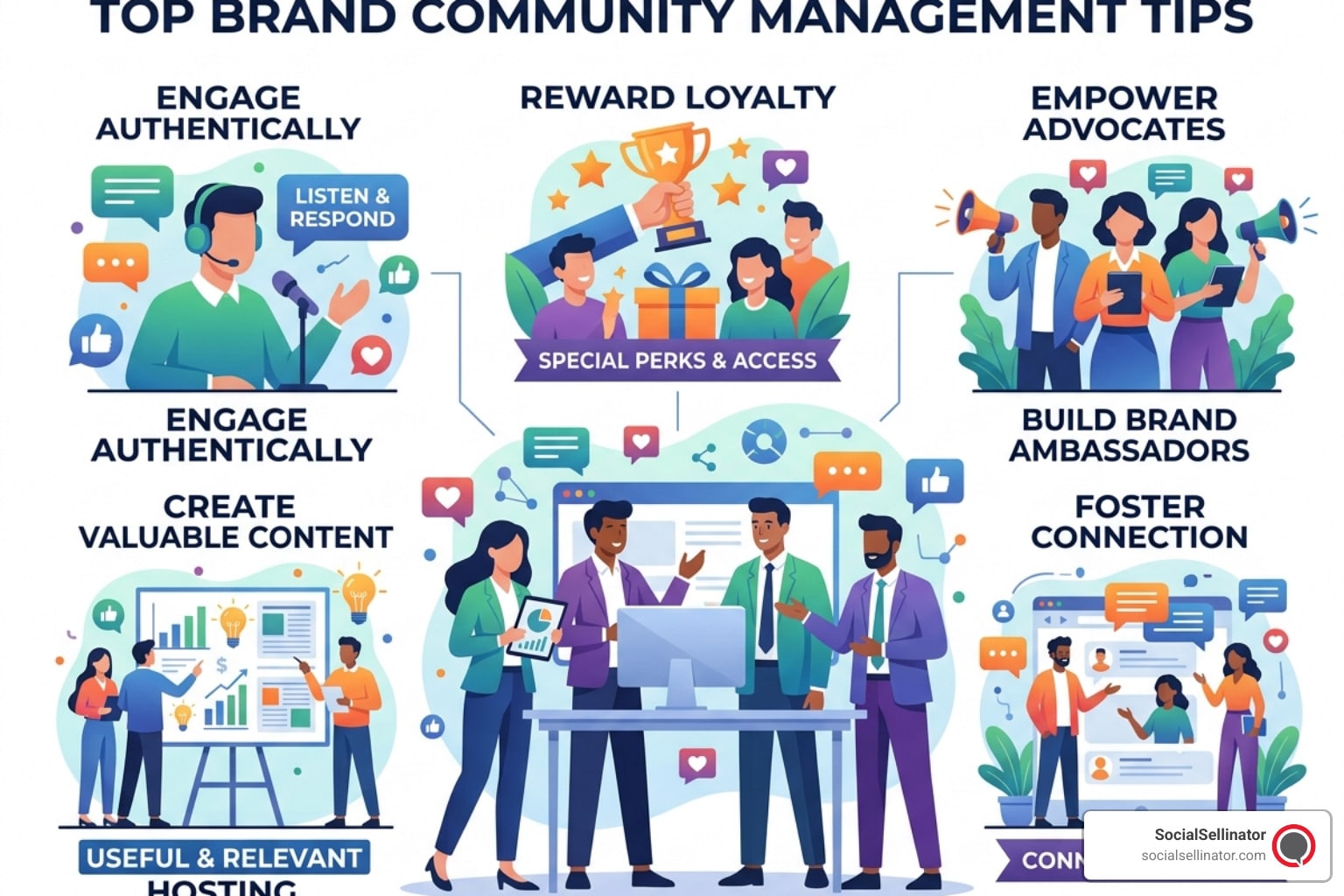

Why SaaS Brand Fan Communities Are Now a Core Growth Strategy
A community gives SaaS users a place to exchange advice about the product.
Here’s why that matters for you right now:
What is a SaaS brand fan community?
A SaaS brand fan community is a group of active users, advocates, and enthusiasts who gather on a shared platform to learn from each other, solve problems together, share feedback, and champion the product they love. It goes well beyond a support ticket queue or a social media following.
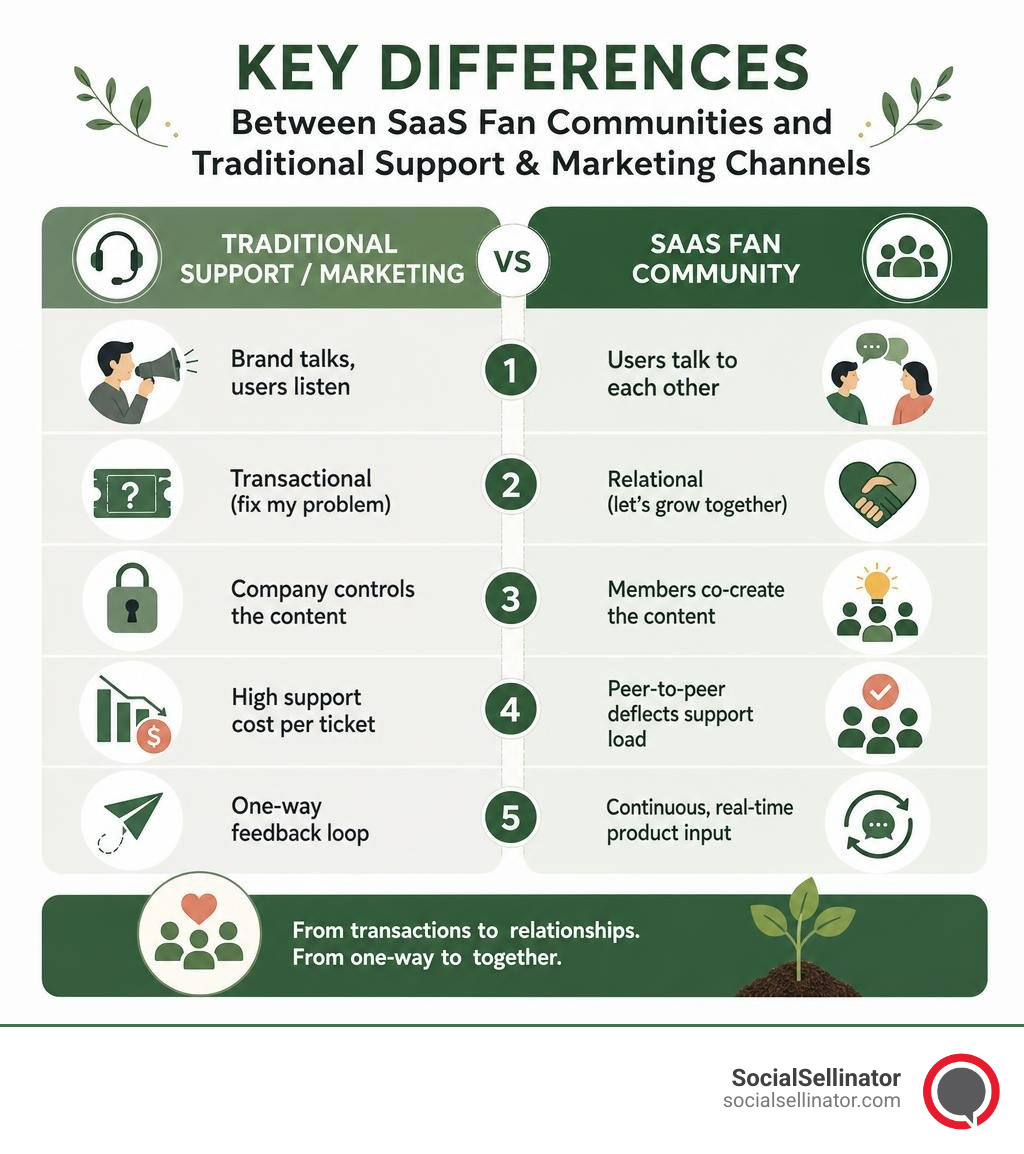
How it differs from traditional channels:
| Traditional Support/Marketing | SaaS Brand Fan Community |
|---|---|
| Brand talks, users listen | Users talk to each other |
| Transactional (fix my problem) | Relational (let’s grow together) |
| Company controls the content | Members co-create the content |
| Support cost per ticket | Members can answer one another’s questions |
| One-way feedback loop | Members can suggest product changes |
This guide walks you through exactly how to do the same.
SaaS brand fan communities basics:
- brand community management tips
- future trends brand communities
Understanding the Power of SaaS Brand Fan Communities
To understand why a dedicated community is so transformative, we have to look at how it reshapes the customer lifecycle. In traditional software marketing, the relationship between brand and customer is often transactional. The customer buys the software, uses it, and turns to customer support mainly when something breaks.
An active brand community can change this dynamic: it gives customers another place to stay in touch after a purchase.
When a new user joins your community, invite power users, advocates, and experienced peers to show them how to complete their first task.
Peer-to-peer support is part of this ecosystem. Instead of your customer support team answering every single basic question, let community members answer routine questions, and make it easy to escalate unresolved issues to support staff.
Invite highly engaged members who find a workflow useful to share it on social media, recommend your software to their colleagues, or write a review. If you want to dive deeper, check out our guide on How to Turn Your Brand Community into a Raving Fanbase.
How to Launch SaaS Brand Fan Communities from Scratch
Launching a community from a blank slate can feel daunting, but success comes down to careful planning and a deep understanding of your users. You can’t simply build a forum, invite everyone on your email list, and expect magic to happen. You must start with a clear, targeted strategy.
First, you need to define your target audience and identify who your founding members will be. These are your most passionate early adopters: the ones who already send you detailed feedback, mention you on social media, or use your tool daily. To map out these ideal community members, we highly recommend utilizing structured Social Media Buyer Personas to understand their motivations, professional challenges, and daily routines.
Once you know who you’re building the community for, you must select the right platform. While third-party networks like Facebook Groups or Reddit are easy to set up and have built-in audiences, they come with significant drawbacks, such as algorithm changes and a lack of custom branding.
For a SaaS brand community, you might consider a dedicated platform that allows for white-labeling. White-labeling can make your community platform look and feel like a natural extension of your product. Before selecting a community platform, check its branding options, member-data export rights, privacy terms and limits on how you may use the data. Where those terms allow it, you can use the data to track user behavior, run analytics, and feed community insights into your product development pipeline.
How Community Can Complement Sales-Led and Product-Led Growth
SaaS go-to-market strategies include sales-led growth (SLG) and product-led growth (PLG). Sales-led growth relies on sales teams to help prospects evaluate software and close deals, while product-led growth uses the product itself to let prospects try it directly. Either approach can include peer support.
Community-led growth (CLG) places the community at the center of your growth engine and can complement both models. For example, invite trial users to ask existing customers how they use the product.
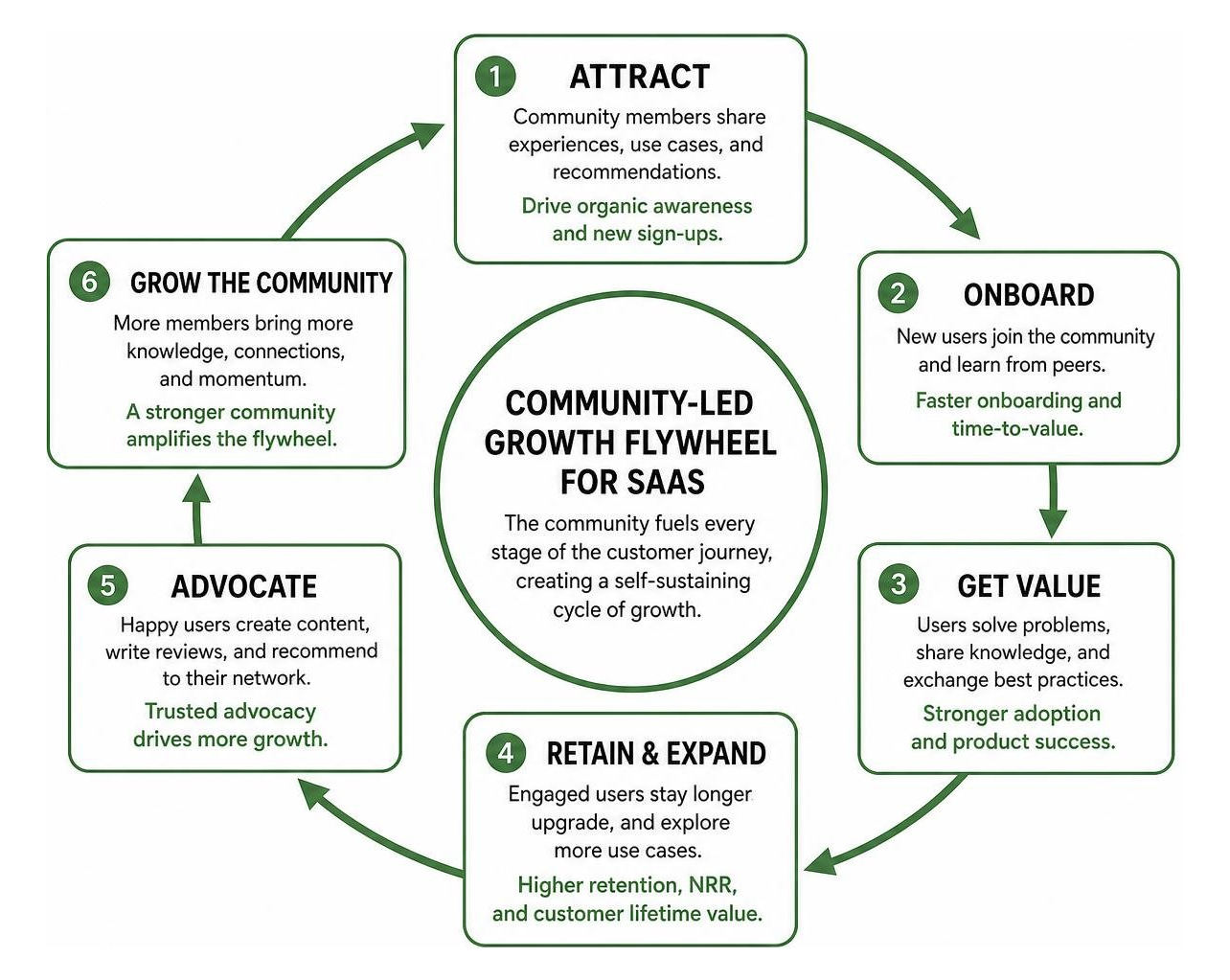
In a community-led model, members may refer prospective customers by sharing their experiences, templates, and use cases with their networks. Compare referral costs and conversions with those of other channels. Ortto’s guide to community-led product growth offers a breakdown of how SaaS communities contribute content, feedback, and trust that can support new sign-ups.
Renewals, upselling, and expansion can contribute to a customer’s lifetime value (LTV) after the initial purchase. To see whether community-led growth affects net revenue retention (NRR) and LTV, compare retention and expansion across customer groups before attributing a change to community participation.
When customers are active in a brand community, member discussions can introduce them to new use cases, advanced workflows, and unfamiliar features. Track adoption and renewals separately to see whether either changes. For related reading, see The Top Advantages of a Seriously Strong Brand.
Integrating Content Strategy with SaaS Brand Fan Communities
A successful SaaS community is fueled by valuable, relevant content. However, the days of brands broadcasting corporate blog posts to a passive audience are long gone. Today, the most effective community content strategy is built on collaboration and authenticity.
User-generated content (UGC) is content your members create. When your members share their custom templates, write step-by-step tutorials, or record video walkthroughs of their setups, they show other users how they work.
Our role as community builders is to facilitate, highlight, and reward this user-generated content. We can do this by creating dedicated resource hubs, running content creation contests, or offering exclusive rewards for members who share their expertise. To build a comprehensive framework for this, consult our Ultimate B2B Content Marketing Guide.
Organic social media plays a key role in bringing external audiences into this content loop. By sharing community wins, member spotlights, and user-generated templates on platforms like LinkedIn and X (Twitter), you show the active human ecosystem behind your software and build thought leadership by facilitating a space where professionals solve real problems together.
Actionable Tactics to Embed Co-Ownership in Your Community
One way to move from a simple engagement group toward a more dedicated fan community is to build a sense of co-ownership. Give members a say in the agenda by asking them to propose topics or host discussions.
But how do you build this sense of co-ownership? Give members a clear path to influence: ask them which decisions they want to influence, and show them what changed because of their input.
Here are twelve highly actionable tactics to embed co-ownership in your community:
- Create Peer Support Roles: Recruit active members to serve as official “Support Guides.” Equip them to help newer users navigate the product and the community before issues are escalated to your internal staff.
- Establish a Roadmap Council: Invite your most active power users to join an exclusive, invite-only council where they get direct access to your product managers and founders to discuss future features.
- Design a Visible Path to Influence: Make it clear how a new member can progress from a passive observer to an active contributor, and eventually to a recognized community leader.
- Reward Contribution with Advisory Roles: Give your top contributors official advisory status, offering them early access to beta features and direct influence over key decisions.
- Run Member-Led Product Education Sessions: Encourage your expert users to host live training sessions, webinars, or workshops for the rest of the community.
- Publish Transparent Support Wins: Regularly share how community feedback has directly resolved product bugs or shaped recent updates, giving credit to the specific members who flagged them.
- Build a Community-Sourced Knowledge Base: Let your members write, edit, and maintain help articles, creating a highly practical, user-driven resource library.
- Let Members Vote on Community Improvements: Run regular polls letting the community decide on platform upgrades, new channels, or the types of events they want to see.
- Celebrate Impact-Based Contributions: Move away from generic badges. Instead, publicly celebrate and reward contributions that have had a measurable impact on other members.
- Invite Members to Shape Onboarding: Ask your long-term community members to help design and test the onboarding experience for new users joining the platform.
- Provide Event Funding and Swag: Support local, member-led meetups by providing official event funding, promotional assets, and custom brand swag for hosts and attendees.
- Tag Contributors in Product Release Notes: Whenever you release a feature or fix a bug that was requested by the community, publicly tag and thank those contributors in your official release notes.
How Industry Leaders Structure and Nurture Their Fanbases
To see these strategies in action, here are examples of how software companies have organized their communities.
Notion
Ortto recounts that Notion hired fan-site operator Ben Lang as Head of Community, helped ambassadors fund event venues and invited them to give product feedback.
Figma
Ortto described Figma Community as a place where designers could share templates through their profiles and find resources such as plugins and wireframes.
Surfer SEO
Ortto reported that Surfer SEO’s private Facebook group had grown past 10,000 members. Separately, Surfer Academy offered live training.
Roam Research
Ortto reported that Roam Research’s help section featured articles and videos from users and that a directory pointed readers to public graphs.
Salesforce
Salesforce’s Trailblazer community is another example of a community around a software platform.
Key Metrics to Measure the ROI of Your Community Efforts
Building a community is a long-term investment, and to justify that investment to stakeholders, you must track the right metrics.

When measuring the health and financial impact of your community, focus on these key performance indicators (KPIs):
- Engagement Rate: The percentage of community members who actively participate (post, comment, react, or attend events) within a given timeframe, rather than just passively reading.
- Active Members: The total number of unique users who log in and interact with the community platform weekly or monthly.
- Net Revenue Retention (NRR): Compare net revenue retention for comparable cohorts of community members and non-community members over the same period. A difference between members and nonmembers does not establish that participation caused it.
- Referral Acquisition Cost: Track how many new sign-ups or demo requests originate from community referrals, organic word-of-mouth, or member-shared content, then divide the costs assigned to community referrals by the number of new customers attributed to those referrals over the same period.
- Support Ticket Deflection: Ask whether members found an answer through peer-to-peer discussions or community-created help articles that avoided a support request; report the result as an estimate.
- Feedback Loop Efficiency: Track how quickly product bugs are identified, reported, and resolved thanks to real-time community flagging, compared to traditional support channels.
Overcoming Common Challenges in Community Management
While the benefits of a SaaS community are clear, building and managing one comes with distinct challenges.
One of the most common risks is platform dependency. If you build your entire community on a third-party social network, you are at the mercy of their algorithm changes, policy updates, and potential downtime. To mitigate this, aim to transition your core community to a brand-owned, white-labeled platform as soon as you scale past the initial testing phase.
Moderation is another critical challenge. As your community grows from a few hundred members to tens of thousands, maintaining a safe, respectful, and high-value environment becomes difficult. To scale your moderation efforts, establish clear community guidelines early on and empower your trusted power users with official moderator status and tools.
Scaling issues often arise when the community grows faster than your internal team can manage. This is where your co-ownership model becomes essential. By training peer support guides and community leaders, you can distribute the management load across your most dedicated members.
Finally, you must carefully balance community feedback with your product roadmap. Your community will have endless feature requests, but not all of them will align with your long-term business goals. Be transparent with your members. When you decide not to build a requested feature, explain the trade-offs and reasoning behind your decision. Your community will respect your transparency far more than empty promises.
Frequently Asked Questions about SaaS Communities
What is the difference between a SaaS community and a traditional support forum?
A traditional support forum usually organizes conversations around questions and fixes. A broader SaaS community can also host shared learning, networking, industry discussions, and product discussions, including for users who don’t have technical problems right now. The formats can overlap.
How do early-stage vs. mature SaaS companies approach community building?
Early-stage SaaS companies might start with a “Minimum Viable Community”: a small, focused group of early adopters or testers (for example, on Slack or Discord) where founders can interact directly with users to refine the product. As participation grows, consider whether the group needs dedicated community managers, a structured ambassador program, a different platform, or closer integration with marketing, product, and customer success.
Which platforms are best for hosting a SaaS brand community?
The best platform depends on your audience and technical needs. Choose chat (for example, Slack or Discord) for live conversation or a searchable forum (for example, Discourse) for longer-lived questions and technical Q&As. Check branding, export and integration options against your requirements before choosing a vendor.
Conclusion
Building a thriving SaaS brand fan community is not an overnight project. It requires a shift in mindset from broadcasting to facilitating, from managing to empowering, and from transaction to relationship. Choose the purpose of the community first, then track whether it helps users get answers, share ideas or refer others.
Explore SocialSellinator’s content marketing and social media management services.
SocialSellinator is headquartered in San Jose and serves businesses nationwide. It works primarily with B2B companies and also serves select B2C and local businesses.