

What Search Engine Ranking Means and Why Every Site Owner Should Care
What Search Engine Ranking Means for Your Website
The phrase search engine ranking meaning refers to where a web page appears in unpaid search results for a specific query. A page might rank third for one search and not appear for another. Rankings can also change by location and device.
A higher rank can help more people find your site, but it does not guarantee clicks or customers. Ads and features such as AI answers can appear alongside organic results, so it helps to track both your ranking and the traffic it brings. For example, a page that moves from position eight to position four may see a meaningful increase in qualified visitors, while a page stuck on page two may receive almost no organic attention even if the content is strong.

I’m Jock Breitwieser, and I’ll walk you through what shapes rankings and which numbers are worth watching. Understanding these signals is especially important for small and midsize businesses that need to turn limited marketing budgets into measurable growth.
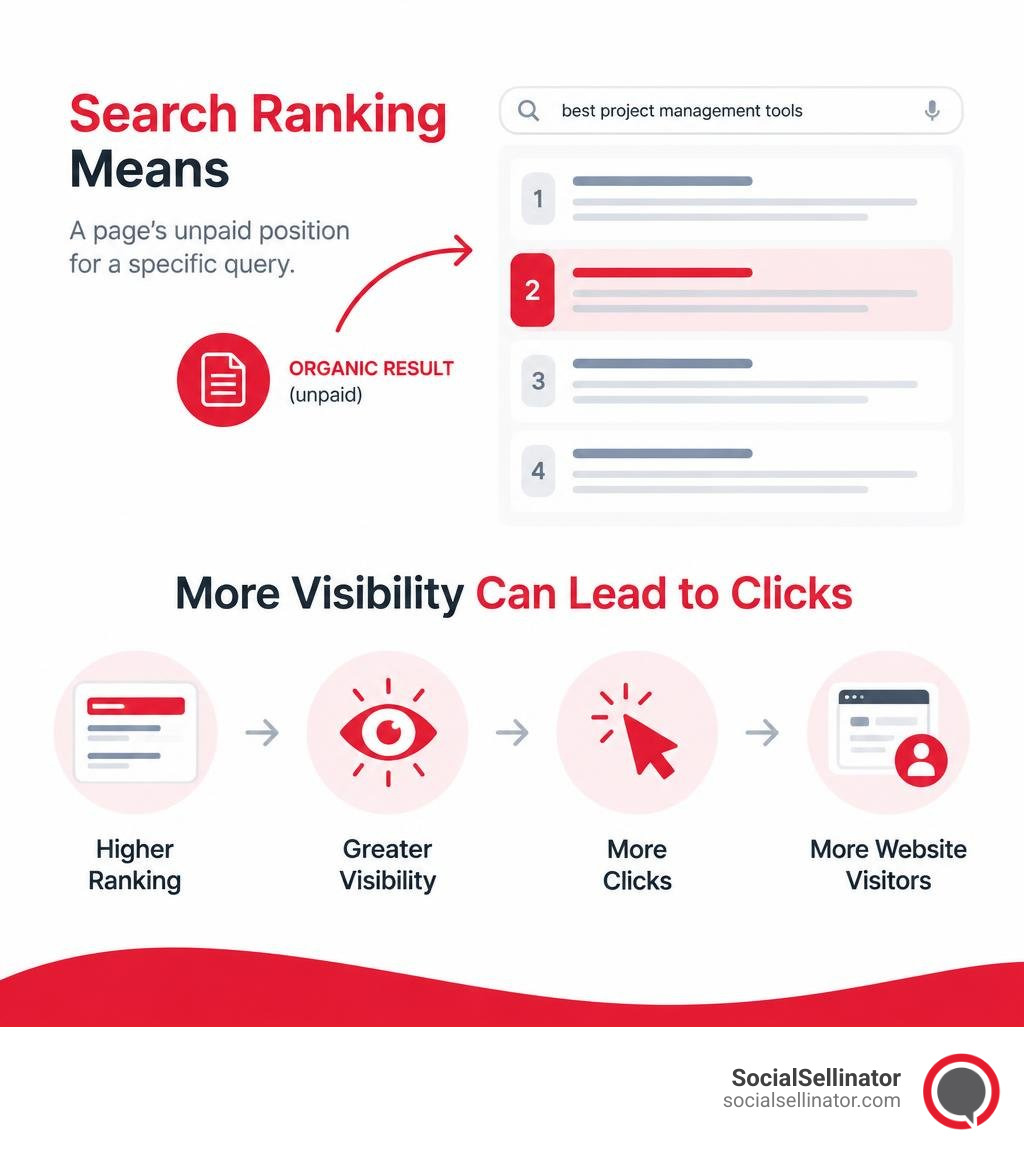
Terms related to search engine ranking meaning:
A search engine results page typically separates organic listings from paid placements, along with features like featured snippets and local packs, each playing a distinct role in how searchers find and trust a website. For a deeper understanding of how search engines evaluate and rank pages, exploring the core principles of search engine optimization provides vital context for your digital strategy.
Search Engine Ranking Meaning and Core Mechanics
Beneath the intuitive interface of modern search engines lies a complex computational infrastructure operating as a hyper-intelligent, round-the-clock digital librarian. With hundreds of sophisticated ranking criteria evaluated across distributed server networks in fractions of a second, deciding precisely where a URL appears on screen is an extraordinary technological feat. Every time a potential customer types a query into the search bar, automated algorithms scan vast indexes, evaluate lexical and semantic relevance, calculate domain trust, measure historical user interaction, and return an organized list of answers. These automated algorithms assess natural language models, search intent, page loading speed, mobile usability, author expertise, and contextual relevancy. Grasping the true search engine ranking meaning behind these algorithmic signals allows organizations to build effective digital marketing strategies.
Organic search visibility is never an arbitrary outcome. It is a structured, engineering-driven pipeline that traces its origins back to foundational mathematical models like PageRank, designed to connect searchers with direct solutions to their problems. When an organization’s website offers deep topical value, answers user intent thoroughly, and rests upon an accessible technical infrastructure, search engines reward that domain with premium placement. High-ranking visibility supports broader marketing objectives, including brand awareness, inbound lead generation, customer acquisition, and multi-channel attribution. When properly aligned with content marketing, targeted PPC, and ongoing digital marketing campaigns, strong organic rankings form the backbone of scalable, long-term business growth.
Understanding Search Engine Ranking Meaning in Modern SEO
In search engine optimization, a ranking represents the exact numerical position occupied by a specific web URL on search engine results pages for a given search query. Position #1 occupies the highest standard organic placement directly beneath any paid search ads or top SERP features, while position #10 sits at the base of the first page.
Earning a first-page ranking is vital for sustainable digital customer acquisition. Statistical analyses consistently show that the top three organic search results capture over half of all available clicks for any targeted search query. As listings decline toward the bottom of page one and slip to page two or page three, organic click-through rates plummet dramatically toward zero. Modern searchers rarely click past the first page because search algorithms have become remarkably proficient at satisfying search intent within the top several listings. Gaining a solid grasp of the fundamentals of SEO and its importance allows businesses to build sustainable traffic channels rather than relying entirely on fleeting marketing tactics.
Contemporary search algorithms do not merely look for exact keyword matches. Instead, they interpret entities, semantic concepts, natural conversational nuances, and overall topical depth. As machine learning models continue to advance, a web page must thoroughly explore surrounding subtopics and related concepts to maintain stable, top-tier rankings across hundreds of long-tail search variations. Modern search engines evaluate contextual relationships between ideas and the established real-world topical authority of the publishing brand.
Crawling, Indexing, and the Retrieval Pipeline
Before any web page can compete for top organic rankings, it must successfully navigate four essential stages: crawling, indexing, retrieval, and re-ranking.
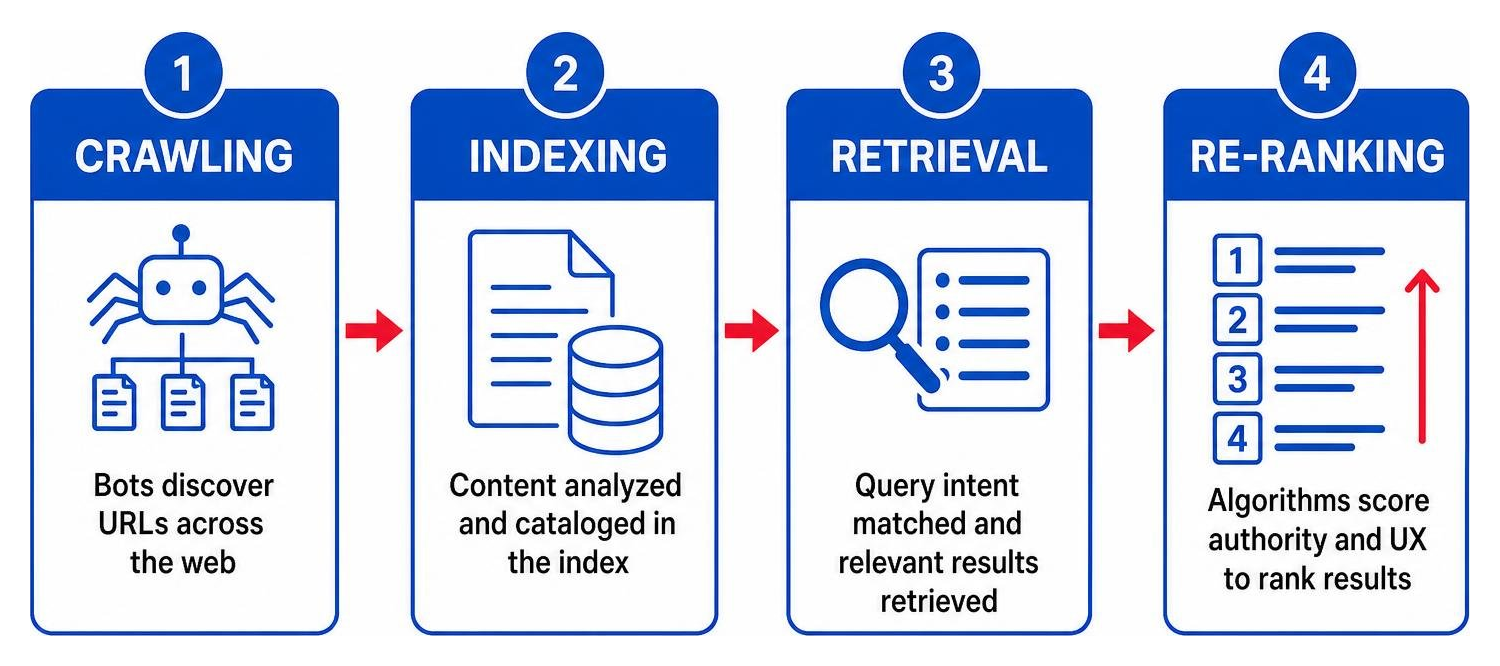
- Crawling: Automated search engine spiders traverse the internet by following hyperlinks across billions of web pages. If your site architecture contains crawl errors, broken internal paths, or misconfigured directives that block bots, search crawlers cannot discover your content.
- Indexing: After crawling a page, the search engine parses its HTML, rendered JavaScript, text copy, images, and structured metadata, storing this information in a massive database known as an inverted index. Any page not indexed cannot appear in search results under any circumstances.
- Retrieval: When a user enters a search term, the retrieval engine queries the index to pull all documents containing relevant lexical and semantic matches to the user’s inquiry.
- Re-Ranking & Scoring: Advanced deep-learning algorithms, quality filters, and historical satisfaction signals score the candidate pages to generate the final ordered ranking displayed on the search results page.
During re-ranking, search engines assess technical performance, content freshness, brand credibility, and Core Web Vitals. Sites with excessive layout shifts or slow load times are demoted in favor of faster, more reliable competitors. To explore this technical process in greater depth, review how search engines crawl, index, and rank web content to ensure your website is engineered for seamless discovery.
The Difference Between SERP Position, Organic Rank, and Paid Ads
Every result displayed on a search engine results page serves a distinct function. When users submit an inquiry, search engines present an integrated mix of organic web listings, paid advertisements, and interactive SERP features. Understanding the technical and financial differences between these placements is fundamental when designing a comprehensive, high-return digital marketing program.
| Search Result Type | Cost Structure | Visibility Position | Longevity of Results | Trust & Click Share |
|---|---|---|---|---|
| Organic Ranking | Earned (zero per-click cost) | Main body of SERP (Positions 1–10) | Long-term asset, compound growth | High user trust, ~55% of clicks in top 3 |
| Paid Search (PPC) | Pay-per-click via ad auction | Top and bottom of SERP (labeled “Sponsored”) | Immediate visibility, stops when budget ends | Captures high commercial/transactional intent |
| SERP Features | Earned via structured data & authority | Snippets, Local 3-Pack, AI Overviews | Dynamic, depends on algorithm tests | Drives zero-click answers or massive CTR jumps |
Decoding Organic Search Engine Ranking Meaning vs. Paid SERP Placement
Organic search rankings represent earned digital real estate. Businesses cannot purchase higher organic placement through financial bids; they must earn these positions by producing authoritative, topically comprehensive, and technically optimized content that satisfies user intent more effectively than competing resources. Because more than half of all measurable web traffic originates from organic search queries, organic SEO remains one of the most reliable and cost-effective digital marketing channels available for long-term growth.
Paid search advertising (PPC), by comparison, operates on an instantaneous auction system where advertisers bid on specific keywords. Each time an interested buyer clicks a sponsored ad listing, the business pays a predetermined fee. While paid advertising delivers immediate first-page visibility, ad traffic disappears the moment advertising budgets are depleted or paused.
Combining organic SEO strategies with targeted paid advertising creates a powerful, integrated digital marketing strategy. While PPC campaigns capture immediate high-intent transactional queries and test conversion messaging, organic search optimization establishes compounding brand equity that delivers prospective leads for years without ongoing per-click costs. Furthermore, top-ranking organic positions generate psychological credibility, as consumers inherently perceive organic search leaders as trustworthy industry authorities. To learn more about how search positions correlate with overall performance, explore our detailed guide on keyword SERP positioning.
SERP Features, Zero-Click Searches, and Visibility Metrics
Modern search results pages have evolved well beyond traditional blue hyperlinks into interactive digital dashboards incorporating specialized rich features:
- Featured Snippets: Prominent informational boxes positioned above the standard organic listings that provide direct, concise answers to specific questions.
- Local 3-Pack: A map-integrated module highlighting three localized businesses for queries with geographical or service-based intent (such as “digital marketing agency near me”).
- AI Overviews: Algorithmic summaries situated at the top of the SERP that synthesize multi-source answers to answer complex informational queries directly.
- People Also Ask & Knowledge Panels: Expandable FAQ modules and entity profiles that supply immediate context on related subtopics and organizations.
Because these advanced modules provide quick solutions directly within search results, zero-click searches have become increasingly common. To maximize organic visibility, organizations must structure their content with clear schema markup, concise summary paragraphs, and structured bullet lists that make it easy for search algorithms to extract and highlight key insights.
Core Factors That Determine Search Engine Rankings
Modern search engines evaluate hundreds of algorithmic ranking signals to assess the quality and relevance of web pages. Rather than attempting to manipulate individual algorithmic criteria, high-performing digital marketing and SEO campaigns focus on three foundational pillars: Relevance, Authority, and User Experience.
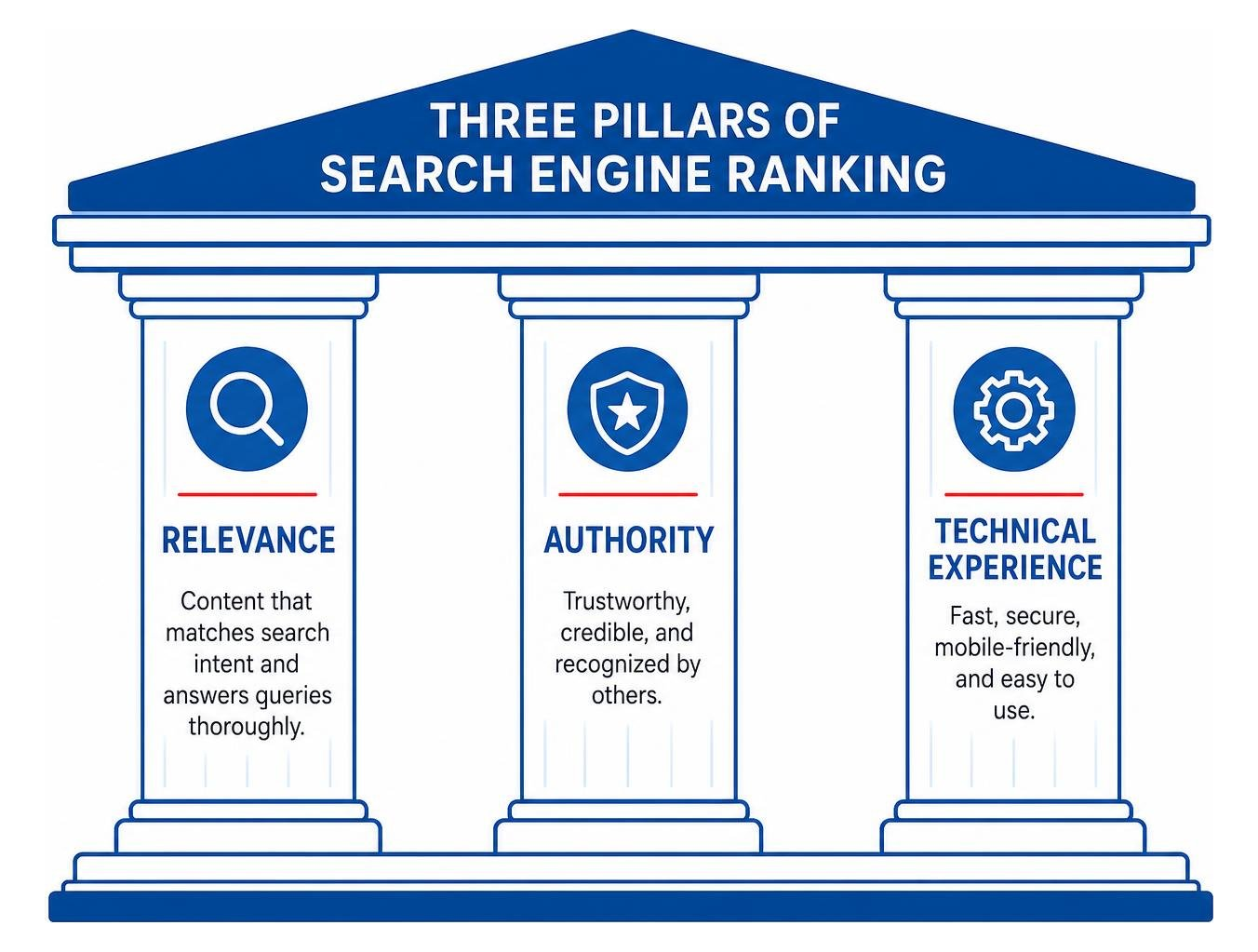
Content Relevance, Search Intent, and E-E-A-T
High-quality, helpful content serves as the cornerstone of organic search engine performance. Search algorithms actively prioritize web pages that answer search queries with exceptional depth, clarity, and factual accuracy. In-depth content consistently outperforms shallow overviews because it resolves follow-up questions and provides complete answers in one location.
Achieving true topical relevance requires aligning content with the searcher’s primary intent:
- Informational Intent: The user is seeking knowledge or troubleshooting an issue (e.g., “what is search engine ranking”).
- Navigational Intent: The searcher wants to locate a specific website, brand, or portal (e.g., “SocialSellinator client dashboard”).
- Commercial Intent: The user is comparing vendors, pricing models, or service capabilities (e.g., “best B2B digital marketing agency”).
- Transactional Intent: The searcher is ready to complete a transaction, book a consultation, or request a customized proposal.
Beyond matching query intent, search engines assess web content through the lens of E-E-A-T (Experience, Expertise, Authoritativeness, and Trustworthiness). Demonstrating first-hand industry experience, citing verifiable case studies, and featuring accredited author bios signal to search algorithms that your website is a reliable source of information. Automated search systems increasingly prioritize insights produced by verified subject-matter experts while suppressing generic, unverified summaries.
Content freshness also influences ranking sustainability. Periodically auditing and updating legacy content with modern data, fresh case examples, and refined structural subheadings signals to search crawlers that your resources remain accurate. Implementing an intentional on-page SEO optimization framework ensures your page titles, header structures, image alt attributes, and body copy communicate clearly with search crawlers and human readers alike.
Backlinks, Authority, and Digital PR
While on-page content communicates your subject expertise, external backlinks demonstrate how the wider internet views your brand. When a respected third-party website links to your content, it functions as an editorial vote of confidence that transfers equity and reinforces your overall domain authority.
Critical factors that govern link profile health include:
- Editorial Quality Over Sheer Volume: A single authoritative backlink from a well-known industry publication carries substantially more ranking weight than dozens of low-grade directory links.
- Topical Context and Relevance: Inbound links originating from websites within your specific industry niche provide strong contextual authority and drive qualified referral traffic.
- Natural Anchor Text Distribution: Using varied, descriptive anchor text maintains a natural link profile and protects your domain from algorithmic over-optimization penalties.
- Digital PR & Brand Citations: Unlinked brand mentions in major news outlets and industry publications contribute to your brand’s digital footprint and strengthen search entity recognition.
Technical Health, Page Speed, and Mobile-First Indexing
Even world-class content will struggle to rank if underlying technical deficiencies impede crawler access or create friction for mobile visitors.
- Mobile-First Indexing: Because the vast majority of web searches occur on smartphones and tablets, search engines evaluate and rank the mobile version of your site by default. A responsive, mobile-optimized design is indispensable for search visibility.
- Core Web Vitals & Load Speed: Site performance directly impacts user engagement and search rankings. Slow loading speeds cause elevated bounce rates. Optimizing Largest Contentful Paint (LCP), Interaction to Next Paint (INP), and Cumulative Layout Shift (CLS) provides a fast, stable user experience.
- Security Protocols (HTTPS): Encrypted HTTPS connections protect user privacy and are standard baseline requirements for search engine indexing and trust.
If your website suffers from sluggish loading speeds or visual layout instability, explore actionable solutions for fixing slow site performance issues to protect your organic ranking visibility.
How Long Does Ranking Take and Common Mistakes to Avoid
Organic search engine optimization is an ongoing, compounding marketing investment. Unlike paid advertising campaigns that generate instant traffic upon launching, organic search rankings require deliberate effort to build domain authority, secure quality citations, and establish consistent algorithmic trust.
Ranking Timelines for New vs. Established Domains
The timeline required to achieve top organic search rankings varies according to domain age, existing backlink authority, content thoroughness, and competitive market intensity:
- New Websites: Newly registered domains lacking historical authority typically require 6 to 12 months of consistent content creation, technical optimization, and link building before ranking on the first page for competitive keywords. Industry research shows that only a small percentage of newly published pages achieve top-ten rankings within their first year. New websites must undergo an initial algorithmic evaluation phase where search engines assess domain credibility, content consistency, and user satisfaction.
- Established Domains: Mature websites that possess established backlink authority and strong topical credibility can often rank newly published articles on page one within 2 to 3 months, particularly when supported by structured internal linking networks.
- Target Keyword Difficulty: Long-tail, low-competition search phrases can rank within several weeks, while broad, highly competitive commercial search terms require months of dedicated optimization, digital PR outreach, and continuous content enhancement.
Search algorithms frequently test new content by exposing it to small user cohorts. When visitors click your URL, spend meaningful time reading your insights, and refrain from immediately bouncing back to search results, algorithms systematically elevate your ranking position. To accelerate your organic search growth, follow these simple steps to improve your website ranking.
Costly SEO Mistakes That Destroy Ranking Visibility
Many organizations inadvertently harm their organic visibility by falling victim to common strategic and technical SEO missteps:
- Keyword Cannibalization: Publishing multiple pages targeting identical search queries confuses search engines, forcing your own URLs to compete against each other and diluting ranking authority.
- Keyword Stuffing: Repetitively forcing target keywords into titles, subheadings, and paragraphs harms readability and triggers algorithmic spam penalties.
- Unresolved Crawl Errors: Broken links, 404 error pages, redirect loops, and misconfigured
robots.txtinstructions prevent search bots from discovering and properly indexing your highest-value pages. - Low-Quality Automated Content: Publishing generic, unedited AI-generated articles lacking original thought, real-world examples, or expert analysis invites algorithmic quality downgrades.
- Poor Internal Link Architecture: Failing to connect related articles with descriptive contextual internal links prevents link equity from flowing efficiently across your domain.
- Ignoring Mobile Usability: Offering unoptimized mobile layouts with slow load times, overlapping text, or unclickable buttons leads to poor user retention and algorithmic demotions under mobile-first indexing.
To ensure your organic strategy drives sustainable, compounding results, align your execution with modern SEO optimization strategies designed for continuous pipeline growth.
Frequently Asked Questions About Search Engine Rankings
How is search engine ranking calculated?
Search engines calculate rankings using complex mathematical algorithms that analyze hundreds of variables, including content relevance, search intent alignment, domain authority, backlink quality, technical performance, and user engagement signals. The algorithm evaluates your page against billions of indexed documents to place the most helpful and authoritative resources at the top of search engine results pages.
What is the difference between search rank and organic traffic?
Search rank represents your specific numerical position on the SERP for a given keyword query (such as holding position #2). Organic traffic measures the actual volume of visitors who click your listing and browse your website. A #1 rank for a query with zero monthly searches generates no traffic, whereas a #3 rank for a high-volume, high-intent keyword can generate thousands of qualified prospective leads every month.
Can social media directly improve search engine rankings?
Social media engagement metrics (such as likes, retweets, and follower counts) do not act as direct algorithmic ranking signals. However, social media marketing supports SEO indirectly by expanding content reach, increasing brand searches, attracting referral traffic, and boosting the likelihood that industry publications and bloggers will discover and link to your content.
How often do search engine rankings change?
Search engine rankings fluctuate on a daily and weekly basis due to algorithmic updates, competitor optimizations, shifts in search trends, and the continuous indexing of new web content. Minor ranking fluctuations of one or two positions are standard across competitive queries, whereas sudden, severe ranking drops usually indicate technical crawl issues or major search algorithm shifts.
What are the most critical ranking factors for small businesses?
For small and midsize businesses, the most crucial ranking factors include a fully optimized Google Business Profile, consistent local NAP (Name, Address, Phone) citations, targeted content answering local buyer intent, positive customer reviews, clean technical SEO, and an intuitive mobile experience.
How do search engines handle duplicate content across a website?
Duplicate content occurs when identical or substantially similar text appears on multiple distinct URLs within the same domain or across multiple websites. Search engines generally do not apply a direct punitive penalty for duplicate content, but they will filter out redundant versions from search results, consolidating ranking equity to a single preferred URL. To prevent indexing confusion, webmasters should implement canonical tags (rel="canonical"), configure appropriate 301 redirects, and ensure every published page provides unique, specialized value to target users.
Conclusion
Understanding what search engine ranking means is the first step toward transforming your website into a reliable customer-generation engine. Securing top placements on Google is not about chasing elusive algorithm hacks—it comes down to matching search intent, producing authoritative content, building a trustworthy backlink profile, and maintaining flawless technical health.
At SocialSellinator, we take the guesswork out of digital growth. Our team pairs data-driven SEO with compelling content creation, targeted PPC campaigns, and comprehensive digital marketing management to help businesses increase visibility, outrank competitors, and drive measurable revenue.
Headquartered in San Jose, in the heart of Silicon Valley and the San Francisco Bay Area, SocialSellinator proudly provides top-tier digital marketing, SEO, PPC, social media management, and content creation services to B2B and B2C SMB companies. While serving businesses across the U.S., SocialSellinator specializes in supporting clients in key cities, including Austin, Boston, Charlotte, Chicago, Dallas, Denver, Kansas City, Los Angeles, New York, Portland, San Diego, San Francisco, and Washington, D.C.