

The Deep Dish Guide to On-Page SEO and Law Firm Marketing
Why On-Page SEO in Chicago Is the Foundation of Local Search Success
On-page SEO Chicago strategies are the single most controllable factor in whether your business shows up when local customers are searching — and the stakes are high. The top three organic search results capture 68.7% of all clicks, while fewer than 1% of searchers ever make it to page two.
Here is a quick answer to what on-page SEO for Chicago businesses actually involves:
On-Page SEO Chicago — At a Glance
| Element | What It Does |
|---|---|
| Title tags | Tell Google what your page is about and where you’re located |
| Meta descriptions | Encourage clicks from local searchers |
| Heading structure (H1–H3) | Organizes content so Google and users can follow it |
| Page content | Matches what Chicago searchers are actually looking for |
| URL structure | Keeps pages easy to crawl and understand |
| Schema markup | Adds structured data so search engines and AI tools can read your page |
| Image optimization | Helps pages rank in image search and load faster |
| Internal linking | Passes authority across your site and improves crawlability |
| Page speed & mobile | Critical ranking factors, especially for mobile-first Chicago users |
| Local signals | Location keywords, Google Business Profile, and neighborhood relevance |
Chicago is one of the most competitive digital markets in the country. Whether you run a law firm in the Loop, a service business in Lincoln Park, or a B2B company in the West Loop, your website has to work hard just to be seen.
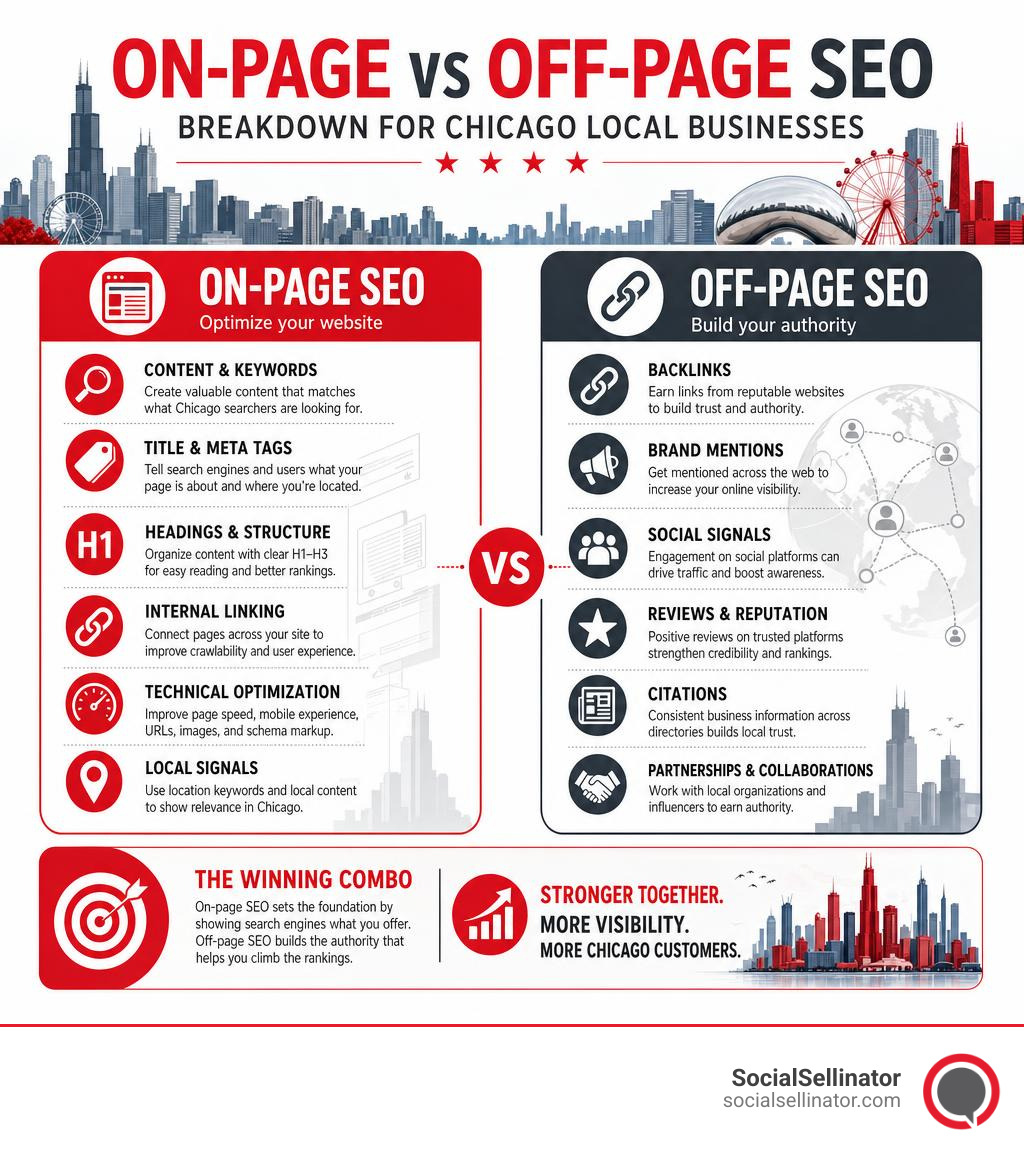
On-page SEO is everything you do on your own website to help search engines understand your content and help users trust your business. It’s different from off-page SEO — which is about building authority through backlinks and external signals. Think of it this way: on-page SEO determines what you rank for, while off-page SEO influences how high you rank.
For Chicago businesses, that distinction matters a lot. Getting the on-page fundamentals right is the prerequisite for everything else.
On-page seo chicago vocab explained:
- conversion rate optimization washington dc
- customer testimonial videos san francisco
- ecommerce marketing los angeles
Demystifying On-Page SEO Chicago: Why Local Relevance Rules the Windy City
To win in the Chicago market, we have to look beyond generic SEO advice. Chicago is a city of neighborhoods, distinct business districts, and highly localized consumer behavior. If your website treats Chicago as a single, uniform block, you are missing out on the hyper-targeted traffic that actually drives revenue.
When local customers search for services, Google uses sophisticated algorithms to match their physical location or search intent with the most relevant local providers. If your website elements do not clearly communicate your geographic and topical relevance, your business will remain invisible. This is where tailored search engine optimization becomes your primary growth engine.
For Chicago businesses, integrating your organic search efforts with your broader digital marketing strategy is essential. In fact, industry data shows that marketers who combine SEO with paid search see 25% more clicks and 27% higher profits compared to those who rely on just one method. By aligning your on-page elements with your paid campaigns, you create a cohesive digital presence that dominates both the paid and organic sections of the search results page. To discover how to align these elements for maximum visibility, read about How Site Optimization Chicago Can Help You Dominate the Local Search Results.
To truly capture the local market, working with an experienced Chicago Local SEO Company can help you navigate the nuances of neighborhood-level targeting, ensuring that your website speaks directly to the unique search patterns of Windy City residents.
Core Differences: On-Page vs. Off-Page SEO
Understanding the distinction between on-page and off-page optimization is critical for allocating your marketing budget effectively.
On-page SEO encompasses all the measures we can take directly within your website to improve its position in the search rankings. This includes optimizing your HTML tags, refining your heading structures, improving your site speed, and, most importantly, ensuring exceptional content quality. It is the structural and contextual foundation of your digital presence. When search engine crawlers scan your site, your on-page elements tell them exactly who you are, what services you offer, and which geographic areas you serve.
Off-page SEO, on the other hand, refers to actions taken outside of your own website to impact your rankings within search engine results pages. This primarily involves authority building through acquiring high-quality backlinks from reputable websites, digital PR, local citations, and social media signals.
While off-page SEO acts as a vote of confidence from the rest of the web, it is ultimately ineffective if your on-page foundation is weak. If a search engine crawler follows a high-authority backlink to your site but finds confusing navigation, slow load times, or thin content, it will not rank your page highly. For a deep dive into creating content that search engines love, explore our comprehensive guide on On-Page SEO Recommendations: How to Make Google Fall in Love with Your Content.
Why Law Firms Need On-Page SEO Chicago Strategies
In the legal sector, competition in Chicago is fierce. From personal injury attorneys in River North to corporate law firms in the Loop, every firm is vying for the same high-value clients. Legal marketing relies heavily on capturing users who are submitting high-intent queries—meaning they are actively looking to hire an attorney immediately.
When someone searches for “criminal defense attorney near me” or “best divorce lawyer in Chicago,” they are not looking for general educational reading; they need immediate, trustworthy representation. To capture these leads, your website must feature highly optimized local landing pages tailored to specific practice areas and geographic locations.
If your law firm’s landing pages are slow, difficult to navigate on a mobile device, or fail to clearly state your office locations, prospective clients will immediately click back to the search results to find a competitor. A robust on-page strategy ensures that your practice area pages are structured to answer specific legal questions, build trust through embedded client reviews, and guide users seamlessly toward booking a consultation. To build a comprehensive digital marketing strategy for your firm, explore our specialized SEO Services.
The Anatomy of a Perfectly Optimized Chicago Law Firm Page
Optimizing a webpage for a Chicago audience requires a meticulous, structured approach to both content and HTML elements. Let’s break down the essential components that make a local landing page rank highly and convert visitors into clients.
First, your title tags must be highly specific. A generic title tag like “Home – Law Firm” is a massive wasted opportunity. Instead, use a localized, keyword-rich structure such as “Chicago Personal Injury Lawyer | [Firm Name] | Loop Office.” This immediately tells both Google and the searcher your practice area, your target city, and your specific neighborhood.
Second, your meta descriptions must act as compelling ad copy. While meta descriptions are not a direct ranking factor, they directly influence your click-through rate. Write persuasive, clear descriptions that include your primary local keywords and a clear call to action, such as: “Injured in Chicago? Contact our award-winning personal injury attorneys today for a free consultation. Over $10M recovered for our clients.”
Third, a clear heading structure (H1–H3) is vital for readability and search engine crawlability. Your page should have exactly one H1 tag that outlines the primary topic, followed by logical H2 and H3 subheadings that break down specific aspects of your services. For example:
- H1: Experienced Family Law Attorneys in Chicago, IL
- H2: Our Divorce and Family Law Practice Areas
- H3: Child Custody and Visitation
- H3: Asset Division and Spousal Support
- H2: Why Choose Our Chicago Law Firm?
By organizing your content this way, you make it incredibly easy for search engine crawlers to parse your page and understand its contextual hierarchy. To ensure your site’s structure is fully optimized, consider partnering with a dedicated Local SEO Agency to audit and refine your on-page elements.
Keyword Mapping and Local Intent for Chicago Attorneys
A common mistake many businesses make is targeting broad, highly competitive keywords without considering search intent or geographic relevance. For a Chicago attorney, ranking for “lawyer” is nearly impossible and ultimately unprofitable, as it attracts searchers from across the globe who may not need services in Illinois.
Effective keyword research involves identifying localized, long-tail keywords that demonstrate clear commercial intent. Once you have identified these terms, you must map them to specific pages on your website. Each page should target a single primary keyword and a small cluster of highly related secondary terms.
For example, your homepage might target “Chicago law firm,” while your dedicated service pages target hyper-focused variations like “car accident lawyer Chicago Loop” or “estate planning attorney Lincoln Park.” This prevents keyword cannibalization—a situation where multiple pages on your website compete against each other for the same search queries, ultimately dragging down the performance of your entire site. For a complete breakdown of how to map keywords to local search intent, consult our guide, Local SEO Explained: Your Guide to Dominating Local Search Results.
Technical On-Page Factors: Speed, Mobile, and Schema
While content is undeniably important, your on-page success is heavily dependent on the technical health of your website. Google prioritizes user experience, which means technical performance issues can actively prevent your high-quality content from ranking.
Core Web Vitals are a set of specific real-world metrics that Google uses to measure a user’s experience loading a page. These metrics focus on three key areas: loading performance (Largest Contentful Paint), interactivity (First Input Delay), and visual stability (Cumulative Layout Shift). To optimize these metrics, we must implement technical enhancements such as compressing high-resolution images, leveraging browser caching, minimizing render-blocking JavaScript, and utilizing fast, reliable hosting.
Additionally, mobile-friendliness is non-negotiable. The vast majority of local searches in Chicago are conducted on mobile devices by users on the go. If your website’s layout is distorted on a smartphone, or if your contact forms are difficult to fill out on a touch screen, users will abandon your site immediately.
Finally, implementing structured data (schema markup) is one of the most powerful technical on-page tactics available. By adding LocalBusiness and LegalService schema to your website’s HTML, you provide search engines with structured information about your physical address, phone number, business hours, practice areas, and customer reviews. This makes it significantly easier for search engines to display your business in rich snippets and local search results. To get professional technical support for these elements, contact an experienced Local SEO Service Company.
Advanced Tactics: Entity Clarity, GEO, and AI Search Optimization
As search technology evolves, traditional keyword matching is being replaced by semantic search and entity-based optimization. Search engines no longer just look at the individual words on your page; they seek to understand the entities (people, places, concepts, and organizations) and the relationships between them.
For Chicago businesses, this means your content must establish clear entity clarity. When you write about your services, you should reference trusted, real-world entities. For example, instead of just saying “we are located in Chicago,” your content should mention specific landmarks, neighborhoods (like Wicker Park, River North, or Hyde Park), and local institutions. This helps search engines build a robust conceptual map of your business’s physical and professional footprint.
Furthermore, we are witnessing the rise of Generative Engine Optimization (GEO) and AI search. Platforms like Google’s AI Overviews, ChatGPT, Gemini, and Perplexity are changing how consumers find information. These platforms do not simply return a list of links; they synthesize answers from multiple authoritative sources. To stay ahead of this shift, your website must be optimized to be easily read and cited by AI engines. To understand how your website measures up against these modern search requirements, refer to our Local SEO Audits Complete Guide.
Optimizing for AI Overviews and ChatGPT Search
To make your website highly visible in AI-generated search summaries, you must adapt your content strategy to match how AI models process information. AI engines prioritize structured, highly authoritative, and direct content that answers complex, conversational queries.
When users search via AI platforms, they tend to use natural, conversational language. Instead of typing “Chicago criminal lawyer,” they might ask, “What should I do if I am pulled over for a DUI in Cook County?” To capture these queries, your website should feature dedicated FAQ sections that address these conversational questions directly.
Structure your answers clearly: state the question in an H2 or H3 heading, followed immediately by a concise, direct answer in the first paragraph. This format makes it incredibly easy for AI engines to extract your content and use it as a direct citation. Additionally, building deep brand authority through comprehensive, expert-authored articles ensures that AI models recognize your business as a trusted entity in your industry. For actionable strategies on capturing these modern searchers, read Local SEO Unlocked: Get Found by Customers Searching Near Me.
Local SEO Integration: Google Business Profile and Reviews
On-page SEO does not exist in a vacuum; it must be tightly integrated with your local search presence, specifically your Google Business Profile (GBP) and your Google Maps visibility.
To create a seamless local search experience, ensure that the Name, Address, and Phone Number (NAP) information displayed on your website matches your Google Business Profile exactly. Any discrepancies in this data can confuse search engines and harm your local rankings.
Furthermore, embedding your actual Google Maps location directly onto your contact and location pages provides search engines with additional geographic verification.
Review integration is another critical on-page element. By showcasing real, schema-verified customer reviews directly on your local landing pages, you send powerful trust signals to both search engine crawlers and prospective clients. This localized social proof directly influences your conversion rates, turning casual searchers into paying clients. To explore how to weave these local signals together, read our article on Local SEO Strategies.
Measuring Success and Avoiding Common On-Page SEO Chicago Mistakes
Implementing an on-page SEO strategy is an ongoing process of refinement, measurement, and optimization. To ensure your campaign delivers a strong return on investment, you must know how to track your success and avoid the common pitfalls that can derail your progress.
Common Pitfalls in On-Page SEO Chicago Campaigns
Even well-intentioned businesses can fall victim to outdated or poorly executed SEO tactics. One of the most frequent mistakes we see is keyword stuffing. This occurs when a website repeatedly forces target keywords into paragraphs, headings, and alt text in an unnatural way. Not only does this create a terrible user experience, but modern search algorithms are also highly sophisticated and will actively penalize websites that attempt to manipulate rankings this way.
Another major issue is duplicate content. This is especially common for businesses with multiple locations or service offerings. Creating identical landing pages where only the city name is changed (e.g., “SEO Services in Chicago,” “SEO Services in Naperville,” “SEO Services in Evanston”) signals to search engines that your site lacks unique value. Each local landing page must feature original, helpful, and hyper-local content tailored to that specific community.
Finally, ignoring broken internal links and broken redirects can severely hinder your site’s performance. When search engine crawlers encounter broken links, it wastes your crawl budget and signals that your website is poorly maintained. Regularly auditing your site’s link health is essential for maintaining strong rankings. If you suspect your site is suffering from these issues, finding a professional SEO Agency Near Me is a critical next step.
Key Performance Indicators for Law Firm SEO
To accurately measure the effectiveness of your on-page SEO efforts, you must look beyond “vanity metrics” like raw impressions and focus on Key Performance Indicators (KPIs) that directly impact your bottom line.
The most critical KPIs to track include:
- Organic Traffic Growth: Monitor the volume of visitors coming to your site via organic search results. Specifically, look at traffic growth on your optimized practice area and local landing pages.
- Conversion Rate: Track how many organic visitors take a desired action, such as filling out a contact form, calling your office, or scheduling a consultation. High traffic is meaningless if it does not convert into leads.
- Local Search Rankings: Keep tabs on where your website ranks for high-intent, localized keywords in both the traditional search results and the local map pack.
- Dwell Time and Bounce Rate: Analyze how long users stay on your pages and whether they immediately leave after arriving. High dwell times indicate that your content is valuable and matches user intent.
By consistently monitoring these metrics, you can make data-driven decisions to continually refine your digital presence. To partner with a team that focuses on these revenue-driving metrics, read about the Best Local SEO Company and learn how we track and deliver the Best Local SEO results.
Frequently Asked Questions About Chicago SEO

To help you navigate your digital marketing journey, we have compiled answers to some of the most common questions Chicago businesses ask about search engine optimization.
What is the difference between on-page and off-page SEO?
On-page SEO refers to the optimization strategies you implement directly on your own website. This includes writing high-quality content, optimizing HTML tags (like title tags and meta descriptions), structuring your headings, improving site speed, ensuring mobile-friendliness, and implementing schema markup. You have complete control over all on-page factors.
Off-page SEO involves actions taken outside of your website to build authority and trust. The primary focus of off-page SEO is link building (acquiring high-quality, relevant backlinks from other reputable websites), as well as managing local citations, social media engagement, and digital PR. While on-page SEO tells search engines what your site is about, off-page SEO tells them how authoritative and trustworthy your business is.
How long does it take to see results from on-page SEO?
The timeline for seeing measurable results from on-page SEO can vary depending on several factors, including the age of your website, its current technical health, the competitiveness of your industry, and how aggressively you implement optimizations.
Generally, you can expect to see initial improvements in search rankings and organic traffic within 3 to 6 months of implementing a comprehensive on-page strategy. Technical fixes, such as improving page speed and fixing broken links, can sometimes yield quicker improvements, while content optimization and keyword ranking growth typically build momentum over time. SEO is a long-term investment that compounds in value over time.
Can a law firm do on-page SEO without professional help?
While it is entirely possible for a law firm to handle basic on-page SEO tasks in-house—such as writing blog posts or updating contact information—achieving dominant search rankings in a highly competitive market like Chicago typically requires deep technical expertise and dedicated resources.
Search engine algorithms are constantly updating, requiring continuous monitoring and adaptation. Furthermore, advanced tactics like implementing schema markup, optimizing Core Web Vitals, conducting thorough keyword mapping, and preparing for AI-driven search require specialized technical skills. Attempting a DIY approach can often lead to costly mistakes, such as accidental search engine penalties or poorly optimized mobile experiences that drive prospective clients away. To protect your brand and maximize your return on investment, exploring Local Business SEO Services is highly recommended.
Conclusion
In the , highly competitive Chicago business landscape, on-page SEO is not a luxury—it is the bedrock of your digital survival. By aligning your website’s content, structure, and technical performance with local search intent, you position your business to capture high-value, ready-to-buy clients right when they need you most.
Whether you are looking to dominate local search results, optimize for the future of AI-powered search, or simply convert more website visitors into loyal clients, a tailored digital marketing strategy is your path to sustainable business growth. To take your online presence to the next level, consult with our team and explore our Local SEO Consultant Services to Boost Your Business Visibility.
Headquartered in San Jose, in the heart of Silicon Valley and the San Francisco Bay Area, SocialSellinator proudly provides top-tier digital marketing, SEO, PPC, social media management, and content creation services to B2B and B2C SMB companies. While serving businesses across the U.S., SocialSellinator specializes in supporting clients in key cities, including Austin, Boston, Charlotte, Chicago, Dallas, Denver, Kansas City, Los Angeles, New York, Portland, San Diego, San Francisco, and Washington, D.C.