
How to Plan US Market Entry Marketing
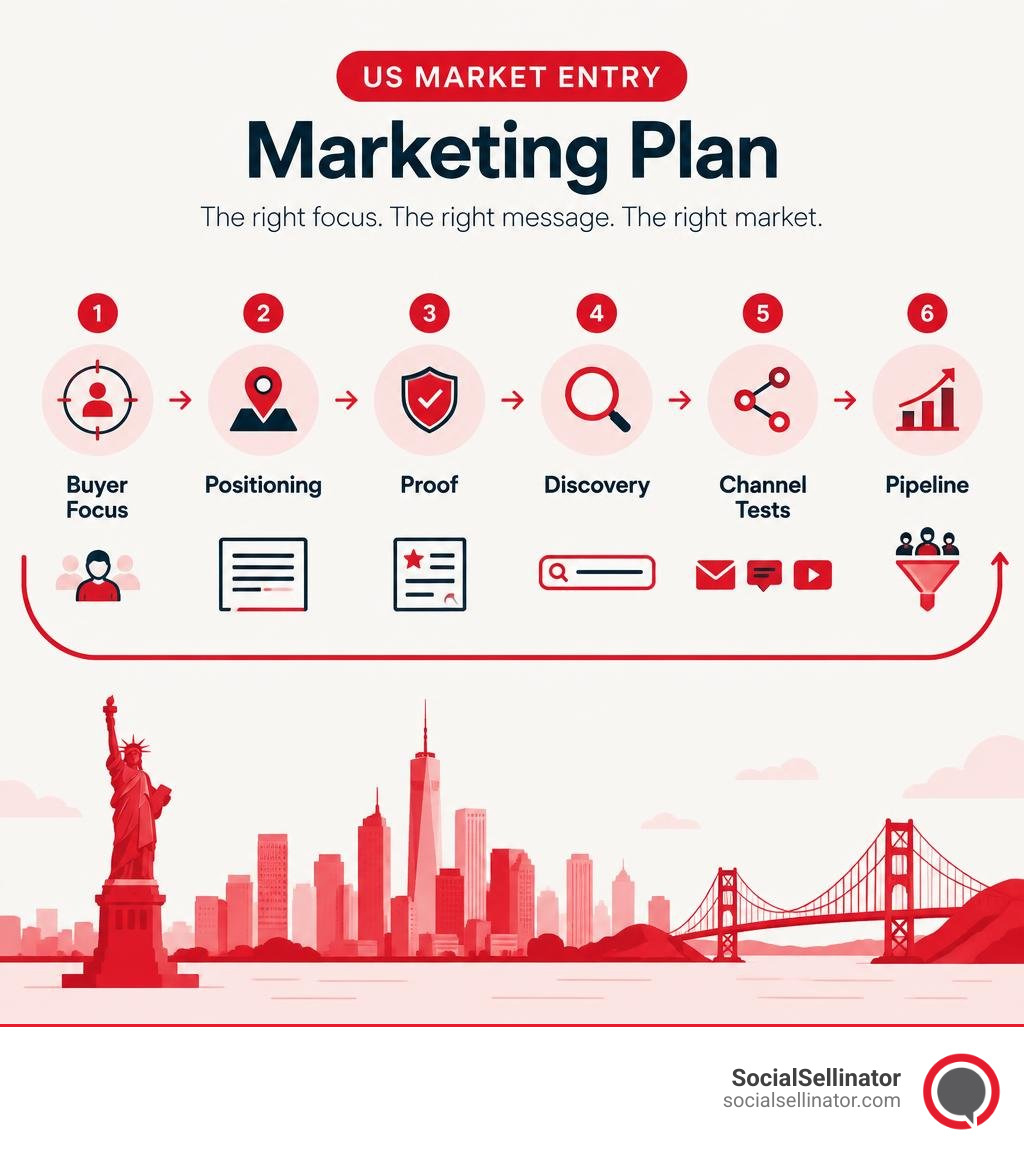
Start with one US buyer segment, not the whole country. For effective US market entry marketing, learn how that segment describes its problem, compare your offer with the options it already knows, and build proof it can check. Set pricing for US costs and buyer expectations. Then make your company easy to find in search and AI answers before testing a small number of demand channels. Measure qualified conversations and pipeline, not just traffic.
A strong home-market track record helps, but US buyers may not know your customers, awards, or category terms. That trust gap is why positioning and proof need work before a large campaign. This guide shows how to make those choices, test them, and decide what to scale.
I’m Jock Breitwieser, and I’ll walk you through that plan.
Key Takeaways
- Rebuild your positioning locally: American buyers discount unfamiliar international credentials; your messaging must address local competitors, specific dollar-denominated outcomes, and US category terminology.
- Expect higher acquisition costs: B2B paid channels in the US frequently exhibit cost-per-click rates 3 to 10 times higher than domestic European or Asian markets due to intense auction density.
- Sequence findability before paid demand: Secure your entity presence across search engines, AI search engines, and review directories before deploying large media budgets.
- Plan for a 6 to 12-month runway: Meaningful enterprise pipeline signals generally emerge within two to three quarters; treat faster wins as outliers rather than a repeatable baseline.
- Adopt a structured 50-33-17 budget model: Allocate roughly 50% of early capital to credibility and compounding content assets, 33% to narrow channel experiments, and 17% to measurement infrastructure.
Table of Contents
- Why Does US Market Entry Marketing Fail for Proven Global Brands?
- How Should You Localize Your Positioning, Pricing, and Beachhead for US Buyers?
- Which Marketing Channels Work Best for a US Market Launch?
- How Long Does US Market Entry Take and How Should You Budget?
- What Are the Most Critical Mistakes to Avoid During US Market Entry?
- Frequently Asked Questions About US Market Entry Marketing
- Conclusion: Turning US Visibility into a Predictable Growth Engine
Why Does US Market Entry Marketing Fail for Proven Global Brands?
US market entry fails for established international companies because home-market trust signals do not transfer across borders, and the sheer density of American competitors drives up customer acquisition costs. When expanding into America, foreign brands encounter sophisticated domestic buyers who default to familiar local alternatives and demand verifiable proof before engaging in a sales cycle. Recognizing the importance of digital marketing tailored to the nuances of the American ecosystem is the first step in avoiding expensive go-to-market missteps.
| Dimension | Home Market Dynamics | US Market Realities |
|---|---|---|
| Trust Signals | National awards, regional bank partners, domestic press | Local customer logos, US reference calls, SOC 2 / G2 reviews |
| Competitive Density | 2 to 4 primary alternatives | 10 to 20 well-funded competitors bidding on identical keywords |
| Paid Channel Economics | Moderate CPCs and predictable ad inventory | 3x to 10x higher CPCs across search and social auctions |
| Buyer Communication | Technical specifications and functional features | Direct, outcome-first claims with quantifiable metrics |
| Sales Cycle Velocity | Faster relationship-driven closures | Phased, consensus-driven committee buying cycles |
The Credibility Gap: Why Foreign Badges and Awards Fail in the US
American procurement teams, enterprise risk managers, and department heads rarely recognize foreign regulatory authorizations or domestic accolades. For instance, a European fintech arriving with Financial Conduct Authority (FCA) authorization, backing from prominent regional institutions, and tier-one domestic media coverage frequently finds that US risk officers place little weight on those achievements.
US buyers operate with severe time constraints and rely on specific shortcuts to evaluate credibility. When evaluating unfamiliar software or services, they search for domestic reference clients, peer reviews on established US software platforms, and local security assurances. To cross this credibility gap, international founders must replace foreign credentials with tangible evidence that directly addresses American operational, technical, and regulatory concerns.
Competitive Density and the 3x to 10x Acquisition Cost Spike
The United States represents the largest, most competitive commercial market in the world. In almost every enterprise software, financial technology, and business services category, you will encounter numerous well-funded competitors with established content engines, established analyst relations, and continuous presence at national industry conferences.
This density directly impacts digital advertising dynamics. In most US B2B categories, bidding on high-intent search terms costs between 3 and 10 times more per click than in European or Asia-Pacific markets. Founders who assume their domestic customer acquisition unit economics will translate directly to Google Ads or LinkedIn Ads in the US often exhaust their testing budgets before achieving statistical significance. Reaching self-sustaining scale requires moving beyond broad advertising to capture targeted, intent-driven demand.
How Should You Localize Your Positioning, Pricing, and Beachhead for US Buyers?
Localizing for the US market requires defining a concentrated beachhead segment, adjusting your category vocabulary, and rebuilding your commercial model around American willingness to pay. Simply converting your existing website copy into American English spelling and changing foreign currency signs into dollar signs is insufficient. Academic research on market entry strategies from UT Dallas confirms that tailoring your value proposition to regional market structures and specific customer segments is essential for sustainable cross-border expansion.

Selecting Your Beachhead Segment and Category Terminology
Attempting to sell across the entire United States on day one dilutes your resources and confuses your messaging. A proper beachhead is the smallest viable segment—defined by vertical, company size, and specific pain point—where you can establish a concentrated market presence within 12 months. Rather than targeting every mid-market enterprise across the nation, focus on specific operational hubs such as financial services in New York, life sciences in Boston, enterprise technology in San Francisco and San Jose, or logistics operators across Dallas, Denver, and Chicago.
Simultaneously, your category vocabulary must mirror how American decision-makers search. For example:
- European companies referring to “bespoke software development” must reposition as “custom enterprise application engineering.”
- Providers of “open banking aggregator solutions” must adopt the US industry phrasing “bank data connectivity and API infrastructure.”
- “Turnover reduction tooling” must be translated to “employee retention and talent management platforms.”
Validate your chosen category terms by conducting preliminary discovery interviews with target buyers in your beachhead before producing marketing collateral.
Setting US Pricing: Moving Beyond Currency Conversion
Pricing is a positioning statement, not a mathematical conversion. Directly converting Euros, Pounds, or Australian Dollars into USD ignores differences in customer expectations, local operational overhead, and domestic competitive alternatives.
When setting your US pricing structure, account for:
- The Full Cost to Serve: Factoring in localized customer success personnel operating across US time zones, local data residency hosting, payment processing fees, and state-level sales tax compliance requirements.
- Value Anchors: Benchmarking against the 3 to 5 domestic US alternatives your prospects evaluate during vendor reviews. Setting prices significantly lower than domestic averages often signals inferior capability to enterprise buyers, while pricing too high without recognized US customer references introduces friction into the procurement cycle.
- Packaging Norms: Structuring predictable, annual SaaS tiers or transparent consumption-based billing models that conform to US corporate purchasing processes.
Building US Proof and Transferable Credibility from Zero
When you have zero brand awareness in the US, you must intentionally manufacture proof points. Modern digital marketing for companies expanding internationally relies on establishing verifiable, staged evidence rather than relying solely on brand reputation.
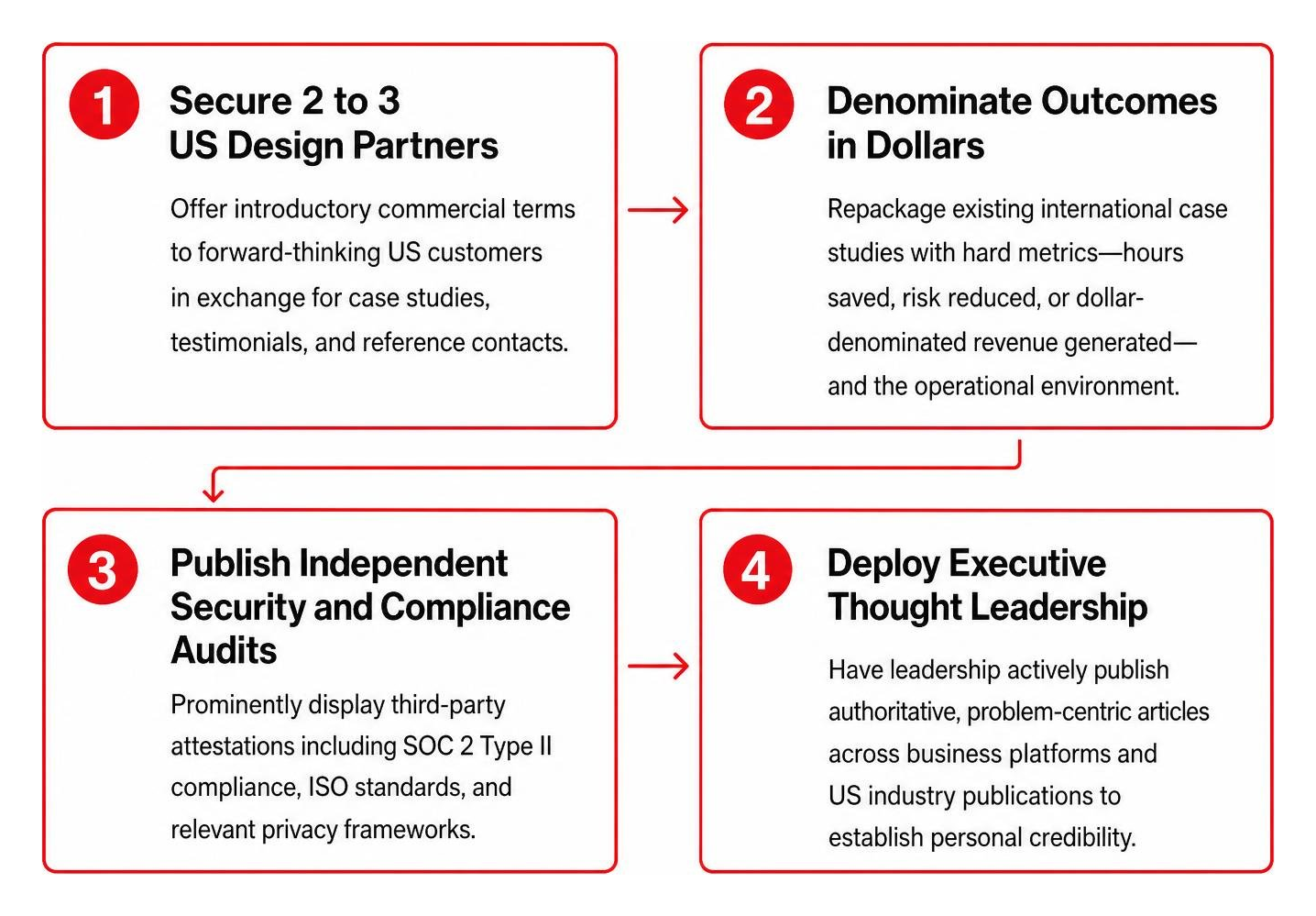
- Secure 2 to 3 US Design Partners: Offer introductory commercial terms to a handful of forward-thinking US customers in exchange for comprehensive case studies, public testimonials, and willingness to serve as reference contacts.
- Denominate Outcomes in Dollars: Repackage existing international case studies by highlighting hard metrics—such as hours saved, risk reduced, or specific dollar-denominated revenue generated—while clearly detailing the operational environment.
- Publish Independent Security and Compliance Audits: Prominently display third-party attestations including SOC 2 Type II compliance, ISO standards, and relevant regional privacy frameworks directly on your digital properties.
- Deploy Executive Thought Leadership: Have your leadership team actively publish authoritative, problem-centric articles across business platforms and US industry publications to establish personal credibility.
Which Marketing Channels Work Best for a US Market Launch?
The most effective marketing channels for entering the US market combine high-intent search visibility, AI assistant citations, and focused, founder-led outbound prospecting. Testing too many marketing platforms simultaneously spreads resources thin and generates inconclusive data. Building a modern digital marketing strategy for business growth requires sequencing your acquisition channels so that every dollar spent on paid demand is reinforced by strong organic findability and clear social proof.

Phased Channel Sequencing for US Market Entry Marketing
Channel success depends on execution order. Launching aggressive paid media campaigns before establishing a searchable, credible digital footprint wastes ad spend. A phased approach creates a structured path to traction:
- Phase 1: Findability Foundation (Days 1–30): Establish comprehensive search and directory profiles. Ensure that when a prospect searches your company name or category problem on Google, ChatGPT, or LinkedIn, they find cohesive, professional positioning.
- Phase 2: Credibility Layer (Days 31–60): Publish detailed comparison guides, customer success breakdowns, and proactive security documentation answering technical procurement questions.
- Phase 3: Targeted Demand Tests (Days 61–120): Deploy narrow, tightly controlled campaigns across high-intent Google search keywords and account-targeted LinkedIn campaigns focused strictly on your beachhead segment.
- Phase 4: Channel Scaling (Days 121+): Allocate additional budget to the single acquisition channel demonstrating stable cost-per-qualified-lead (CPQL) metrics, while pausing underperforming tests.
Modern B2B Discovery: Search Engines, AI Assistants, and Review Networks
B2B buying behavior in the US has shifted significantly toward independent, digital research. Decision-makers conduct extensive due diligence long before speaking with a sales representative. Consequently, your company must maintain consistent authority across all platforms where buyers research solutions:
Maintaining consistent entity data across your corporate website, business directories, Crunchbase profiles, and social accounts ensures that large language models and search engines cite your brand accurately when buyers research your category.
Navigating US Legal, Regulatory, and Advertising Compliance
Marketing claims in the United States face strict oversight from federal regulatory bodies. Before launching public promotional campaigns or partner marketing initiatives, international brands must ensure compliance with relevant US marketing frameworks:
- Federal Trade Commission (FTC): The FTC’s updated Endorsement Guides require prominent disclosures of any material connection between your brand and third-party creators, affiliates, or sponsored publications targeting US audiences.
- Securities and Financial Marketing (SEC & FINRA): International financial technology providers and asset management firms entering the US market must structure their promotional communications in alignment with SEC Rule 206(4)-1 and FINRA Rule 2210. Institutional U.S. expansion research from Cerulli Associates underscores that product distribution, promotional claims, and institutional diligence materials must be coordinated with US compliance standards to avoid regulatory friction.
- Consumer Protection and Data Privacy: The Consumer Financial Protection Bureau (CFPB) enforces strict prohibitions against Unfair, Deceptive, or Abusive Acts or Practices (UDAAP). Ensure all performance claims are substantiated with verifiable operational data, and establish a clear internal review process with a 48-hour service level agreement (SLA) to keep campaigns agile while remaining compliant.
How Long Does US Market Entry Take and How Should You Budget?
Achieving sustainable commercial traction in the US market generally requires 6 to 12 months of consistent execution, with initial pipeline indicators emerging in months 3 to 6. Market entry timelines depend on category maturity, regulatory complexity, and sales cycle lengths. Understanding how digital marketing helps your business grow allows international founders to establish realistic milestones and avoid underfunding their expansion before compounding returns take hold.
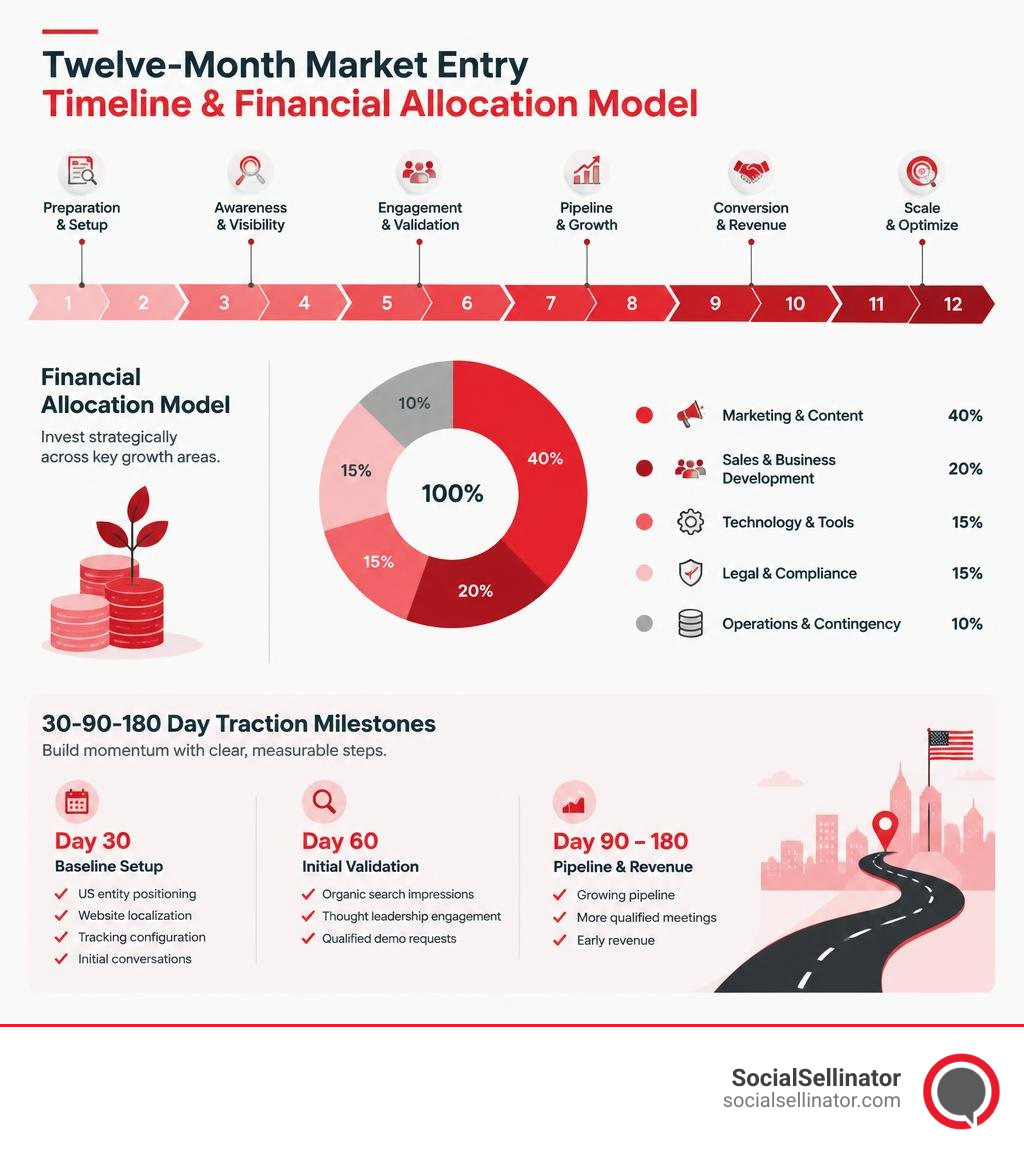
30-90-180 Day Traction Milestones and Leading Indicators
Rather than evaluating entry success solely on closed revenue during the first two quarters, monitor these progressive leading indicators:
- Day 30 (Baseline Setup): US entity positioning finalized, core website assets localized, measurement tracking configured, and initial buyer discovery conversations initiated.
- Day 60 (Initial Validation): Consistent organic search impressions on US category terms, engagement with executive thought leadership content, and initial qualified inbound demo requests.
- Day 90 (Audience Verification): Clear identification of the specific customer profile converting at the lowest cost, validation of primary messaging objections, and the generation of 5 to 10 qualified sales conversations.
- Day 180 (Repeatable Economics): At least one acquisition channel showing a predictable cost per qualified meeting, active pilot programs in progress, and steady growth in US branded search volume.
- Day 365 (Scale & Expansion): Multi-channel pipeline contribution, referenceable domestic customer case studies, and predictable revenue forecasting across your target beachhead.
Budgeting and Resource Allocation for US Market Entry Marketing
A balanced budget structure protects international companies from exhausting their capital on premature media spend. When entering the US market, follow the 50-33-17 budget allocation model:
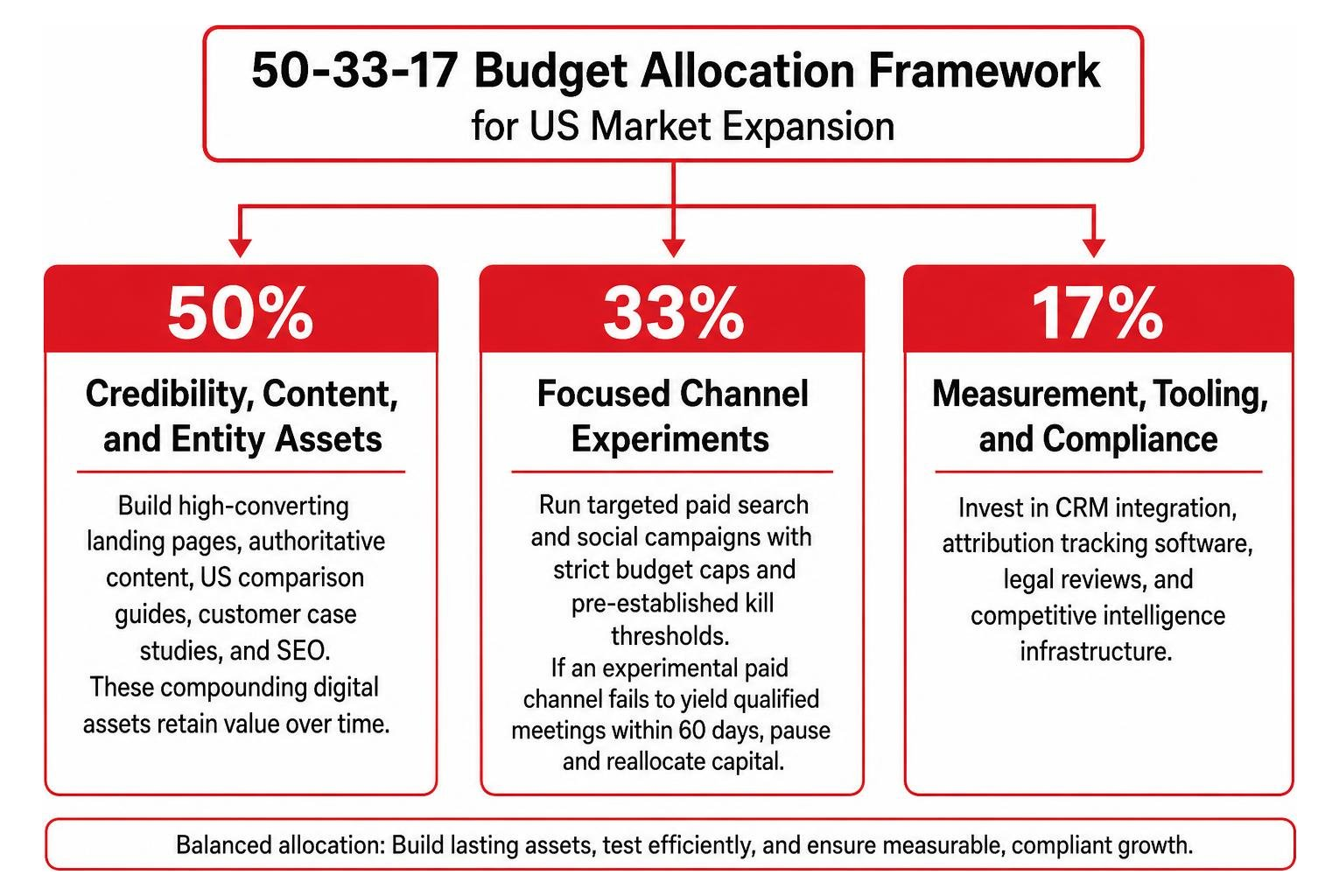
- 50% into Credibility, Content, and Entity Assets: Dedicated to building high-converting landing pages, authoritative technical content, US comparison guides, customer case studies, and search engine optimization. These compounding digital assets retain value over time.
- 33% into Focused Channel Experiments: Reserved for targeted paid search and social campaigns with strict budget caps and pre-established kill thresholds. If an experimental paid channel fails to yield qualified meetings within 60 days, pause the campaign and reallocate capital.
- 17% into Measurement, Tooling, and Compliance: Dedicated to CRM integration, attribution tracking software, legal reviews, and competitive intelligence infrastructure.
In terms of team structure, engage local specialized agency partners for channel execution, AI search optimization, and creative distribution early on, while retaining core positioning strategy, compliance oversight, and sales closing capabilities in-house.
What Are the Most Critical Mistakes to Avoid During US Market Entry?
The most costly mistakes international founders make during US market entry stem from treating the US as a single homogeneous market and applying domestic playbooks without local adaptation. Driving sustainable business growth through digital marketing in the US requires identifying and avoiding these common traps:
- Translating Copy Instead of Repositioning: Reusing domestic website phrasing word-for-word fails to resonate with US buyers, who expect clear, direct, outcome-focused communication and familiar category terms.
- Premature Scaling of Paid Media: Funneling large ad spend into Google or LinkedIn before validating conversion paths, establishing domestic social proof, or confirming message-market fit leads to high bounce rates and wasted capital.
- Targeting Broad Geographic Regions: Launching national marketing campaigns without geographic focus spreads budgets thin and prevents building concentrated brand awareness in key metropolitan hubs like Austin, Chicago, Los Angeles, San Francisco, or Washington DC.
- Operating Outside US Business Hours: Managing US go-to-market motions exclusively from European or Asian time zones introduces delays in lead response times and customer support. Appoint a dedicated team member or local agency operating in US time zones.
- Neglecting Proactive Security and Procurement Needs: Delaying compliance preparation—such as SOC 2 documentation, clear data privacy policies, or standardized vendor questionnaires—until the late stages of a deal slows down the sales cycle and risks losing enterprise accounts.
Frequently Asked Questions About US Market Entry Marketing
How long does it realistically take to see meaningful traction in the US?
In most B2B and technology categories, seeing meaningful qualified pipeline signals takes 6 to 12 months. Early indicators—such as increases in US-specific branded search queries, organic content engagement, and inbound partnership inquiries—typically emerge between months 3 and 6. Because US enterprise sales cycles often span several quarters, companies should plan for a 12 to 18-month strategic runway before expecting fully stabilized customer acquisition costs.
Do we need US customers before launching marketing campaigns in America?
You do not need dozens of US clients to begin marketing, but you do need an intentional plan to secure domestic proof quickly. Launching targeted outbound campaigns and offering introductory commercial terms to secure 2 or 3 referenceable US design partners provides the foundational case studies, testimonials, and review listings necessary to convert cold inbound traffic into active sales opportunities.
What is the most common mistake international founders make when launching in the US?
The most common mistake is launching broad, national paid advertising campaigns before establishing local credibility and refining their positioning for American buyers. When foreign companies direct paid traffic to unlocalized landing pages lacking US references, familiar category terms, or visible security certifications, conversion rates decline, driving up acquisition costs.
Conclusion: Turning US Visibility into a Predictable Growth Engine
Expanding into the United States offers substantial growth opportunities, but winning market share requires more than just exporting a domestic playbook. To succeed in the world’s most competitive business landscape, international companies must establish clear positioning, build credible domestic proof, align with local buyer expectations, and sequence their marketing channels strategically.
At SocialSellinator, we help ambitious global founders and enterprise leaders bridge the trust gap and turn American market visibility into measurable revenue. As a specialized B2B digital marketing agency based in San Jose, California, our team works directly with mid-market and enterprise companies—including international brands entering the US—to build high-performing growth systems.
Through our comprehensive AI search optimization services, organic SEO programs, and targeted content engines, we ensure your company appears with authority when US decision-makers research solutions across Google, ChatGPT, and Perplexity. By connecting high-intent search visibility directly to qualified sales pipeline, we provide the strategic foundation your brand needs to scale across the United States. Connect with us today to build your US market entry marketing engine.