

Modern Real Estate Marketing Playbook for Boston Brokers
Introduction
Executing successful real estate marketing Boston campaigns requires a hyper-local, multi-touch digital presence that captures high-intent buyers and sellers across search engines, social platforms, and AI-driven discovery tools. As of October 2026, the digital landscape for regional property acquisition has evolved dramatically. With 92% of buyers initiating their property search online and 82% of homebuyers utilizing AI search tools to identify top agents, generic advertising strategies no longer generate sustainable revenue. National property portals saturate broad municipal search results, but they cannot replicate authentic, on-the-ground neighborhood advisory.
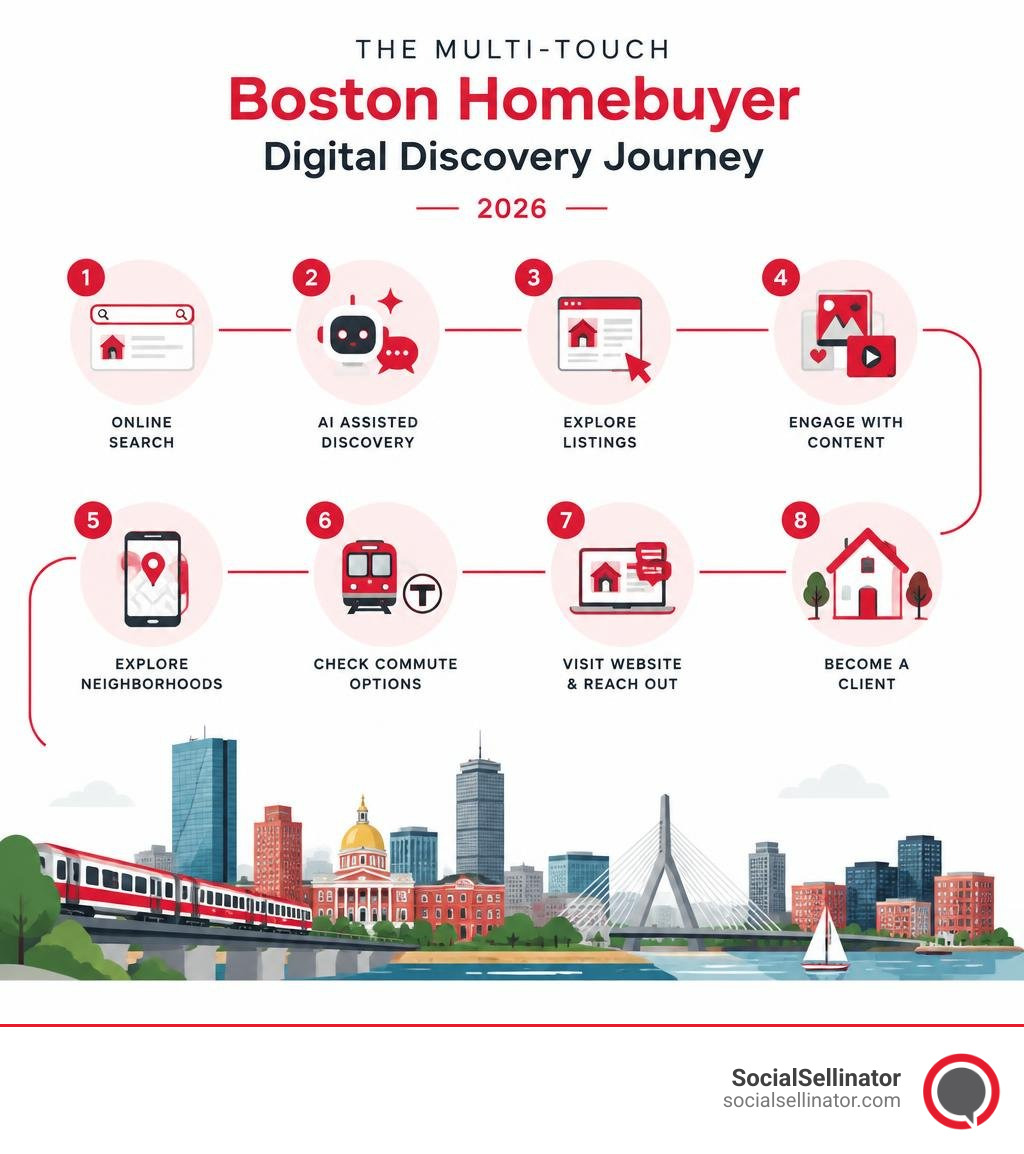
Securing high-intent listing leads and qualified buyers requires capturing prospects across a structured, multi-touch digital journey. Industry research shows that prospective clients interact with a brokerage’s website, market reports, and social media channels eight or more times before making initial contact. For real estate professionals across Greater Boston, establishing an omnipresent, authoritative digital footprint is the decisive factor in converting casual web browsers into signed representation agreements. Modern home shoppers compare micro-neighborhood appreciation rates, evaluate transit accessibility, and cross-reference broker reviews across multiple digital touchpoints long before attending an open house or scheduling a private tour.
To build a resilient transaction pipeline in an competitive regional market, brokers and agency teams must align every asset—from technical local search optimization and targeted pay-per-click advertising to cinematic social video and automated email nurturing—into a unified lead generation engine.
Navigating the Boston Real Estate Landscape: Transit, Neighborhoods, and Nuance
Marketing real estate across Greater Boston requires a nuanced understanding of geography, historic architecture, and commuter infrastructure. Boston is a city of distinct micro-pockets. A digital campaign tailored to attract luxury buyers to ultra-modern high-rise condominiums in the Seaport District will fall flat when marketing historic brick brownstones in Back Bay, Beacon Hill, or the South End. Each submarket features its own demographic profile, pricing dynamics, building regulations, and lifestyle appeal, making blanket marketing strategies fundamentally ineffective.
Commuter logistics heavily influence buyer search behavior across Eastern Massachusetts. The Massachusetts Bay Transportation Authority (MBTA) network—spanning the Red, Green, Orange, and Blue subway lines alongside an extensive Commuter Rail system—dictates residential search boundaries for working professionals. High-performing marketing campaigns must explicitly highlight accessibility to specific transit hubs, proximity to Interstate 90 (Mass Pike) and Interstate 93, and direct connections to Boston Logan International Airport. Furthermore, ongoing outward migration patterns toward the Route 128 and Interstate 495 technology and life sciences corridors demand marketing narratives that clearly illustrate suburban lifestyle upgrades without minimizing daily commute realities. Boston commercial real estate services and expanding corporate office hubs also shape regional residential demand, directly determining where professionals prioritize their home purchases.
Addressing Hyper-Specific Buyer Trade-Offs
Boston buyers encounter structural and financial trade-offs that generic national listing portals rarely articulate. High-converting marketing assets stand out by directly addressing these complex local considerations across digital campaigns, landing pages, and listing descriptions:
- Homeowners Association (HOA) Health and Fees: Providing clear breakdowns of reserve study funding, upcoming special assessments, capital improvement plans, and monthly dues in historic multi-unit associations. Disclosing these details upfront builds credibility with discerning buyers evaluating long-term maintenance liabilities.
- Deeded Parking vs. Street Permits: Clarifying tandem parking configurations, deeded garage spaces, heated driveway allocations, or neighborhood resident parking sticker logistics, which represent critical decision drivers in dense urban enclaves like Charlestown and the North End.
- Historic District Restrictions: Navigating interior and exterior renovation guidelines enforced by local historic preservation commissions and architectural conservation boards, clarifying permissible window replacements, masonry repointing, and facade modifications.
- Triple-Decker Nuances: Highlighting structural updates, split utility configurations, soundproofing upgrades, and rental income potential in classic multi-family conversions across South Boston, Dorchester, East Boston, and Somerville.
- Flood Zones and Coastal Resiliency: Addressing climate preparedness, localized sea-level mitigation, sump pumps, and insurance implications for properties situated along waterfront corridors in East Boston, the Seaport, and coastal North Shore or South Shore communities.
- Massachusetts Fair Housing Compliance: Maintaining inclusive, legally compliant descriptive language across all advertising copy without steering buyers based on protected classes, ensuring complete adherence to state and federal statutes.
Segmenting Academic, Medical, and Tech Demographics
Greater Boston’s economic engine attracts specialized professional demographics with distinct housing timelines, spatial needs, and capital capabilities:
- Biotech and Life Sciences: Professionals centered around Kendall Square, Cambridge, Watertown, and the Seaport seeking modern luxury amenities, integrated smart home technology, energy-efficient construction, and minimal transit commutes.
- Medical Professionals: Resident physicians, attending surgeons, clinical directors, and biomedical researchers working within the Longwood Medical Area and Massachusetts General Hospital network who require streamlined transaction timelines, flexible closing terms, and close proximity to hospital call rooms.
- Higher Education Ecosystem: Faculty, department chairs, visiting fellows, and university administrators tied to institutions like Harvard, MIT, Boston University, Northeastern, and Boston College who operate on strict academic calendar turnover cycles centered around late spring and late summer.
- Relocating Corporate Executives: Senior leadership relocations demanding turnkey luxury residences, dedicated concierge services, private elevator access, and effortless connectivity to downtown financial and legal headquarters.
Effective multi-channel marketing for these specialized segments requires tailored messaging, dedicated landing pages, and demographic-specific value propositions that speak directly to their relocation timelines and lifestyle priorities.
The Strategic Pillars of Real Estate Marketing Boston Brokers Must Master
To thrive in this competitive environment, brokerages must deploy an integrated, full-funnel marketing system. Relying solely on cold outreach, traditional print mailers, or passive word-of-mouth is no longer viable; prospects searching for terms like “best listing agent in Boston” represent high-intent leads that convert at three times the rate of cold prospects.
Achieving consistent conversion requires cross-channel synergy. Research demonstrates that 60% of millennial consumers expect brands to present a coherent marketing strategy across every digital channel, while companies maintaining a strong online portfolio and consistent brand management are four times more likely to improve visibility and win clients. When inbound channels work synchronously, prospective home sellers encounter your brand across search results, social feeds, and digital video hubs, reinforcing your status as the definitive local authority.
Partnering with an experienced Boston digital marketing agency enables brokerages to align technical execution with strategic storytelling across every buyer touchpoint.
| Channel Strategy | Primary Objective | Target Audience Intent | Expected Conversion Timeline |
|---|---|---|---|
| Local & AI SEO | Organic dominance for neighborhood and “hire” searches | High intent; actively researching agents and hyper-local data | 3 to 6 months (Compounding) |
| Paid Search (PPC) | Immediate capture of active buyers and sellers | High intent; searching specific property types and zip codes | Immediate to 30 days |
| Paid Social & Retargeting | Brand recall, lead capture, and property showcase | Medium intent; browsing feeds, engaging with local content | 30 to 90 days |
| Reputation & Reviews | Social proof, trust building, and conversion rate lift | High intent; evaluating agent credibility before outreach | Continuous trust signal |
Hyperlocal SEO and AI Search: Winning Real Estate Marketing Boston Queries
Search behavior has shifted decisively toward natural-language queries and generative AI discovery engines. Today, 82% of homebuyers use AI search tools to locate local agents and evaluate neighborhood suitability. When a prospect asks an AI engine to compare commuting options from Quincy versus Medford, or evaluate condo appreciation in Cambridge versus Somerville, the AI synthesizes hyper-local web content to formulate its recommendations.
Dominating these organic search environments requires rigorous technical optimization. Real estate professionals must focus on optimizing Boston local SEO to establish strong geographic entity signals. This involves structuring neighborhood guides with schema markup, verifying Google Business Profiles for every team location, maintaining consistent name, address, and phone (NAP) data across regional citation networks, and answering specific buyer questions regarding zoning, transit lines, and architectural styles. Creating in-depth content hubs dedicated to specific school districts, parking availability, and preservation rules positions the broker as an authoritative knowledge graph source. By focusing on hyper-local “who-to-hire” queries, individual brokers and boutique agencies consistently win high-value business that national aggregators cannot capture.
High-Impact Paid Media and Retargeting
Organic search provides sustainable, long-term visibility, but paid media delivers immediate lead generation velocity. High-performing Google Ads campaigns target high-intent transactional search terms, such as neighborhood-specific condominium keywords, luxury waterfront developments, and instant home valuation requests.
Collaborating with a dedicated real estate Google Ads consultant ensures ad budgets are allocated efficiently without wasteful spend on broad, non-converting search terms. By pairing precise Google Search campaigns with Meta (Facebook and Instagram) ad funnels, agents can geo-fence specific zip codes, promote interactive open house announcements, and deploy dynamic retargeting. Because prospects interact with digital touchpoints multiple times before initiating contact, sequential retargeting keeps listings and agent branding top of mind throughout the multi-month evaluation window.
Furthermore, conversion rate optimization (CRO) must be integrated across every paid touchpoint. Landing pages tailored to specific Boston property types—such as historic South End brownstone buyer guides or Seaport high-rise inventory breakdowns—convert ad clicks into qualified inquiries at significantly higher rates than standard brokerage homepages.
Social Media, Video Marketing, and Authority Building
Modern property marketing demands dynamic visual assets. Video marketing helps real estate businesses generate 66% more qualified leads, 51% more web traffic, and a 31% increase in conversions. Static photography remains essential for digital listing sheets, but video builds an emotional connection, showcases architectural craftsmanship, and conveys spatial flow far more effectively.
Using actionable frameworks like generating 30 customers in 30 days as a realtor, agents can systematically produce lifestyle tours, street-level walkthroughs, and educational market breakdown videos that position them as trusted regional advisors rather than transactional sales agents.
Visual Storytelling Across Meta, YouTube, and Emerging Channels
Social media is more than a digital billboard—it is a conversation engine and relationship accelerator. Over 91% of U.S. marketers use social media branding campaigns to initiate meaningful consumer relationships. Each platform serves a distinct strategic purpose in a comprehensive real estate marketing plan:
- Instagram Reels and Carousels: Ideal for cinematic property tours, highlighting architectural finishes, historic brickwork, private roof decks, custom kitchen millwork, and neighborhood dining highlights. These short-form assets capture mobile attention and drive direct message conversations.
- YouTube: The primary channel for comprehensive neighborhood relocation guides, monthly market trend analyses, property tax breakdowns, and deep-dive buyer advisory videos that capture long-tail search intent over months and years.
- LinkedIn: A powerful network for connecting with corporate relocation specialists, wealth managers, real estate attorneys, estate planners, and executives moving to Greater Boston’s corporate hubs, establishing high-level professional partnerships.
- Community Micro-Content: Producing hyper-local spotlight reels focusing on neighborhood cafes, parks, boutique retailers, and historic landmarks in areas like Coolidge Corner or Davis Square reinforces localized authenticity and fosters organic community sharing.
Online Reputation and Social Proof Management
Trust is the central currency of high-stakes real estate transactions. With 86% of consumers citing authenticity as a deciding factor when choosing a brand, maintaining an impeccable online reputation is non-negotiable.
Sellers and luxury buyers thoroughly vet agent reviews before submitting an inquiry form or signing an exclusive listing agreement. Brokerages must establish automated post-closing workflows that prompt satisfied clients to leave detailed Google Business Profile reviews highlighting specific achievements, such as negotiating above asking price or navigating complex inspection contingencies. Promptly responding to all feedback with professional, compliant messaging reinforces brand integrity and delivers vital trust signals to search engine algorithms.
Selecting the Right Agency Partner for Growth
Executing a modern, multi-channel marketing system requires diverse technical capabilities: technical SEO, website development, paid ad optimization, graphic design, video production, and conversion copywriting. For most brokerages and top-producing teams, partnering with a specialized agency delivers superior ROI compared to hiring a fragmented internal team or attempting to manage digital marketing between client showings.
When reviewing top digital media companies in Boston MA, look for teams that offer comprehensive execution rather than isolated services. A complete approach to Boston online marketing ensures that paid ad traffic lands on high-converting, search-optimized property pages that seamlessly capture lead information and trigger automated nurturing sequences.
Budget Allocation and Hiring for Real Estate Marketing Boston Campaigns
When evaluating agency proposals, look beyond surface-level vanity metrics like impressions and social clicks. Top agencies offer clear deliverables, data transparency, and defined timelines for return on investment.
Before signing an agreement, ask prospective marketing partners these critical questions:
- How do you tailor content strategy to individual neighborhood demographics and transit patterns across Greater Boston?
- What is your strategy for capturing local AI-driven, generative search, and zero-click search visibility?
- How do you track and report cost-per-lead (CPL) versus customer acquisition cost (CAC)?
- What follow-up and automation sequences do you implement to nurture leads across multi-month decision cycles?
- How do your campaigns ensure full compliance with Massachusetts real estate advertising regulations and fair housing laws?
- What integrations do you establish between paid ad landing pages and lead management platforms to prevent response delays?
Measuring Attribution and Customer Acquisition Cost
A reliable marketing partner does not stop at generating web traffic; they connect marketing data directly to your customer relationship management (CRM) software. Multi-touch attribution models help brokerages identify which initial touchpoints (such as an educational blog post or YouTube video) introduced the lead, and which bottom-of-funnel assets (such as a private listing page or email market report) prompted direct outreach. Tracking lead velocity, conversion rates, and client acquisition costs ensures marketing budgets are continually optimized toward the highest-producing channels.
Frequently Asked Questions About Boston Real Estate Marketing
How can Boston real estate agents outrank national portals like Zillow?
While national portals dominate high-level listing searches, individual agents and boutique brokerages win by capturing high-intent “who-to-hire” searches, localized neighborhood queries, and AI-driven conversational questions. Portals provide raw listing data, but they lack authentic, block-by-block commentary, detailed HOA insights, hyper-local zoning knowledge, and personalized client consultation. Building deep neighborhood guide hubs, earning continuous five-star Google reviews, and optimizing local schema signals allows agents to outrank portals for hyper-local queries.
What makes Boston real estate marketing distinct from other metro areas?
Boston’s property landscape is uniquely shaped by historic architecture, complex transit infrastructure, dense multi-family housing styles (such as classic triple-deckers), and strict local zoning regulations. Additionally, the region’s economy is driven by specialized academic, biotech, and medical sectors with specific relocation cycles. Marketing must address hyper-local factors like deeded parking, historic preservation rules, and commuter station access rather than relying on generic property descriptions.
How quickly can a brokerage expect measurable ROI from digital marketing?
Paid search and targeted social media advertising campaigns can generate inquiries and open-house attendance within the first 30 days of launch. Organic search engine optimization, content marketing hubs, and local AI authority building typically gain significant traction within three to six months. Over time, these organic assets compound, reducing customer acquisition costs and delivering consistent inbound listing leads.
What digital channels deliver the highest conversion rates for Boston luxury listings?
A balanced mix of hyper-targeted Google Search ads targeting high-net-worth relocation queries, sequential Meta retargeting showcasing architectural video walkthroughs, and organic local SEO pages dedicated to luxury enclaves yields the highest conversion rates for premier listings.
How should agents allocate their marketing budget across channels?
A balanced allocation typically directs 40% of the budget toward high-intent paid search and retargeting ads, 30% toward organic SEO, local content generation, and website optimization, 20% toward cinematic video production and social distribution, and 10% toward reputation management and email automation.
Conclusion
Succeeding in Boston’s dynamic property market requires more than traditional advertising. By embracing hyper-local SEO, AI-ready search architecture, strategic paid media funnels, engaging video production, and proactive reputation management, brokers can build a durable competitive advantage across Greater Boston.
We at SocialSellinator specialize in crafting full-funnel digital growth strategies that elevate real estate brands and generate qualified, high-intent client inquiries. If you are ready to expand your market share and dominate your local submarket, explore our tailored solutions and partner with our full-service digital marketing agency today.
Headquartered in San Jose, in the heart of Silicon Valley and the San Francisco Bay Area, SocialSellinator proudly provides top-tier digital marketing, SEO, PPC, social media management, and content creation services to B2B and B2C SMB companies. While serving businesses across the U.S., SocialSellinator specializes in supporting clients in key cities, including Austin, Boston, Charlotte, Chicago, Dallas, Denver, Kansas City, Los Angeles, New York, Portland, San Diego, San Francisco, and Washington, D.C.