

Media Management Solutions: Turn Scattered Content Into a Clear Workflow
Media management solutions help teams organize, create, approve, publish, and measure content in one workflow. If your main job is running social channels, look for scheduling, a shared inbox, and analytics. If you manage a large video or image library, look for searchable assets, version control, secure access, and delivery tools. Some teams need both.

The right choice depends on where work gets stuck. Are people hunting for the latest file, waiting on approvals, or posting the same content by hand across channels? Start with that bottleneck, then compare tools against the time they save and the results you need to track.
I’m Jock Breitwieser, and I’ll help you sort through the options without buying more software than your team needs.
Understanding what comprehensive social media management includes helps growing organizations navigate the evolving social media management market and establish effective social media management practices across their marketing tech stack.
Core Types of Media Management Solutions: SMM vs. Enterprise MAM
Managing multimedia assets and cross-channel marketing campaigns can require clear technical distinctions. Teams may need to manage a broad range of creative deliverables, including raw video footage, graphic design source files, localized advertising variations, customer inquiries, and daily organic publishing schedules across multiple digital platforms. When files are spread across local drives, cloud storage accounts, and communication channels, it can be hard to find the latest version.
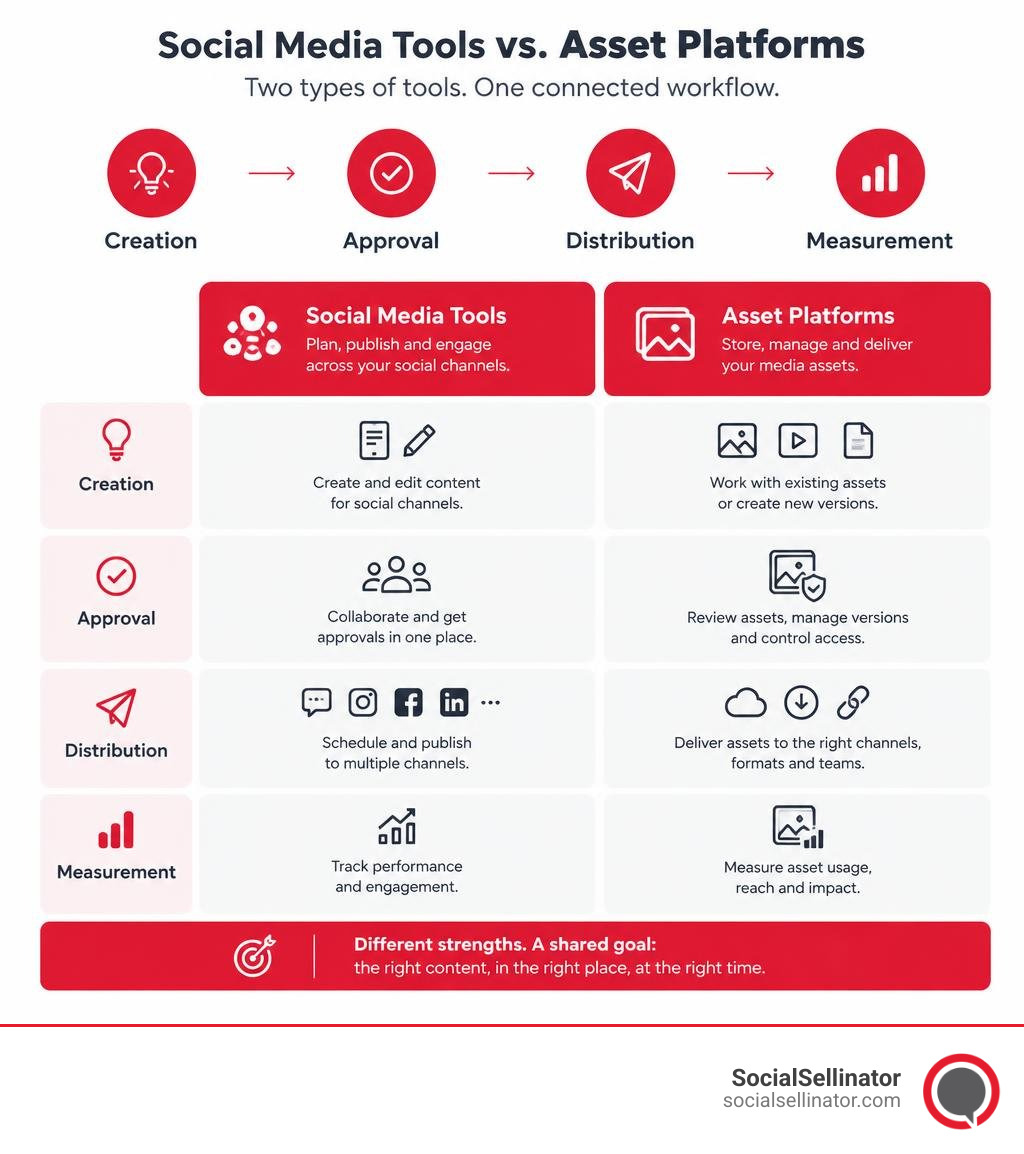
To establish scalable operational order, organizations generally rely on two primary categories of software: Social Media Management (SMM) platforms and Enterprise Media Asset Management (MAM) systems. While both toolsets optimize how brand media moves through its lifecycle, they fulfill distinct operational roles, handle different data payloads, and serve different stakeholder groups within an enterprise.
SMM software operates as the outbound publishing and engagement layer. Its primary mission is to schedule content, facilitate audience conversations, track real-time brand sentiment, monitor direct messages, and measure multi-channel campaign attribution. In contrast, enterprise MAM platforms serve as the core production and cataloging engine for rich audiovisual media. They manage heavy ingest pipelines, automated transcoding, frame-accurate video proxy generation, detailed metadata tagging, non-linear video editing integrations, and secure downstream archival storage.
Asset governance and preservation (ensuring long-term ownership, deep searchability, rights management, and security over valuable proprietary media) form the foundation of enterprise MAM platforms. Meanwhile, rapid engagement response, cross-channel brand coherence, and publishing velocity drive SMM platforms.
| Feature / Capability | Social Media Management (SMM) | Enterprise Media Asset Management (MAM) |
|---|---|---|
| Primary Operational Objective | Outbound publishing, community engagement, brand monitoring | High-volume ingestion, cataloging, editing, secure distribution |
| Core Media Handled | Finished graphics, vertical reels, carousels, text copy | Heavy raw video (4K/8K), audio stems, project files, b-roll archives |
| Storage Architecture | Short-term cloud staging for active campaigns | Multi-tier hybrid cloud, on-premise SAN/NAS, petabyte cold storage |
| Primary Users | Social media managers, content creators, copywriters | Video editors, broadcast engineers, creative directors, archivists |
| Collaboration Model | Draft post reviews, approval workflows, shared inbox queues | Frame-accurate video markup, versioning, timeline integrations |
| Search & Discovery | Campaign tag search, social keyword tracking | AI semantic search, visual object detection, facial and audio tagging |
| Downstream Distribution | Social network APIs (LinkedIn, X, Meta, YouTube, TikTok) | Broadcasters, OTT streaming networks, ad servers, global partners |
Key Capabilities of Modern Social Media Management Solutions
For growing businesses and enterprise marketing departments alike, a robust social management platform functions as a command center for brand visibility. It removes the inefficiencies of manually toggling between multiple native social apps, replacing disconnected workflows with a centralized interface.
Operational capabilities to compare include:
- Unified Social Inboxes: Consolidating direct messages, story mentions, and public comments into a single collaborative queue. Check which networks and message types a shared inbox supports, and test whether marketing and customer support teams can route tickets, assign conversations to specific specialists, tag priority leads, and resolve customer questions with pre-approved response templates.
- Visual Content Calendars and Multi-Channel Scheduling: Providing visual, drag-and-drop planning across weeks and months. Cross-functional teams gain complete transparency into upcoming product launches, promotional campaigns, and brand milestones across all channels, avoiding accidental publishing overlaps or scheduling gaps.
- Social Listening and Competitive Intelligence: Tracking brand keywords, executive mentions, competitor campaigns, and broader industry trends. Check which of these the tool can track and how often results update before relying on it to adjust content strategies.
- Performance Analytics and Attribution Tracking: Delivering comprehensive reporting on audience growth, post engagement, click-through rates, video retention, and conversion metrics, helping marketers connect creative output with measurable revenue outcomes and marketing qualified leads.
- Campaign Tagging and Taxonomy Management: Structuring posts by product line, target persona, funnel stage, and regional campaign code, so marketing leadership can compare campaign performance across segments.
To maximize pipeline impact, forward-thinking organizations align daily publishing with strategic social media marketing and management programs that connect organic storytelling with search engine optimization, paid advertising, and targeted digital marketing campaigns. When internal resources are constrained, utilizing professional social media posting services ensures reliable publishing cadences and high production standards without overburdening internal staff.
Evaluating Enterprise Media Management Solutions for Content Workflows
When creative teams produce hundreds of gigabytes of raw multimedia content weekly, standard consumer cloud drives struggle under the workload. Enterprise media asset management solutions address this operational friction by creating automated, structured media supply chains that scale alongside organizational output.
Consider media production networks and enterprise creative departments that maintain extensive video libraries spanning thousands of hours of footage. Fulfilling distribution requests manually (such as transcoding codecs, generating localized subtitling tracks, validating broadcast compliance, and distributing massive master files) creates severe operational bottlenecks.
Cloud-native MAM platforms can streamline these fulfillment workflows by automating file conversions, compliance checks, and secure digital delivery pipelines. Compare turnaround times on your own production requests.
When comparing enterprise MAM systems, check for these architectural capabilities:
- Scalable Multi-Tier Storage Architectures: Unifying local on-premise storage arrays, network-attached storage (NAS), and cloud repositories into a centralized interface, eliminating painful data migrations while balancing high-speed editing performance with cost-effective long-term cold storage.
- Automated Proxy Generation: Creating lightweight, web-friendly streaming proxies immediately upon file ingest, allowing distributed creative teams to review, annotate, and rough-cut high-resolution footage in standard web browsers without downloading massive original media files.
- Deep Semantic Search and Indexing: Multi-modal artificial intelligence can index spoken dialogue, on-screen individuals, brand logos, visual scenes, and background audio in video archives. Test whether editors can find spoken lines, people, logos or scenes in a sample from your archive.
- Policy-Based Lifecycle Archiving: Check whether the system can apply automated archiving rules that transfer legacy project files from high-speed storage to cost-effective cold cloud storage while keeping proxy representations and metadata catalogs searchable.
- Non-Linear Editing (NLE) Integrations: Directly connecting desktop editing suites with central asset repositories, enabling editors to import proxies, assemble timelines, and conform final cuts to original master files without leaving their creative application environment.
Platforms and Software Features to Compare
The software market reflects ongoing technological consolidation across the creative and marketing sectors. Rather than relying on disconnected point tools for creation, storage, and publishing, modern organizations seek integrated software environments that bridge raw asset production with multi-channel distribution.

Whether evaluating the top social media management platforms or deploying an enterprise-grade MAM system, choosing software built on open API architectures, high availability, and intelligent workflow automation is vital for long-term operational success.
Leading Social Marketing Platforms: Features and Pricing Models
Social management platforms support diverse organizational needs, from regional SMBs managing local audience engagement to multinational brands managing hundreds of localized social accounts across several business units.
- Enterprise Social Marketing Suites: Full-featured enterprise platforms offer comprehensive brand governance, real-time social listening, compliance approval workflows, and structured employee advocacy systems. Real-world case studies illustrate the business value of centralized social media operations:
- Hootsuite reports that Barceló Hotel Group centralized its brand strategy and grew new followers by 46%.
- Hootsuite reports that DaVita’s employee ambassadors helped save the equivalent of $1.5 million in ad value.
- Hootsuite reports that Mapfre consolidated account management on one platform and increased online interactions by 31%.
- Pricing Models: Hootsuite lists per-user prices for several plans and custom pricing for enterprise organizations.
- Agile Small-to-Midsize Schedulers: When comparing tools emphasizing visual publishing grids, intuitive review loops, and streamlined collaboration, check whether pricing is per profile or a flat team subscription rate.
- Executive Thought Leadership Platforms: If you publish for executives, look for review loops, ghostwriting approval workflows, and formatting options that fit how you draft posts for their profiles.
Compare social media management pricing models against your budget and the publishing, listening and reporting features you need.
Cloud-Native Media Asset Management Platforms
For enterprise media organizations, commercial production houses, and brands operating as digital publishers, specialized MAM software provides the infrastructure needed to produce content at scale.
- Nomad Media Manage: Nomad says Manage connects its media library with production tools such as AWS and Adobe. Nomad’s AI workflows can tag, clip and route footage.
- MediaSilo: Video production teams can share clips securely and leave frame-accurate feedback.
- Viz One: Vizrt reports that in its tests of Viz One 8.1, cataloguers spent as little as one-tenth the time per asset and longform metadata logging was over 50% more accurate than manual logging.
- Cue Media Platform: Stibo DX describes a story-centric workflow that lets editorial teams adapt a story for web, mobile and print.
How AI, Automation, and Security Transform Digital Media Operations
Digital media workflows have evolved from static storage repositories into intelligent, automated production environments. Artificial intelligence now acts as an operational backbone that coordinates end-to-end media processing, metadata enrichment, brand compliance, and digital rights governance across complex modern marketing departments.
Agentic AI and Workflow Automation in Media Production
Some media management systems don’t merely store raw video and graphic assets; they analyze, categorize, and prepare them for multi-channel distribution using computer vision, natural language processing, and automated workflow triggers.
Key automated capabilities include:
- Automated Speech-to-Text and Subtitling: Check whether the tool produces searchable, time-coded transcripts and subtitle files in the languages your team needs.
- Visual Scene Recognition and Entity Tagging: Scanning video frames to identify on-screen talent, brand logos, visual objects, scene transitions, and camera angles without requiring manual human logging, dramatically cutting cataloging overhead.
- Automated Transcoding and Quality Validation: Check whether the system can convert high-bitrate master files into the broadcast, web, and vertical social formats you need (such as 9:16 mobile video), and which audio level, color profile, or broadcast standard checks it supports.
- Generative Copy Variations: Assisting marketing teams by drafting platform-tailored post copy, identifying high-performing hashtags, and adapting tone according to audience engagement data across diverse social networks.
- Contextual Sentiment Classification: Evaluating inbound customer messages and brand comments across connected networks to route urgent customer inquiries, high-intent sales inquiries, or potential public relations risks directly to human support specialists.
- Predictive Asset Performance Scoring: If a tool analyzes historical engagement and view-through rates to suggest creative thumbnails, video aspect ratios, and posting schedules for target buyer personas, test those suggestions with your audience.
For expanding companies, deploying social media management for small business that incorporates intelligent automation frees internal creative talent to focus on high-impact strategic initiatives, PPC advertising, search engine optimization, and conversion rate optimization.
Media Security: Access Controls, Watermarking, and Governance
As proprietary digital assets grow in commercial value, protecting intellectual property throughout the production and distribution lifecycle is essential. Unreleased marketing collateral, confidential product videos, or unauthorized creative variations can lead to significant brand damage if exposed prematurely.
Enterprise media solutions incorporate robust security protocols directly into daily workflows:
- Role-Based Access Controls (RBAC): Limiting asset permissions based on user roles, internal departments, or external agency relationships. Check how integration with SAML or identity providers such as Okta handles provisioning, and how access is updated or revoked when team members change roles.
- Recipient-Specific Watermarks: Overlaying recipient-specific identifiers (such as user email addresses, IP addresses, session IDs, and timestamps) onto video review screeners can help trace a copy to its intended recipient.
- Expiring Links and Download Permissions: Instead of email attachments and public download folders, check whether you can share time-limited viewing links, restrict downloads, and revoke access to a shared link.
- Audit Logging: Check which system activities, including file views, downloads, edits, approvals, metadata changes, and exports, the system records against your accountability and reporting requirements.
- Automated Usage Rights Tracking: Flagging licensed visual assets, stock audio tracks, or talent agreements nearing expiration dates to prevent costly copyright violations before distribution across public advertising campaigns.
Strategic Selection Framework: Choosing the Right Platform for Your Business
Selecting media software without a clear evaluation framework often results in unnecessary software costs, low user adoption, and workflow friction. Organizations must balance technical capabilities against actual day-to-day requirements to ensure measurable productivity gains.
SMM Schedulers vs. Full-Featured Enterprise Hubs
To determine whether your team needs an agile social scheduler, an enterprise listening suite, or a full media asset management system, evaluate your operational requirements against three core pillars:
- Asset Volume and File Complexity: If your team primarily creates static graphics, promotional copy, and short-form video for social networks, an agile social media suite provides all necessary tools. If your team produces multi-gigabyte raw footage, broadcast packages, and massive b-roll libraries, an enterprise MAM platform is essential for handling complex ingest and rendering pipelines.
- Team Structure and Approval Workflows: Multi-location franchises, agency teams, and regulated industries require multi-tiered legal approvals, role-based governance, and localized brand controls. Single-brand marketing teams operate more efficiently with intuitive, streamlined tools that prioritize speed to market.
- Budget and Resource Allocation: For growing businesses, exploring low cost social media management software allows capital to be directed toward high-impact paid search, social media advertising, search engine optimization, and high-production content creation.
If your team doesn’t have the resources to manage complex software stacks internally, consider an established media management company for strategic guidance, creative production, or full-service execution. Before working with social media management services, compare how each would keep your brand consistent across channels.
Overcoming Implementation Challenges and Measuring ROI
Deploying a new media management system requires careful data migration, clear change management strategies, and consistent user adoption across creative and marketing teams.
To ensure a successful rollout:
- Conduct Phased Data Migrations: Avoid transferring legacy, disorganized file directories directly into a new system. Audit, clean, and standardize folder structures and metadata taxonomy before ingestion to prevent polluting the new catalog.
- Unify Cross-Functional Teams: Involve video editors, social media specialists, graphic designers, and marketing managers during pilot testing to verify that real-world publishing workflows operate smoothly from initial ingest to final publication.
- Establish Clear Metadata Taxonomies: Create consistent naming conventions, tag hierarchies, and project categorization rules across the organization to make search instantaneous and accurate for every department.
- Track Actionable ROI Metrics: Measure platform impact using concrete operational and performance indicators, including:
- Time Saved per Campaign: Tracking reductions in manual asset searching, file conversions, format exporting, and repetitive administrative posting.
- Asset Repurposing Velocity: Measuring how quickly high-performing campaign assets are identified, reformatted, and republished across secondary channels and paid media campaigns.
- Lead Generation and Pipeline Impact: Connecting multi-channel media engagement directly to website traffic, qualified leads, customer acquisition, and overall digital marketing revenue.
Frequently Asked Questions About Media Management
What’s the primary difference between a DAM and a MAM platform?
While Digital Asset Management (DAM) and Media Asset Management (MAM) systems seem similar, they address distinct file types and operational workflows across creative organizations:
- Digital Asset Management (DAM): Designed for finished corporate marketing assets, including logos, PDF brochures, sales presentations, static images, brand guidelines, and marketing collateral. DAM platforms focus on brand consistency, collateral distribution, sales enablement, and corporate asset accessibility.
- Media Asset Management (MAM): Built specifically for rich, time-based audiovisual files, such as high-bitrate raw video footage, multi-channel audio tracks, visual effects plates, and motion graphics project files. MAM platforms provide specialized tools for proxy rendering, frame-accurate review annotations, timeline integrations with non-linear editing software, automated format transcoding, and high-speed distribution pipelines.
How do modern AI media tools enrich video metadata and transcription?
Some AI media platforms run multi-modal machine learning models during the ingestion process that can transcribe spoken dialogue into synchronized, searchable text transcripts with timecodes. Check transcript and timecode accuracy on a sample of your footage.
Some tools use computer vision to identify on-screen talent, read visible on-screen text, classify physical locations, and catalog brand logos and products. Time-stamped tags can help editors search for specific spoken lines or visual scenes without scrubbing through the entire recording.
How do organizations measure the ROI of upgraded media management systems?
Organizations evaluate return on investment across three main operational and strategic dimensions:
- Direct Operational Labor Savings: Calculating hours saved across creative, editorial, and marketing teams by automating file transcoding, asset searching, cross-network publishing, and reporting. Compare the hours your teams spend on these tasks and on file transfers before and after the change.
- Earned Media and Ad-Spend Equivalency: Quantifying expanded brand reach, engagement, and visibility achieved through employee advocacy programs, optimized scheduling, and rapid trend responses across social channels.
- Asset Lifecycle and Repurposing Value: Generating incremental business value by easily finding, adapting, and republishing valuable archival footage and high-performing creative assets that previously sat unused in unindexed cold storage.
Can social media management tools integrate directly with enterprise MAM systems?
Some systems can connect production MAM repositories with outbound social media publishing tools through open REST APIs, custom webhooks, or cloud middleware integrations. As a hypothetical example, a workflow might use export presets to render platform-specific vertical clips from a finalized video master, attach metadata, and send them to the social scheduler for stakeholder review and approval. Check whether your MAM and social scheduler can pass the required files and metadata into your approval workflow.
Conclusion
Transforming your brand from digital chaos to an organized content engine requires unifying your creative assets, operational workflows, and distribution channels. Whether optimizing daily social publishing calendars or orchestrating an enterprise video supply chain, modern software platforms provide the structure, security, and intelligence necessary to scale your digital presence efficiently.
Selecting the right media management strategy empowers your creative and marketing teams to spend less time managing files and more time crafting compelling stories that captivate audiences and drive measurable business growth.
Explore how social media management services can align creative storytelling with paid advertising, search engine optimization, and digital marketing campaigns.
Headquartered in San Jose, in the heart of Silicon Valley and the San Francisco Bay Area, SocialSellinator provides digital marketing, SEO, PPC, social media management, and content creation services and serves businesses in the Bay Area and nationwide.