

How to Turn Your Customers into a Loyal Community Powerhouse
Why Building a Loyal Brand Community Is Your Most Valuable Growth Asset
Metadata: Dimensions: 1200×630, Format: JPEG, Source: SocialSellinator Creative
Fostering a brand loyal community is one of the highest-ROI moves a marketing leader can make in 2026 — and most brands are still doing it wrong.
Here is a quick answer to what it takes:
How to Foster a Brand Loyal Community (Core Steps)
- Define a shared identity — build around a customer worldview, not just your product
- Prioritize peer-to-peer connections — member-to-member relationships drive more identification than brand-to-consumer messaging
- Satisfy three motivational needs — relationship (social interaction), self (self-expression), and brand content (distinctiveness, utility, entertainment)
- Create rituals and recurring touchpoints — consistent engagement builds habit and belonging
- Measure the right outcomes — track attitudinal loyalty, behavioral loyalty, and personal brand growth among members
- Give members a platform to express themselves — self-expression is the single strongest driver of community identification
Most brands treat their social media following as an audience. An audience watches. A community acts.
There is a meaningful structural difference. An audience has a relationship with your brand. A community has relationships with each other — and that distinction is where the real commercial value lives.
The numbers back this up. Research shows that community identification explains 40% of the variance in attitudinal loyalty and 20% of the variance in behavioral loyalty among social media users. Even more striking: community participation explains 64% of the variance in personal brand building — meaning your community members are growing their own identities through your platform. That is a powerful mutual value exchange most brands never consciously design for.
And the timing matters. By 2019, 72.4% of the global online population was active on social networks, up from 69.6% just three years earlier. In 2026, social media is not a trend — it is the primary arena where brand perception, loyalty, and identity are formed.
Yet paid media costs keep climbing. Meta CPMs rose 34% year-over-year heading into 2026. Every dollar spent on rented attention gets more expensive. Community, by contrast, compounds. It is an equity model, not a rent model. The relationships you build today pay dividends for years.
This guide is for marketing leaders who are ready to stop renting attention and start building something durable.
Metadata: Dimensions: 800×1200, Format: PNG, Source: SocialSellinator Analytics
Foster brand loyal community terms explained:
To build a community that lasts, you must first understand the fundamental shift from traditional broadcast marketing to community-led growth. When we help clients transition from a standard social media presence to an active digital ecosystem, we are not just looking for likes and shares. We are looking to build an infrastructure of belonging. This shift is deeply connected to how you build a strong online presence with social media marketing, laying the groundwork for a self-sustaining customer base.
The Psychology of Belonging: What Drives Consumers to Join?
Why do millions of people voluntarily join online brand communities? It turns out they are not just looking to connect with your products — they are looking to build their own identities. To foster brand loyal community spaces that thrive, we have to look closely at the underlying psychological and social motivations of the modern consumer.

Metadata: Dimensions: 800×500, Format: PNG, Source: SocialSellinator Assets
To understand this dynamic, academic researchers rely on the Uses and Gratifications Theory (UGT). This framework explains that consumers do not passively consume media; instead, they actively select platforms and communities that satisfy specific cognitive, emotional, social, and personal integrative needs.
When applied to social media brand pages, we measure this through Consumer Social Network Brand Identification (CsnBI). This metric represents the degree to which a consumer feels a sense of oneness or belonging with a brand’s social network space.
Research indicates that CsnBI is 90% explained by a specific set of four predictors:
- Social Interaction: The ability to connect, chat, and form relationships with peers.
- Self-Expression: The opportunity to showcase one’s own identity, values, and style.
- Brand Distinctiveness: How unique and recognizable the brand is compared to its competitors.
- Hedonic Function: The entertainment value, fun, and emotional enjoyment the platform provides.
When these four elements are present, consumers stop viewing your brand page as a transactional storefront and begin treating it as a digital home. If you want to know how to turn your brand community into a raving fanbase, you must design your digital platforms to satisfy these exact psychological needs.
Motivational Drivers: Relationship, Self, and Brand Content
To structure your community strategy, we can group these psychological needs into three primary motivational drivers:
- Relationship-Oriented Motives (Social Interaction): Consumers join communities to escape isolation and find their “tribe.” They want to interact with like-minded individuals who share their passions, whether that is cooking, fitness, software engineering, or outdoor adventure. This mutual support system builds trust and a collective consciousness.
- Self-Oriented Motives (Self-Expression and Status): Consumers use brands as symbols to project who they are — or who they want to be — to the outside world. Aligning with a distinctive brand helps individuals define their personal identity and gain social status among their peers.
- Brand Content-Oriented Motives (Utility, Distinctiveness, and Hedonic Functions): This is the direct value the brand provides. It includes high-utility content (tutorials, customer support, exclusive guides) and hedonic content (entertaining videos, interactive polls, and storytelling).
To make these drivers work together, you must establish clear brand messaging pillars that communicate your community’s purpose. If your content lacks utility or fails to entertain, the motivation to participate quickly dissolves.
How Self-Expression Helps Foster Brand Loyal Community Members
Of all the motivational drivers, self-expression is the most powerful catalyst for long-term community identification.
Social media platforms are highly effective outlets for self-presentation. When a user posts a photo wearing your apparel, shares a screenshot of a dashboard built with your software, or participates in a community challenge, they are engaging in identity affirmation. They are telling the world, “This is who I am, and these are the values I stand for.”
In online brand communities, self-expression is the main motive driving consumer-to-other-consumers identification. When members see others expressing themselves in ways that align with their own self-concept, it creates an instant bond. They realize they share a common worldview, which shifts their loyalty from the product itself to the collective group.
For marketing managers, this means your community space must act as a stage for your customers, rather than a megaphone for your brand. By providing tools, prompts, and spaces for user-generated content, you allow your members to shine. To do this successfully, you need a cohesive brand messaging guide that outlines how your brand facilitates, rather than dominates, these conversations.
Strategic Frameworks to Foster Brand Loyal Community Networks
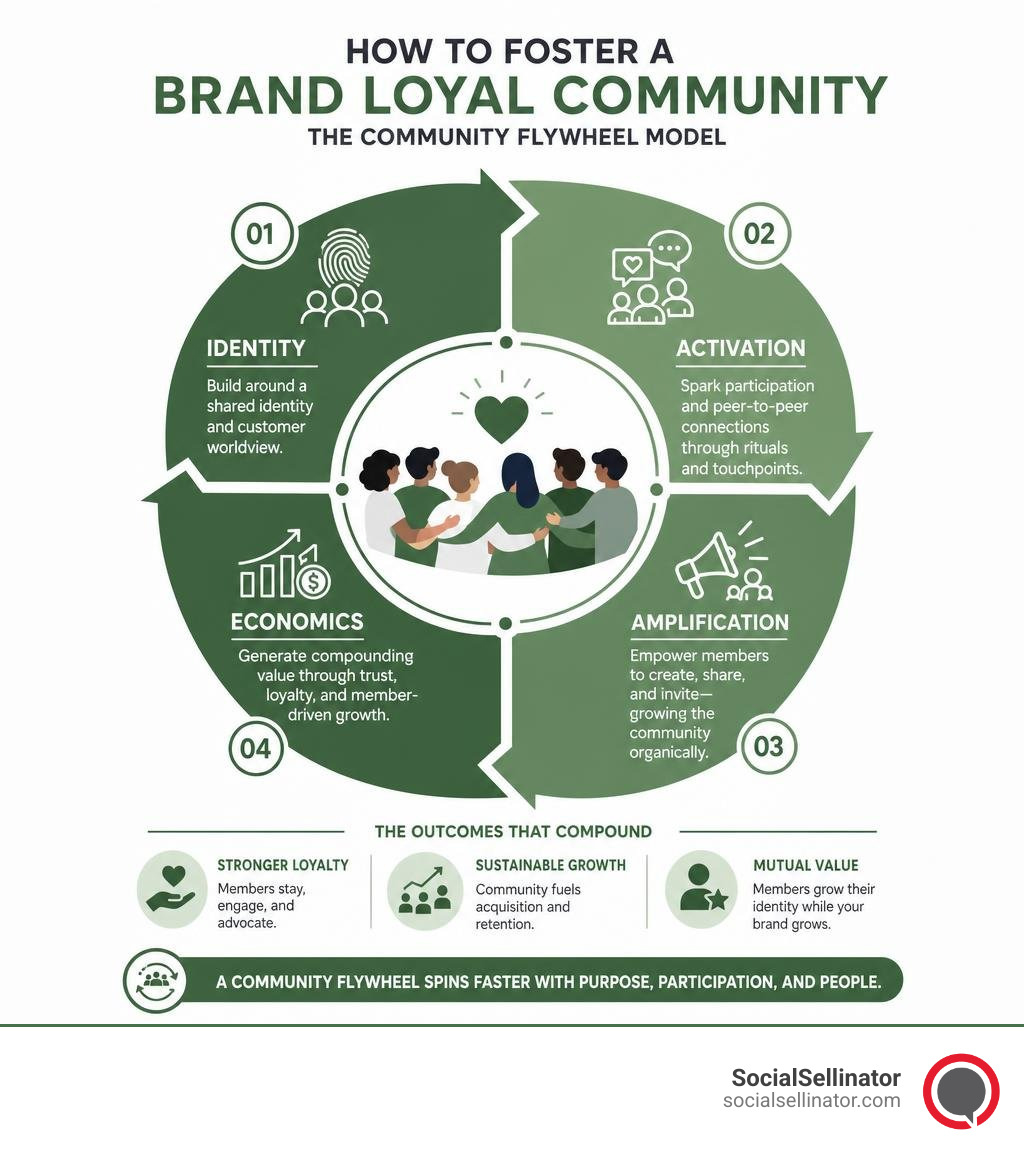
Building a thriving community is not an accident; it is an engineering problem. To scale a community sustainably, we utilize the community flywheel model. This structured, operational framework treats community-led growth as a compounding engine with four distinct layers:
- The Identity Layer (Shared Worldview): This is the foundation. It is where you excavate a shared tension or frustration in your market and name a specific worldview. It is not about your product’s feature list; it is about what your customers believe.
- The Activation Layer (Rituals and Participation): Once the identity is established, you must design consistent rituals that prompt action. This includes weekly discussion threads, monthly virtual events, or community challenges that naturally encourage participation.
- The Amplification Layer (Referrals and UGC): When members are active, they naturally want to share their experiences. This layer provides structured referral loops, ambassador programs, and user-generated content spotlights that turn active members into an organic acquisition force.
- The Economics Layer (LTV/CAC Math): This is where community-led growth proves its financial value. Active communities lower customer acquisition costs (CAC) through organic word-of-mouth and dramatically increase customer lifetime value (LTV) through emotional retention.
By organizing your efforts around this flywheel, you align your community initiatives with a clear social selling strategy, turning human connections into predictable business growth.
Peer-to-Peer vs. Brand-to-Consumer Relationships
When designing your community, where should you focus your energy? Should you spend more time building the relationship between the brand and the consumer, or should you focus on helping consumers connect with one another?
The research yields a surprising, yet definitive answer: Consumer-to-other-consumers identification has a stronger effect on overall brand community identification than consumer-to-brand identification.
While a strong, personalized relationship with your brand is important, it does not scale linearly. A brand can only have so many one-on-one conversations before running out of resources. Peer-to-peer relationships, however, scale infinitely.
When customers form direct social bonds with each other, they create a web of relationships that is incredibly difficult to break. A customer might switch to a competitor if they offer a lower price, but they are highly unlikely to leave a community where their friends, professional peers, and mentors gather. This peer-to-peer network is the ultimate retention mechanism, illustrating why prioritizing these bonds is essential for social media for business growth.
Designing Social Spaces to Foster Brand Loyal Community Growth
For social media managers, the mandate is clear: we must stop designing spaces for broadcasting and start designing spaces for connection. This requires a deliberate focus on experience design.
Here are the practical ways we can design these interactive spaces:
- Host Hybrid Events: Bridge the gap between digital and physical spaces. Whether it is a local meetup, a virtual roundtable, or a live-streamed workshop, hybrid events give members a chance to interact in real-time. Ensure remote participants have the same level of access, Q&A time, and engagement as in-person attendees.
- Elevate User-Generated Content (UGC): Actively spotlight your members’ creations, stories, and achievements. When you feature a customer’s post, you validate their self-expression and signal to the rest of the community that they are valued co-creators of the brand.
- Establish Clear Community Guidelines: A safe, welcoming environment is non-negotiable. Establish and enforce clear rules of engagement to keep discussions respectful, constructive, and free of spam.
- Implement Gamification and Status Mechanics: Reward valuable contributions. Use badges, tiers, or exclusive roles to recognize members who regularly start high-quality discussions or help answer questions for newcomers.
By putting these tactics into practice, you turn your social channels into dynamic hubs of active participation. If you need support in executing this, dedicating resources to professional content creation for social media ensures your prompts and interactive content consistently resonate with your audience.
Measuring the Impact: Attitudinal vs. Behavioral Loyalty
To make community building a defensible business strategy, we must measure its impact with financial and behavioral metrics. In our digital marketing work, we steer clear of vanity metrics like follower counts or arbitrary “likes.” Instead, we focus on hard business outcomes:
- Community-Referred CAC: The customer acquisition cost of users brought in through community referrals, which is typically 40% to 60% lower than blended paid acquisition CAC.
- 12-Month LTV Multiples: The lifetime value of community-engaged cohorts compared to standard customers. Healthy community flywheels often yield a 1.8x to 2.5x LTV multiple over a 12-month period.
- Community-Sourced Revenue: The total revenue driven directly by community channels, referrals, and co-created product launches.
By connecting community health to these financial metrics, you can clearly track your returns. This data-driven approach is essential for understanding your customer lifetime value definition and proving the long-term viability of your marketing investments.
The Loyalty Variance: 40% Attitudinal vs. 20% Behavioral
When analyzing the direct impact of community identification on customer loyalty, researchers make a crucial distinction between attitudinal loyalty and behavioral loyalty:
- Attitudinal Loyalty (40% variance explained): This represents the customer’s emotional attachment, brand love, and psychological preference. It is their internal commitment to your brand.
- Behavioral Loyalty (20% variance explained): This represents actual repeat purchasing behavior, transactional volume, and spending patterns.
Why is community identification twice as powerful at driving attitudinal loyalty (40%) than behavioral loyalty (20%)?
The answer lies in the complexity of purchasing decisions. While a customer may feel deeply aligned with your community (high attitudinal loyalty), their actual buying behavior (behavioral loyalty) is still influenced by external, practical factors like immediate budget constraints, product availability, convenience, and seasonal discounts.
However, attitudinal loyalty is the ultimate shield against market disruption. When a competitor launches a cheaper alternative, a customer who is only behaviorally loyal (buying out of habit or convenience) will easily switch. A customer who is attitudinally loyal will stay because they are emotionally invested in what your brand represents. This emotional buffer is what makes tracking your social media campaign ROI so critical over the long term.
Building the User’s Personal Brand (64% Variance Explained)
One of the most profound findings in modern community research is that brand community identification explains 64% of the variance in personal brand building among social media users.
This is a massive shift in how we view the brand-customer relationship:
Consumers use their association with distinct, reputable brands to build their own professional or social status. A software developer who is highly active in an elite tech brand’s community uses that participation to showcase their expertise, network with peers, and advance their career. A fitness enthusiast uses their association with a high-performance athletic brand to project a lifestyle of discipline and health to their own followers.
This represents a shift from focusing solely on company performance (sales, retention) to actively supporting consumer performance (helping the user succeed in their personal or professional life).
When your brand community helps members build their personal brands, you create a powerful, self-reinforcing bond. The customer is no longer just buying your product; they are using your platform to grow their own influence. This mutual value creation is the ultimate win-win, and it should be a central pillar of your branding strategy setting your digital marketing agency for success.
Frequently Asked Questions about Brand Communities
Navigating the transition to a community-led model can raise practical operational questions. As a specialized brand consulting agency, we regularly help businesses address these core challenges.
What is the difference between a brand audience and a brand community?
The difference lies entirely in the direction of the relationships.
An audience is built on a one-to-many broadcast model. The brand stands on a stage with a megaphone, and the customers sit in the seats watching. The relationship is purely linear: Brand to Consumer.
A community is built on a many-to-many relationship model. The brand steps off the stage and hosts a digital “coffee shop.” While the brand is present, the primary value comes from the social bonds and conversations happening between the customers themselves.
Commercially, this distinction is massive. Audiences require continuous paid spend to stay engaged. Communities self-moderate, self-sustain, and organically advocate for your brand. To see this in action, review these brand messaging examples to understand how to write copy that invites conversation rather than just broadcasting a sales pitch.
How does a brand community reduce customer support costs?
A highly engaged brand community acts as a decentralized, peer-to-peer support network. When a member runs into an issue, encounters a bug, or has a question about how to use a product feature, they often post about it in the community space before reaching out to support.
In a healthy community, other experienced members will jump in to answer the question, troubleshoot the issue, and offer solutions.
Research shows that active social media communities can cut customer support costs by up to 72%. This peer-to-peer assistance dramatically reduces the volume of support tickets landing in your team’s inbox, freeing up your customer service representatives to handle complex, high-priority issues. If you want to protect your brand’s image while scaling support, integrating your community strategy with professional brand reputation management services is an excellent way to keep digital spaces helpful and positive.
How long does it take to see measurable ROI from a brand community?
Building a genuine brand community is a long game. On average, it takes 12 to 24 months to reach a point where a community is self-sustaining and generating clear, compounding commercial returns.
The early months are entirely about establishing culture, recruiting your first 100 to 200 founding members, and building consistent habits of interaction. You cannot rush this phase; scaling a community container before the core culture is established is the fastest way to create a quiet, inactive space.
However, once you cross the tipping point, the returns compound exponentially. While paid media performance plateaus the moment you stop funding it, community-driven acquisition and emotional retention continue to grow, lowering your blended CAC and boosting profitability over time. Understanding this timeline is key to looking beyond the buzz and understanding why a strong brand reputation drives success over the long term.
Conclusion
Fostering a brand loyal community is not a soft marketing initiative; it is a highly structured, mathematically superior growth strategy. By satisfying your customers’ psychological needs for social interaction, self-expression, and belonging, you turn transactional buyers into an active, organic advocacy force.
When you build the identity layer first, design spaces for peer-to-peer connection, and measure the compounding economics of emotional loyalty, you build a growth engine that competitor ad spend simply cannot disrupt.
Ready to build a highly engaged, loyal brand community that drives real business growth? Partner with us at SocialSellinator to develop a customized digital marketing and social media strategy tailored to your business goals. Explore our social media management services today to get started.
Headquartered in San Jose, in the heart of Silicon Valley and the San Francisco Bay Area, SocialSellinator proudly provides top-tier digital marketing, SEO, PPC, social media management, and content creation services to B2B and B2C SMB companies. While serving businesses across the U.S., SocialSellinator specializes in supporting clients in key cities, including Austin, Boston, Charlotte, Chicago, Dallas, Denver, Kansas City, Los Angeles, New York, Portland, San Diego, San Francisco, and Washington, D.C.