
Cracking the Google Top 10 SEO Ranking Factors Code
What Are the Google Top 10 SEO Ranking Factors in 2026?
Alt text: Google top 10 SEO ranking factors header image showing search engine optimization concept. Metadata: Width 1200px, Height 630px, Format JPG
Understanding the google top 10 seo ranking factors is the difference between page one visibility and digital obscurity. Here’s a quick-reference snapshot before we dive deeper:
| Rank | Ranking Factor | Estimated Weight |
|---|---|---|
| 1 | Content Quality | 23% |
| 2 | Keyword in Title Tag | 14% |
| 3 | Backlinks | 13% |
| 4 | Niche/Topical Expertise | 13% |
| 5 | Searcher Engagement Signals | 12% |
| 6 | Content Freshness | 6% |
| 7 | Mobile-First Optimization | 5% |
| 8 | Trustworthiness (E-E-A-T) | 4% |
| 9 | Link Diversity | 3% |
| 10 | Page Speed | 3% |
Source: First Page Sage 2026 analysis. These five factors alone account for roughly 75% of ranking decisions.
Google processes over 3.5 billion searches every single day. Every one of those searches triggers a complex, multi-layered ranking system that evaluates hundreds of signals in a fraction of a second.
Most SEO guides tell you the same things: content is king, get backlinks, make your site fast. That’s not wrong. But it’s not enough to make real decisions with.
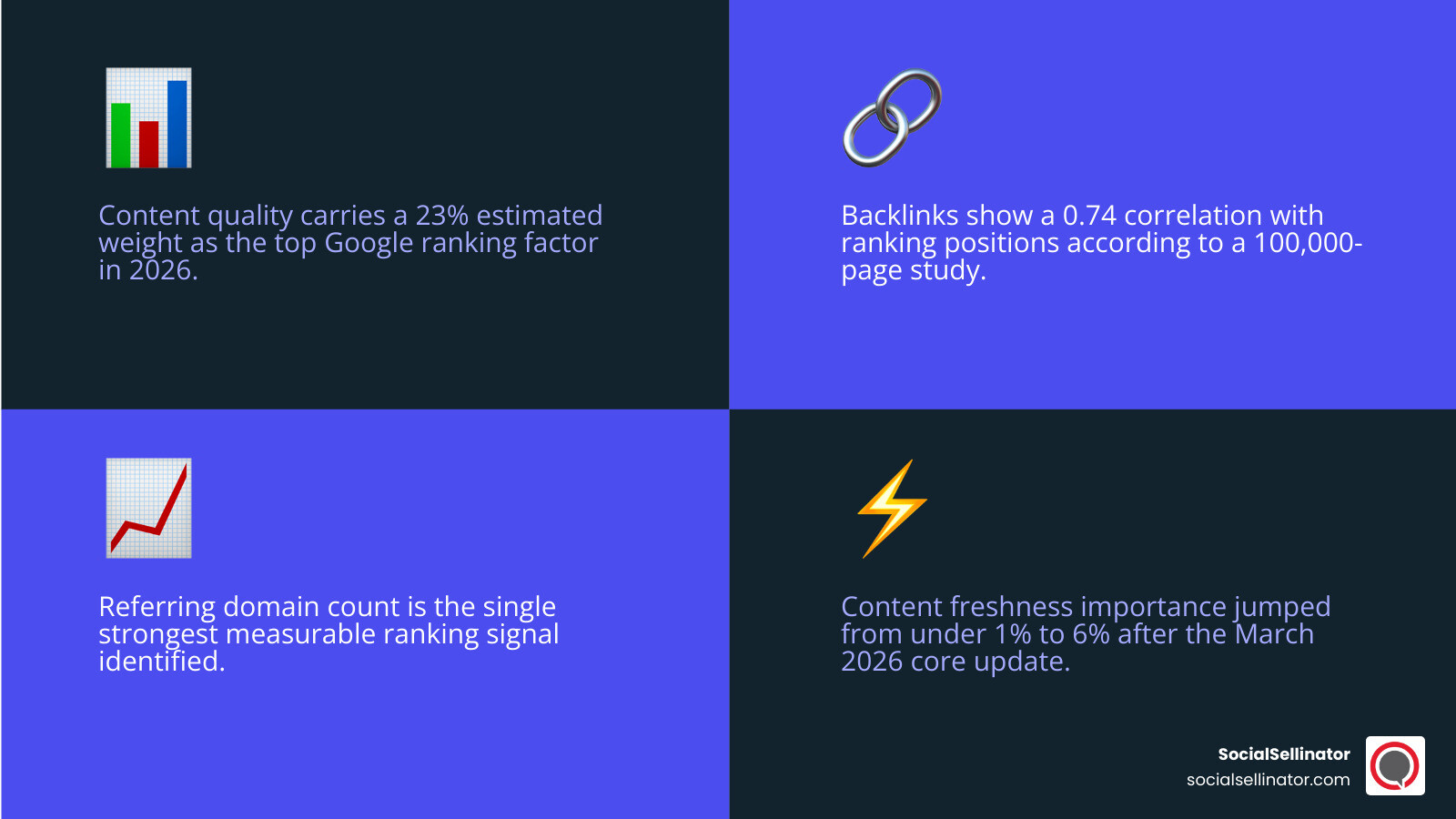
What’s changed in 2026 is the weight of those signals. Content freshness jumped from under 1% to 6% importance in just one year. The March 2026 core update penalized AI-generated content published at scale without editorial judgment. And a large-scale 100,000-page correlation study confirmed that referring domain count is the single strongest measurable factor at a 0.74 correlation with rank.
The good news? The five most important factors combined explain about 75% of ranking outcomes. You don’t need to chase 200 signals. You need to nail the ones that actually move the needle.
Alt text: Google top 10 SEO ranking factors weighted chart infographic showing the percentage weights of key ranking signals in 2026. Metadata: Width 1200px, Height 630px, Format JPG
Google top 10 seo ranking factors terms to learn:
Demystifying the Google Top 10 SEO Ranking Factors
To understand how to rank on the first page of Google, we must first look past the simplified checklists and understand how Google’s ranking architecture actually functions. Google does not merely run down a static list of 200 items. Instead, it processes search results through layered systems that evaluate different dimensions of a web page simultaneously.
Recent technical revelations and documentation leaks have confirmed that Google’s algorithm relies on a core three-factor formula to determine search ranking positions:
$$\text{Topicality } (T^) \times \text{ Site Quality } (Q^) \times \text{ Popularity } (P^*)$$
Each of these three elements represents a distinct layer of the ranking engine:
Topicality ($T^*$): This is the relevance layer. It determines whether your page is actually about the search query. It is built primarily from three signals:
- Anchors: The anchor text of internal and external links pointing to your page.
- Body: The actual written content, keyword placement, and semantic relationships on your page.
- Clicks: Historical user selections that show searchers found your page relevant to that specific query.
Site Quality ($Q^*$): This layer measures the overall caliber of your website. Google uses a quality scale of 0 to 1, where 0.4 serves as a strict eligibility threshold for advanced search features like Featured Snippets and People Also Ask boxes. Site Quality is calculated using:
- Brand Visibility: How often users search for your brand name alongside industry terms.
- SERP Selection Rate: How frequently searchers choose your website over others, even when you aren’t in the absolute first position.
- Anchor Text Brand Prevalence: The proportion of your backlink profile that includes your brand name.
Popularity ($P^*$): This layer measures user engagement and external authority. It relies heavily on systems like NavBoost, which tracks a 13-month rolling history of user click data to determine which results consistently satisfy search intent. It also incorporates Google’s classic PageRank link graph to verify external trust.
When a query is entered, the core ranking engines (such as Mustang and Ascorer) retrieve a broad pool of eligible candidate pages based on basic relevance. Then, specialized post-ranking filters—known internally as the Twiddler framework—re-rank those candidates in real-time, applying adjustments for content freshness, mobile experience, and local intent.
By understanding this multi-layered architecture, you can move away from superficial keyword stuffing and focus on building a site that satisfies all three dimensions of the core ranking formula. For a deeper look at navigating this organic search landscape, read our comprehensive guide on How to Master SEO Organic Ranking and Outshine Your Competitors.
To successfully align with these systems, businesses must adopt a holistic approach. This is where professional digital marketing services become invaluable. By leveraging advanced data analytics and technical expertise, a dedicated team can optimize every layer of this formula, ensuring your site meets the strict quality thresholds and relevance signals that Google’s core engines demand.
The Core Pillars: On-Page, Off-Page, and Technical SEO
Successful search engine optimization is built on three core pillars. Each pillar addresses a different component of Google’s ranking formula, and neglecting any one of them can prevent your site from reaching the top ten.
The Three Pillars of Google Search Visibility
- On-Page SEO (Relevance & User Intent)
- Content Quality
- Title Tags
- Semantic Keywords
- Off-Page SEO (Authority & Popularity)
- Backlink Profile
- Referring Domains
- Brand Mentions
Technical SEO (Usability & Crawlability)
- Core Web Vitals
- Mobile-First Indexing
- HTTPS Security
On-Page SEO: This pillar is fully within your control and focuses on signaling your page’s relevance to Google ($T^*$). It includes writing high-quality content, structuring your pages with logical heading tags, and naturally placing keywords where search engines expect to find them. To align your on-page elements with Google’s modern expectations, explore our On-Page SEO Recommendations: How to Make Google Fall in Love with Your Content.
- Off-Page SEO: This pillar focuses on building your site’s authority and popularity ($P^*$) through external signals. It involves earning links from other reputable websites, generating brand mentions, and establishing a positive reputation across the web. To learn how to build a natural, authoritative backlink profile, check out our proven Off-Page SEO Strategies.
- Technical SEO: This pillar ensures that search engine crawlers can easily find, read, and index your pages. It also guarantees a smooth, secure experience for your human visitors. A site with exceptional content will still struggle to rank if it suffers from broken links, slow load times, or poor mobile rendering. You can evaluate your site’s technical health by reviewing our step-by-step guide on Technical SEO Analysis.
Content Quality: The Core of Google Top 10 SEO Ranking Factors
In May 2026, content quality remains the single most important ranking factor, accounting for an estimated 23% of Google’s algorithm weight. However, what Google considers “high quality” has evolved. With the rise of generative AI, search engines are flooded with generic, synthesized text. To stand out, your content must offer genuine, human-driven value.
Google evaluates content quality using the E-E-A-T framework:
- Experience: Does the content demonstrate first-hand, real-world experience? (e.g., original photos, personal case studies, or hands-on testing).
- Expertise: Is the author uniquely qualified to write on this topic?
- Authoritativeness: Is your website recognized as a primary source of information within your industry?
- Trustworthiness: Is the information accurate, transparent, secure, and honest? This is the most critical element of the framework.
To rank in the top ten, your content must also align perfectly with search intent. You must understand whether a searcher is looking for information, trying to make a purchase, or comparing different options.
Recent correlation analyses show that content depth has a strong 0.62 correlation with high rankings. This doesn’t mean you should simply write longer articles; it means you must cover your topic thoroughly. In fact, long-form content (exceeding 3,000 words) generates 77.2% more backlinks than shorter, superficial posts because it serves as a comprehensive resource.
When optimizing your content, focus on natural language and semantic relevance rather than rigid keyword percentages. To learn more about modern keyword integration, read our guide on Beyond Stuffing: Smart Keyword Usage for SEO Success.
Technical Optimization and the Google Top 10 SEO Ranking Factors
Technical optimization ensures your site is fast, responsive, secure, and accessible on every device. Google prioritizes pages that load quickly and function flawlessly, particularly on mobile devices.
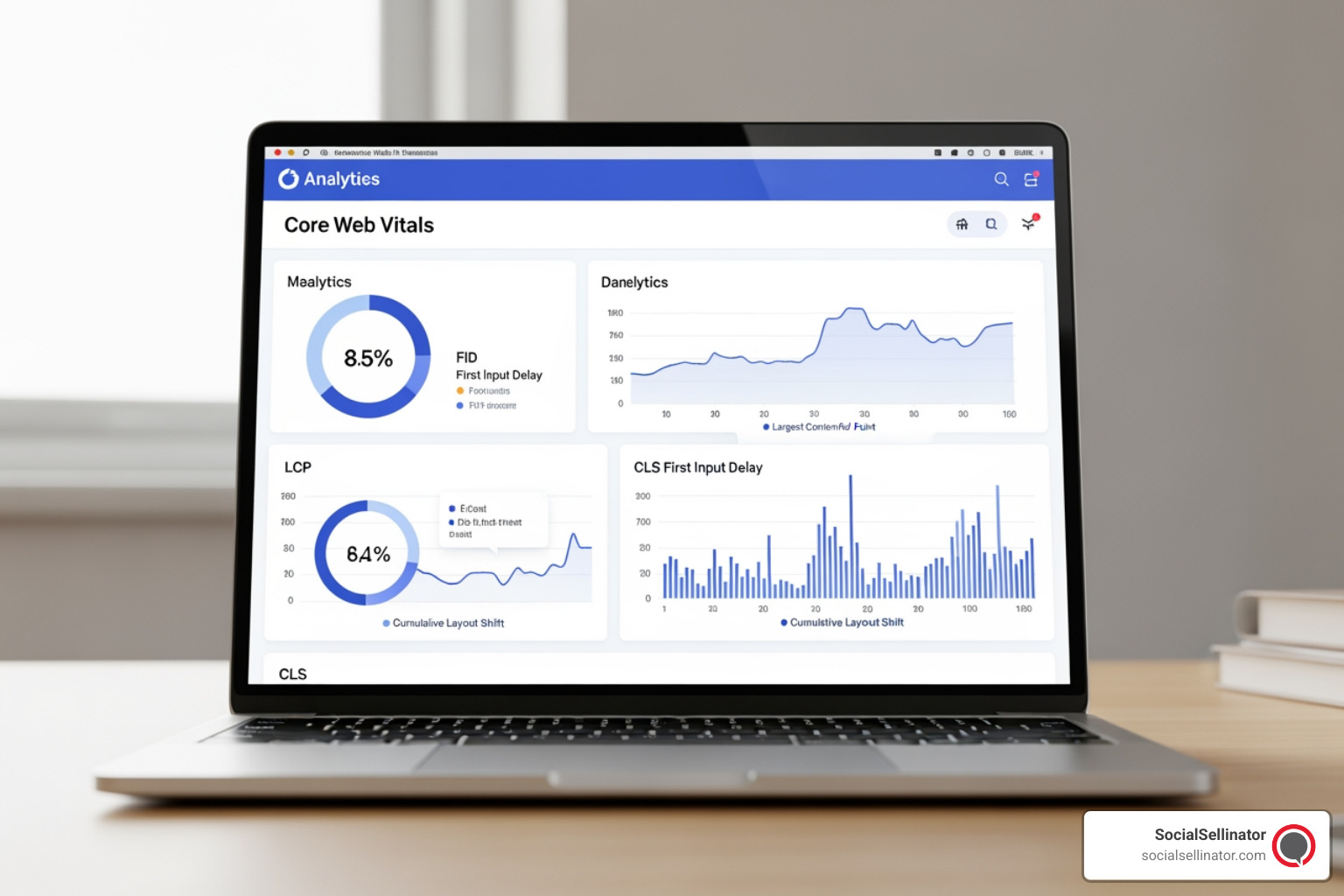
Alt text: Technical SEO metrics and Core Web Vitals diagram showing LCP, FID, and CLS benchmarks. Metadata: Width 800px, Height 450px, Format JPG
To secure a spot in the top ten, your website must meet these technical standards:
- Core Web Vitals: These user-focused metrics measure key aspects of page experience:
- Largest Contentful Paint (LCP): Measures loading speed. To provide a good user experience, LCP should occur within 2.5 seconds of when the page first starts loading.
- First Input Delay (FID) / Interaction to Next Paint (INP): Measures page responsiveness. Pages should have an INP of 200 milliseconds or less to feel snappy and responsive.
- Cumulative Layout Shift (CLS): Measures visual stability. Pages should maintain a CLS score of less than 0.1 to prevent annoying layout shifts while loading.
- Mobile-First Indexing: Google crawls and indexes the mobile version of your website first. If your mobile layout is cluttered, has unreadable text, or features broken navigation, your desktop rankings will suffer as well.
- HTTPS Security: User safety is non-negotiable. Google confirmed HTTPS as a ranking signal back in 2014. Sites without an active SSL certificate are flagged as insecure, which quickly drives visitors away.
- Clean URL Structures: Descriptive, easy-to-read URLs help both search engines and users understand what a page is about. Learn how to structure your addresses with our guide on How to Create SEO Friendly URLs.
- Image Optimization: Large, uncompressed images are a primary cause of slow load times. Keep your site running fast by following our best practices on How to Optimize Images for SEO.
Implementing these technical standards requires a deep understanding of web development and search engine behavior. For many businesses, managing these complex technical requirements internally can be overwhelming. Partnering with a professional agency that offers comprehensive SEO and digital marketing services ensures that your site’s technical foundation is robust, secure, and fully optimized to meet Google’s strict ranking criteria.
Authority, Backlinks, and User Engagement Signals
While on-page and technical optimizations lay a strong foundation, Google also relies on external signals and user behavior to determine final rankings.
Key Off-Page and Engagement Signals
- Authority Signals
- Referring Domain Count (0.74 Correlation)
- Backlink Profile Quality (13% Weight)
- Topical Link Relevance
- Engagement Signals
- NavBoost (Rolling Click History)
- SERP Selection Rate (CTR)
- Pogo-Sticking (-0.41 Correlation)
The Power of Backlinks
Backlinks remain one of the most powerful ways to build search authority. A comprehensive correlation study reveals that referring domain count has a 0.74 correlation with organic rank—making it the strongest single measurable factor in search engine optimization. Furthermore, the top-ranking result on Google typically has 3.8 times more backlinks than positions two through ten.
Howbeit, modern link building is about quality rather than sheer volume. In fact, 93.8% of link builders agree that a single high-quality link from an authoritative, industry-relevant site is worth more than dozens of low-quality directory links. Google’s link analysis systems evaluate the relationships between websites, meaning links from relevant businesses in your niche carry far more weight than random, unrelated links.
Google’s understanding of links is rooted in foundational concepts such as PageRank, which helps explain why authoritative and contextually relevant references still matter so much in 2026. Building these high-quality links requires a strategic approach, combining content creation with targeted outreach to earn the trust of other industry leaders.
User Engagement and NavBoost
Google also monitors how users interact with search results to assess content value. Through systems like NavBoost, Google analyzes a 13-month rolling history of user click data. This includes:
- SERP Selection Rate: If searchers consistently click your link instead of higher-ranking results, Google’s algorithm will boost your position.
- Pogo-Sticking: This occurs when a user clicks a search result, quickly realizes it doesn’t answer their question, and clicks the back button to select a different result. Pogo-sticking has a strong negative correlation of -0.41 with organic rankings. To prevent this, make sure your page answers the user’s query within the first five seconds of loading.
Local SEO and Voice Search Integration
For businesses operating in specific geographic regions, local search signals are critical for driving target traffic. Optimizing for local search helps your business appear in Google’s Local Map Pack, which displays prominent map listings for nearby services.
Key factors that influence your local search visibility include:
- Google Business Profile Optimization: Keep your profile accurate, complete, and updated with fresh photos and posts.
- Local Citations: Ensure your business Name, Address, and Phone number (NAP) are consistent across all online directories.
- Customer Reviews: A steady stream of positive, detailed reviews signals to Google that your business is active and trusted by local customers.
Additionally, as mobile devices and smart speakers continue to grow in popularity, optimizing for voice search is increasingly important. Voice queries tend to be longer, more conversational, and phrased as natural questions. Focus on targeting long-tail keywords and structuring your content to answer common questions clearly and concisely.
To build a strong local presence, explore our guide on Local SEO Explained: Your Guide to Dominating Local Search Results. To prepare your site for conversational queries, read our practical tips on How to Optimize for Voice Search SEO.
Navigating the complexities of local search and user engagement requires a coordinated effort across multiple marketing channels. From managing local citations to crafting conversational content, a comprehensive digital marketing strategy is essential. By utilizing professional SEO and social media management services, businesses can build a cohesive online presence that drives local engagement, improves search visibility, and fosters long-term customer loyalty.
Frequently Asked Questions about Google Rankings
How many ranking factors does Google actually use?
While industry publications often cite “over 200 ranking factors,” this number originally comes from a single interview back in 2009. In reality, Google relies on automated, layered ranking systems rather than a simple checklist. Google has only officially confirmed seven primary ranking factors, including high-quality content, authoritative backlinks, and page experience. Instead of trying to optimize for hundreds of minor signals, you will see the best results by focusing on the core elements: content relevance, site authority, and a fast, user-friendly experience.
Does domain age or domain authority directly impact rankings?
Domain age itself is not a direct ranking factor, but it correlates closely with search success. Data shows that 72.9% of pages ranking in the top ten are at least three years old. This is because older domains have had more time to earn high-quality backlinks, build topical authority, and establish user trust. Rather than worrying about the age of your domain, focus on building topical authority by creating comprehensive clusters of high-quality content that cover your niche thoroughly.
How do AI Overviews and systems like BERT affect SEO?
Google uses sophisticated AI systems to better understand search queries and web page content:
- BERT: This system helps Google understand how words work together in natural sentences, allowing the search engine to grasp the context of a query rather than just looking at individual keywords.
- RankBrain: This machine-learning system helps Google process unique or unfamiliar queries by associating them with similar search terms it already understands.
- AI Overviews: These automated summaries appear at the top of many search results to provide quick answers to complex questions. Sites that feature clear, structured, and authoritative content are much more likely to be cited as sources within these AI-generated answers.
How can businesses keep up with Google’s frequent algorithm updates?
Google updates its search algorithms thousands of times a year, with several major core updates that can significantly shift search rankings. To keep up, businesses must focus on long-term, sustainable SEO practices rather than trying to “game” the system. This involves regularly auditing your website’s technical health, updating older content to maintain freshness, and continuously building high-quality backlinks. Because monitoring these updates and adjusting strategies requires significant time and expertise, many successful companies partner with digital marketing agencies to manage their SEO, content creation, and PPC campaigns, ensuring they remain competitive in an ever-changing search landscape.
Conclusion
Succeeding in search engine optimization in May 2026 requires a balanced approach. While the search landscape continues to evolve with AI updates, the fundamental principles of SEO remain the same. By focusing on high-quality content, building authoritative backlinks, and maintaining a fast, secure website, you can earn lasting visibility on Google’s first page.
Investing in a comprehensive SEO strategy delivers sustainable, long-term returns for your business. To learn more about the business value of search visibility, read our guide on The ROI of SEO: What You Need to Know Before You Invest.
If you are ready to grow your online presence and reach more customers, we can help. Our team of experienced digital marketing professionals will work with you to design a customized strategy that aligns with your business goals and delivers measurable results.
Headquartered in San Jose, in the heart of Silicon Valley and the San Francisco Bay Area, SocialSellinator proudly provides top-tier digital marketing, SEO, PPC, social media management, and content creation services to B2B and B2C SMB companies. While serving businesses across the U.S., SocialSellinator specializes in supporting clients in key cities, including Austin, Boston, Charlotte, Chicago, Dallas, Denver, Kansas City, Los Angeles, New York, Portland, San Diego, San Francisco, and Washington, D.C.