

A Practical Guide to Dallas Split Testing Software and Tools
How to Choose A/B Testing Tools in Dallas
Header image: Dallas marketing team reviewing split-test results.
A/B testing tools in Dallas are not limited to local vendors. For website and landing page tests, start by comparing VWO, Convert Experiences, and AB Tasty. If your team tests app features or needs controlled rollouts, look at Statsig and LaunchDarkly. The best choice depends on what you test, how much traffic you have, and whether marketers or developers will run the experiments.

Inline image: A dashboard comparing landing page results.
A visual editor can help a small marketing team launch a simple test. A growing product team may need server-side testing, feature flags, and tighter control over who sees each version. Either way, check how the tool sends results to Google Analytics 4 or Adobe Analytics before you buy.
I’m Jock Breitwieser, and this guide will help you narrow the options to tools that fit your team and goals.
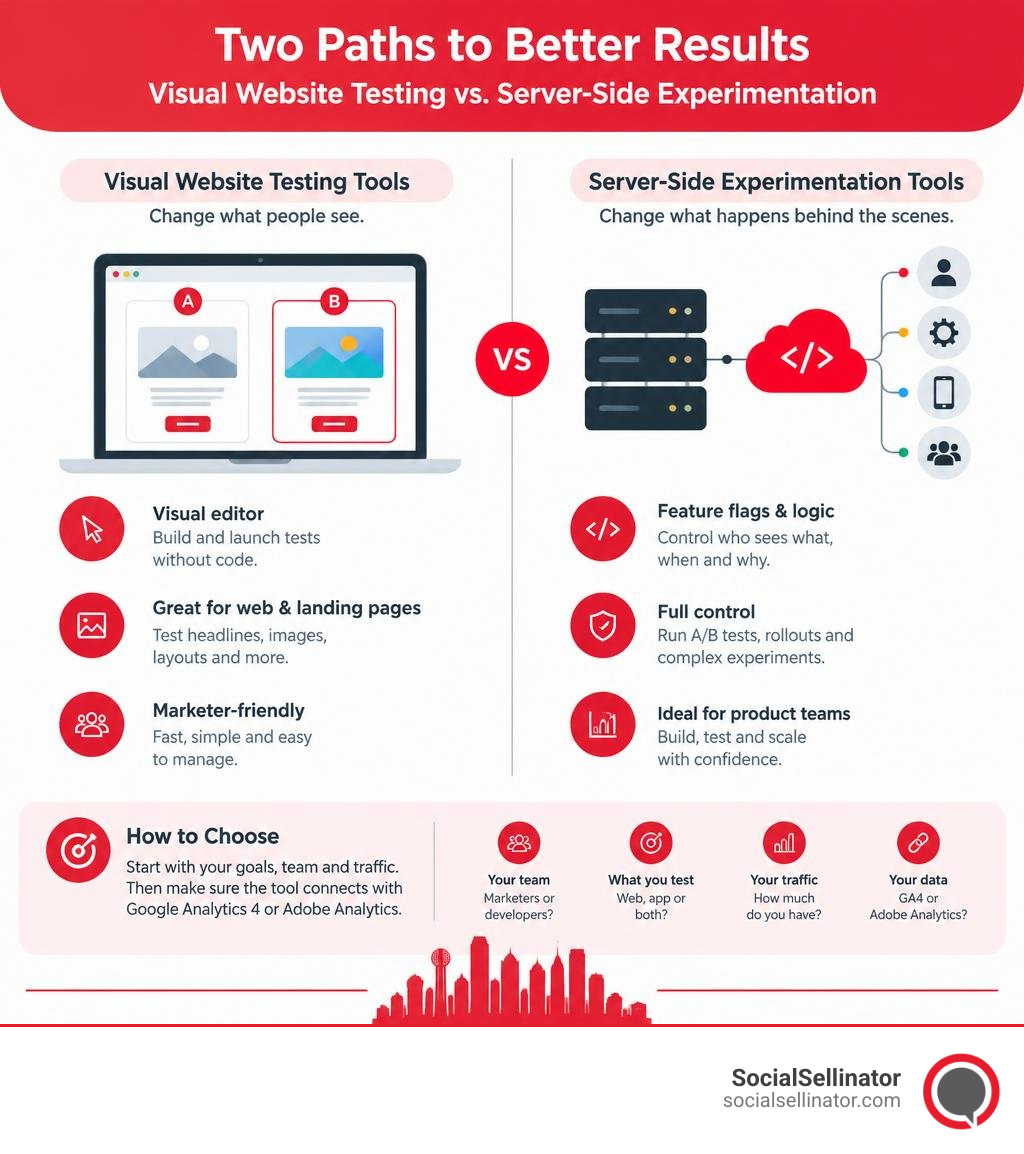
Infographic: Where to start when choosing a website testing or server-side experimentation tool.
Easy a/b testing tools dallas glossary:
Top A/B Testing Tools Dallas Businesses Rely On in 2026
The North Texas business corridor moves at breakneck speed. Whether you manage a global enterprise in Downtown Dallas, scale a high-velocity B2B SaaS venture along the Platinum Corridor in Plano, or lead a boutique eCommerce brand in Uptown, relying on gut instinct to guide conversion pathways leaves substantial revenue on the table. Systematic conversion rate optimization requires software that provides high rendering speeds, dependable statistical modeling, and seamless workflow execution. If your team invests in creating high-converting landing pages, pairing design assets with robust experimentation software ensures maximum return on every marketing dollar.
Here is how the top experimentation and split testing platforms compare across deployment methods, statistical frameworks, traffic sweet spots, and pricing structures:
| Platform | Primary Deployment | Statistical Engine | Traffic Sweet Spot | Starting Price (2026) | Best Use Case |
|---|---|---|---|---|---|
| Convert Experiences | Client-side & Full-Stack | Dual (Bayesian & Frequentist) | 100k+ Monthly Users | $399/mo (Growth plan) | Mid-market & Enterprise B2B CRO |
| VWO | Client-side, Server-side, Mobile | Bayesian Engine (SmartStats) | 10k to Enterprise | Free tier (up to 50k users) | Comprehensive visual testing & heatmaps |
| AB Tasty | Client-side & Server-side | Bayesian & Multi-Armed Bandit | 50k+ Monthly Users | Custom enterprise pricing | Dynamic traffic routing & UX testing |
| Statsig | Server-side & SDK-driven | CUPED & Bayesian/Frequentist | 50k to Millions of Events | Free tier available; usage-based | Engineering-led product experimentation |
| LaunchDarkly | Edge / Server-side / Client | Frequentist & Guardrail Metrics | 10k+ Monthly Active Users | Custom tiered pricing | Feature flagging & safe rollouts |
| Howuku Optimize | Client-side (No-Code) | Multi-Armed Bandit / Bayesian | 50k to 500k Users | Free Starter tier; $150/mo Growth | Fast no-code landing page experiments |
| Keak | Chrome Extension / Pixel | Automated AI Bayesian | 1k to 100k Users | Subscription tiers | Autopilot AI variant generation |
Convert Experiences: Best for Scalable B2B Experimentation
Convert Experiences stands out as a leading platform for B2B brands and mid-market organizations that value site performance, comprehensive targeting rules, and rigorous data privacy compliance. Built specifically for technical growth marketers and agency teams, Convert solves the persistent challenge of page flicker in client-side testing. Its lightweight asynchronous script ensures visitors never encounter a distracting visual flash before the test variation renders, preserving user trust and maintaining data fidelity.
A primary differentiator for Convert is its dual statistical modeling engine. Growth teams can toggle between Bayesian probability calculations and classic frequentist hypothesis testing depending on organizational standards. Bayesian reporting allows stakeholders to understand the exact probability of a variant outperforming the baseline, which accelerates commercial decision-making. Conversely, frequentist reporting provides standard p-values and fixed sample horizons preferred by formal data science teams.
Convert provides over 90 pre-built integrations connecting to customer data platforms, analytics systems, and tag management solutions. The Growth tier starts at $399 per month for up to 100,000 tested visitors, while the Pro tier ($599 per month) adds multivariate testing, multi-page experiment architectures, and full-stack capabilities. For marketing teams managing cross-regional initiatives such as conversion rate optimization austin campaigns, Convert offers enterprise-grade power without onerous multi-year software commitments.
VWO and AB Tasty: Leading Visual and Full-Stack Experiment Suites
For marketing teams prioritizing intuitive point-and-click editing alongside integrated qualitative behavioral analytics, VWO and AB Tasty remain industry favorites.
VWO provides an end-to-end conversion suite. Its visual editor lets marketers update copy, replace imagery, restructure forms, and modify layouts without developer intervention. Beyond traditional split testing, VWO integrates session recordings, funnel drop-off reports, and heatmaps directly into experiment dashboards. Marketers can segment visitor recordings specifically by those exposed to Variant A versus Variant B, revealing not only which page generated more sales, but the behavioral patterns explaining why. VWO also features an IdeaFactory repository that provides evidence-backed hypothesis templates across industries. Early-stage businesses can leverage VWO’s free tier for up to 50,000 monthly visitors, with modular paid tiers scaling as visitor numbers grow.
AB Tasty excels at real-time, data-driven optimization for mid-market and enterprise businesses. While featuring visual and code editors, its defining strength is dynamic traffic management. Using multi-armed bandit algorithms, AB Tasty automatically routes a greater proportion of traffic toward winning variations during active campaigns. This protects marketing budgets by limiting exposure to underperforming designs during high-stakes sales cycles or seasonal promotions.
Statsig and LaunchDarkly: Server-Side Flags and Engineering Agility
As organizations mature, testing expands past headline variations into complex backend logic, dynamic pricing models, search ranking algorithms, and user onboarding flows. In these scenarios, server-side platforms and feature flagging frameworks are essential.
Statsig integrates SDK-based feature evaluation with granular event logging. This architecture prevents attribution discrepancies between user actions and experiment groups. Statsig natively incorporates CUPED (Controlled-experiment Using Pre-Existing Data), a statistical variance reduction method that allows development teams to detect statistically significant outcomes up to 50% faster than traditional testing approaches. With transparent usage-based pricing and a generous free tier, Statsig appeals strongly to product-led software teams.
LaunchDarkly focuses on enterprise feature management and progressive delivery. Rather than deploying code directly into production and hoping for smooth adoption, software teams use LaunchDarkly to encapsulate new releases within feature flags. Engineering teams can route new code to small cohorts (such as 1% or 5% of users), monitor error rates and latency against predefined guardrail metrics, and execute instantaneous rollbacks if performance slips. For tech-forward companies evaluating a/b testing tools dallas, prioritizing edge latency, multi-language SDK support, and role-based permissions is crucial for long-term scalability.
Keak and Howuku: AI-Native Autopilot and No-Code CRO
For lean startups, boutique service firms, and marketing teams lacking dedicated software developers, emerging AI-native tools provide accessible entry points into continuous experimentation.
Keak operates via a lightweight browser extension and a compact 34 KB tracking pixel. Using artificial intelligence models trained on high-converting landing page designs, Keak evaluates existing digital assets and automatically drafts alternative headlines, benefit bullet points, hero banners, and calls to action. In AutoPilot mode, the platform deploys, tracks, and promotes top-performing variations with minimal manual configuration, letting growth managers focus on strategic direction.
Howuku Optimize delivers an affordable alternative to legacy optimization software. With plans ranging from a free starter tier to accessible Growth ($150 per month) and Pro ($360 per month) options, Howuku combines an on-page visual builder, multi-armed bandit routing, and behavioral targeting. Marketers can trigger variations based on scroll percentages, referral channels, user operating systems, or geographic locations, making tailored user experiences attainable on realistic budgets.
Evaluating Experimentation Approaches: AI Automation vs. Traditional Causal Analytics
Choosing experimentation software is only the first step; your strategic framework for designing, executing, and interpreting tests dictates actual return on investment. The modern digital optimization space balances two major philosophies: rapid AI-driven automated personalization and disciplined causal analytics. High-performing organizations integrate both approaches to achieve sustainable conversion growth.
AI-Driven Variant Generation and Dynamic Traffic Personalization
Artificial intelligence has transformed digital testing from a slow, manual cadence into an active, continuous optimization loop. In standard split testing, marketers build two fixed designs, allocate traffic evenly (50/50), and collect data over several weeks to determine an overall winner.
AI-powered testing introduces three distinct operational advantages:
- Automated Copywriting and Creative Ideation: Machine learning assistants inspect user engagement data and automatically produce alternative copy variations aligned with audience intent. For example, when VWO implemented AI-generated copy across interactive customer touchpoints, the automated variants generated a 7.06% lift in click-through rates compared to manual copy. Similarly, European home furnishing retailer Bimago utilized automated personalization to deliver dynamic banners tailored to visitor screen sizes, achieving a 44% lift in newsletter subscriptions.
- Predictive Audience Targeting: Machine learning evaluates incoming visitor attributes in real time, including device type, traffic acquisition channel, historical page interaction, and geographic location, to present tailored variations immediately. Companies using predictive targeting consistently see significant engagement gains; industrial supplier Plasto recorded a 35% increase in click-through rates and a 21% improvement in subscription renewals by targeting promotions to high-intent visitor cohorts.
- Dynamic Pricing and Value Proposition Testing: Digital retailers can leverage automated algorithms to test pricing sensitivity and discount structures without degrading customer loyalty. Analytics firm Omniconvert demonstrated that dynamic promotional split tests achieved a 15% increase in average order value while maintaining strong checkout completion rates.
When combined with strategic ppc advertising complete guide campaigns, dynamic personalization ensures that paid ad traffic lands on custom messaging matching user intent, significantly lowering customer acquisition costs.
Statistical Significance, Causal Inference, and Avoiding Over-Testing
While automated AI tools provide speed, foundational causal analytics prevent growth teams from drawing false conclusions. A key insight taught across advanced data science programs is that correlation does not equal causation. A temporary increase in conversion rates during an active experiment does not automatically prove the variant caused the improvement; seasonal demand, regional ad promotions, external economic factors, or unexpected traffic spikes can easily distort results.
To ensure your testing program produces genuine causal insights, your team should adhere to key statistical principles:
- Establishing Sound Confidence Thresholds: The standard threshold for statistical significance in online experimentation is 95% (a p-value under 0.05), indicating a 5% or lower probability that the observed result occurred by random chance. However, for low-risk micro-copy adjustments or early exploratory tests on moderate-traffic pages, insisting on a 95% threshold can stall velocity. In agile marketing environments, establishing an 80% confidence threshold for non-critical elements can accelerate testing cycles by up to 30%.
- Calculating Minimum Detectable Effect (MDE): Prior to launching an experiment, determine your required sample size based on your baseline conversion rate and the minimum percentage lift you intend to measure. Testing subtle variations on low-traffic checkout steps often requires months of continuous data collection to reach statistical certainty, during which shifting audience behaviors can compromise baseline accuracy.
- Preventing Experimentation Burnout: Industry data indicates that 62% of digital marketers spend excessive time analyzing inconclusive split tests. Over-testing trivial visual elements, like slight border radiuses or minor button shadows, drains team bandwidth and delays meaningful UX enhancements. Impactful optimization prioritizes core value propositions, simplified checkout flows, transparent pricing layouts, and streamlined lead forms.
Selecting and Implementing Experimentation Platforms for Texas Teams
Deploying a scalable experimentation program requires selecting tools that align with your organizational size, technical resources, and broader analytics ecosystem. Here is how growing businesses, enterprise brands, and mission-driven non-profits manage platform selection and technical integration.
Evaluating Enterprise vs. Startup A/B Testing Tools in Dallas
Early-stage companies and established enterprise organizations operate under vastly different technical and financial parameters. For emerging ventures and boutique marketing teams, primary constraints center around visitor volume and software licensing costs. Investing thousands of dollars monthly in complex enterprise software provides little return if site traffic cannot reach statistical significance within a reasonable four-week window.
For early-stage operations, platforms like VWO (with its 50,000 MTU free tier), Howuku Optimize ($0 to $150 per month), or Statsig provide low-friction entry points. As digital acquisition programs expand into regional markets, companies scaling their denver conversion optimization and Texas campaigns can transition into platforms like Convert Experiences ($399 per month for 100,000 tested users) to execute complex JavaScript manipulations, audience segmentation, and multi-page funnel tests.
Enterprise organizations maintaining dedicated product management, web development, and digital marketing departments require centralized governance. These companies prioritize single sign-on (SSO), granular role-based permissions, automated audit logs, and data privacy compliance across regional and federal standards. In these large-scale environments, feature management platforms like LaunchDarkly and server-side solutions like Statsig ensure that product updates and interface experiments deploy securely across millions of customer interactions.
How Nonprofits Adopt A/B Testing Tools in Dallas After Google Optimize
The digital experimentation ecosystem underwent a major shift when Google officially retired its free testing solution, Google Optimize, in late 2023. This change significantly impacted the nonprofit and charitable sector, where organizations relied heavily on the free tool to optimize donation forms, volunteer registrations, and fundraising campaigns.
Modern platforms offer several cost-effective paths forward for nonprofits:
- Utilizing Freemium and Tiered Solutions: Nonprofits can migrate their donor conversion funnels to VWO’s free starter tier or Howuku’s cost-effective plans, retaining on-page visual editing without stretching operating budgets.
- Targeting High-Friction Donation Elements: Rather than spreading tests thinly across entire websites, nonprofit marketing teams should focus experiments on key donor conversion points, such as suggested gift amounts, recurring donation toggles, and simplified mobile payment options like Apple Pay and Google Pay.
- Leveraging Structured Test Repositories: Nonprofits benefit from documenting donor motivations, emotional triggers, and friction points within organized hypothesis libraries before building variants.
Analytics Integrations: GA4 and Adobe Analysis Workspace Workflows
An experimentation tool must not function in isolation. To maintain clean attribution and deliver transparent stakeholder reporting, your testing platform must integrate with your primary analytics reporting stack, whether Google Analytics 4 (GA4) or Adobe Analytics.
When connecting your testing tool with Google Analytics 4, confirm that your software passes experiment IDs and variant labels as custom user properties or event parameters. This configuration enables your team to evaluate downstream engagement, including lifetime value, multi-touch conversion paths, and user retention within GA4 exploration reports. If your organization acquires visitors through paid search, integrating split test data with ongoing google ads optimization workflows ensures ad spend directs immediately to the highest-converting landing page variations.
For enterprise teams utilizing the Adobe Analytics ecosystem, Adobe Analysis Workspace serves as a centralized hub for split-test measurement. By assigning specific eVars to experiment names and variant allocations alongside key success metrics, analysts can construct calculated metrics that track cumulative conversion lift and statistical confidence directly inside Workspace dashboards. Monitoring cumulative performance over time smooths out daily traffic variations and provides leadership with reliable conversion intelligence.
Frequently Asked Questions About Dallas Split Testing
How does pricing compare between entry-level and enterprise split testing software?
Split testing software pricing is primarily structured around Monthly Tested Users (MTU) or backend event volume. Entry-level platforms like Howuku and VWO offer free to low-cost plans ($0 to $150 per month) accommodating up to 50,000 visitors. Mid-market solutions like Convert Experiences start at $399 per month for 100,000 visitors. Enterprise platforms such as LaunchDarkly and advanced server-side suites operate on annual contracts ranging from $1,500 to over $5,000 per month, reflecting their robust feature governance, developer SDKs, dedicated support, and enterprise data security protocols.
What is the main difference between client-side and server-side testing?
Client-side testing runs directly within the user’s web browser using a JavaScript code snippet that alters page elements (the Document Object Model) after the base webpage loads. It is fast to launch, highly visual, and accessible for marketing teams, but heavy or poorly configured scripts can occasionally introduce page flicker. Server-side testing executes on the web server or application backend before content is delivered to the browser. This eliminates visual flicker, protects page loading speeds, and allows teams to test complex application logic, mobile apps, and pricing structures, though it requires software engineering support to implement.
How can Dallas marketing teams avoid the risks of over-testing?
Marketing teams can avoid over-testing by implementing a structured prioritization framework, such as the ICE (Impact, Confidence, Ease) scoring model, before drafting test variations. Concentrate testing efforts on high-traffic, high-intent landing pages and conversion funnels where performance lifts directly impact bottom-line revenue. Define a realistic minimum detectable effect and set clear test duration boundaries (typically two to four weeks). If an experiment fails to reach statistical significance within a reasonable timeframe, conclude the test, log the findings, and reallocate resources toward higher-impact optimization opportunities.
Which metrics should B2B companies track beyond raw conversion rates?
While form submissions and click-through rates provide immediate feedback, B2B companies should track downstream metrics such as Marketing Qualified Lead (MQL) to Sales Qualified Lead (SQL) velocity, demo show-up rates, sales pipeline value, and customer acquisition cost (CAC). Integrating your testing tool with your CRM and analytics platform ensures that variations driving high form fills also produce high-value sales opportunities rather than unqualified leads.
Conclusion
Building a high-velocity, data-driven experimentation engine allows forward-thinking brands to outpace the competition, lower customer acquisition costs, and maximize revenue from existing website traffic. By pairing modern split testing software with proven austin conversion rate optimization principles, agile development frameworks, and multi-channel marketing campaigns, organizations can transform their websites from static digital brochures into dynamic conversion engines.
Whether your team is optimizing complex B2B lead generation funnels or scaling high-volume eCommerce transactions, implementing the right testing platform establishes an objective, evidence-based roadmap for sustainable business growth.
Headquartered in San Jose, in the heart of Silicon Valley and the San Francisco Bay Area, SocialSellinator proudly provides top-tier digital marketing, SEO, PPC, social media management, and content creation services to B2B and B2C SMB companies. While serving businesses across the U.S., SocialSellinator specializes in supporting clients in key cities, including Austin, Boston, Charlotte, Chicago, Dallas, Denver, Kansas City, Los Angeles, New York, Portland, San Diego, San Francisco, and Washington, D.C.