
Top Ranking Search Engines: Market Share, Privacy, and AI Features
Which Search Engines Lead the Market in 2026?
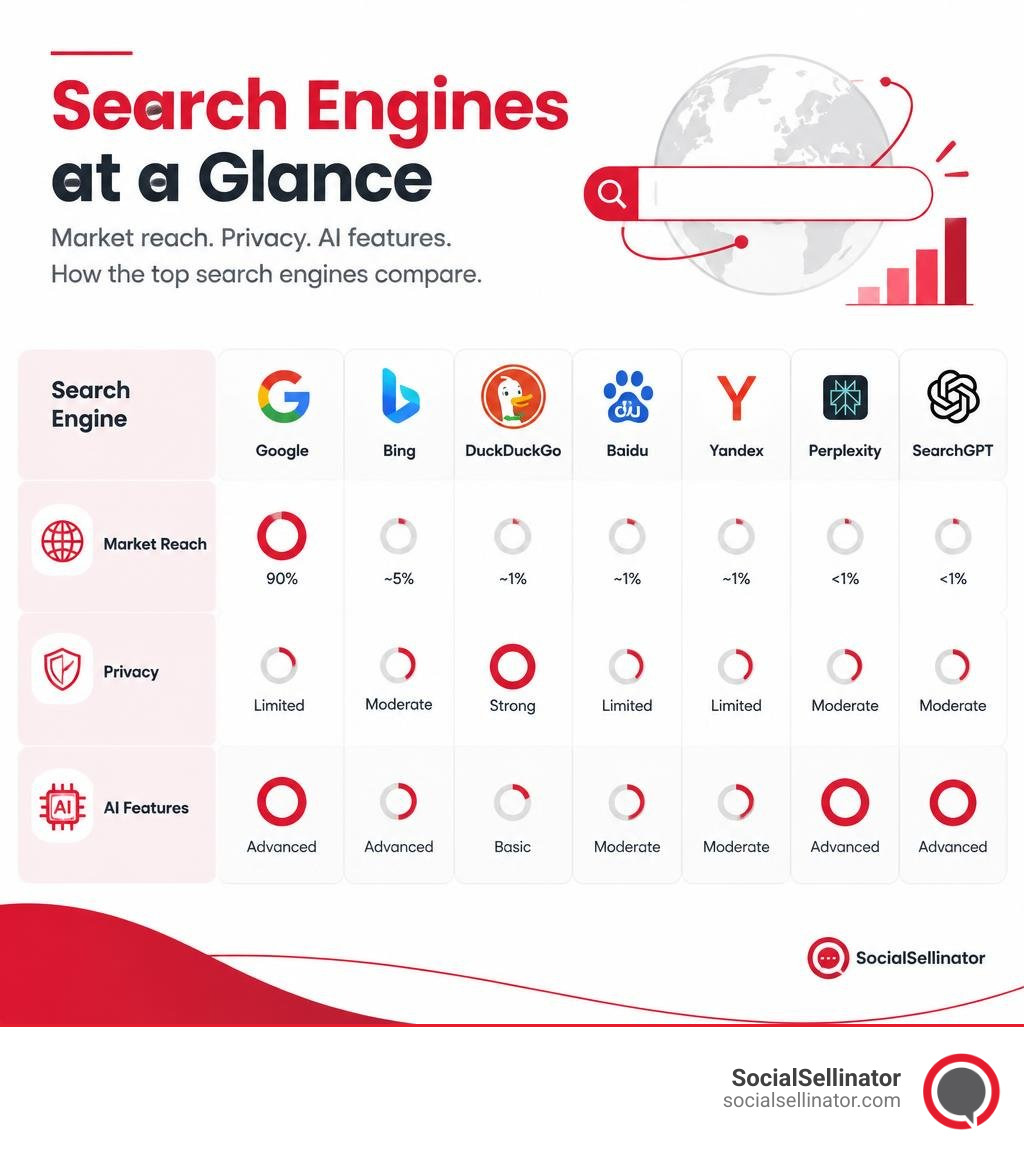
Google is the top ranking search engine worldwide, holding about 90% of global market share. For most businesses, Google is still the primary source of organic discovery. But the leading platforms now serve different needs:
- Google Search for reach, local results, and AI-powered answers.
- Microsoft Bing and Copilot for AI-assisted search and Microsoft ecosystem users.
- DuckDuckGo for privacy-focused, non-profiled searching.
- Baidu and Yandex for major regional markets.
- Perplexity and SearchGPT for conversational, source-led AI discovery.
For marketers, market share is only part of the story. Google’s AI Overviews, featured snippets, and other on-page answers mean more searches end without a website click. Organic search still drives an estimated 53% of website traffic, but visibility now requires strong content, clear entities, technical SEO, and citations that AI systems can understand.
I’m Jock Breitwieser, and the sections ahead compare the search platforms, ranking systems, privacy trade-offs, and AI changes shaping discovery.
Want to learn more how we can help you with SEO?
Click here for a quick overview of our SEO programs.
Top ranking search engine vocab explained:
- Search Engine Ranking Factors
- Google top 10 SEO ranking factors
- On-site SEO factors
The Global Landscape: Identifying the Top Ranking Search Engine Platforms
Understanding the global search engine environment requires looking past simple vanity metrics to examine query volume, algorithmic capabilities, and user intent. Today, search engines process trillions of queries annually, serving as the digital nervous system for commerce, entertainment, academic research, and daily consumer decisions. While one technology giant commands the overwhelming lion’s share of global search volume, regional powerhouses and specialized discovery engines maintain critical footholds across distinct markets and user demographics.
The search engine landscape is defined by vast differences in index scope, data collection philosophies, and underlying retrieval mechanisms. Global platforms index hundreds of terabytes of data across billions of active web pages, utilizing massive distributed networks to return results in milliseconds. Meanwhile, regional search engines cater to specific linguistic structures, local regulatory frameworks, and tailored consumer ecosystems.
| Search Engine Platform | Estimated Global Market Share | Core Strengths & Architectural Features | Privacy & Data Tracking Posture | Primary User Discovery Intent |
|---|---|---|---|---|
| Google Search | ~90.0% | Deep neural matching, massive web index, AI Overviews, Gemini multimodal search | Extensive behavioral tracking, personalized query profiles, ad retargeting | Comprehensive everyday discovery, local business navigation, commercial research |
| Microsoft Bing / Copilot | ~3.5% – 4.5% | Deep OpenAI integration, hybrid conversational interface, Microsoft 365 enterprise synergy | High data profiling linked to Microsoft user IDs, targeted ad networks | Workplace tasks, conversational research, visual and agentic browsing |
| DuckDuckGo | ~0.8% – 1.5% | DuckDuckBot crawler, multi-source meta-aggregation, !Bang direct shortcuts | Zero user profiling, no search history logging, non-personalized SERPs | Privacy-focused research, untracked consumer discovery, non-targeted browsing |
| Perplexity AI | Emerging (<1.0%) | Conversational LLM retrieval, live web synthesis, transparent citation architecture | Standard account tracking with opt-out settings, citation-focused history | Complex multi-step queries, academic research, technical syntheses |
| SearchGPT | Emerging (<1.0%) | Conversational information retrieval, direct publisher sourcing, clean user interface | Integrated OpenAI account tracking, conversational memory | Direct answers, structured summaries, conversational exploration |
Google: The Undisputed Top Ranking Search Engine Worldwide
Since its founding in the late 1990s, Google has evolved from a Stanford dormitory project into an indispensable pillar of global information access. Handling well over 3.5 billion searches every single day, Google remains the primary engine driving global digital visibility. The foundation of this dominance was built upon the PageRank algorithm, which evaluated a webpage’s authority not merely by keyword density, but by the recursive quantity and quality of inbound links from other pages across the web.
Over the decades, Google has systematically overhauled its underlying infrastructure to handle the exponential growth of digital content. The rollout of the Caffeine architecture upgrade dramatically increased the freshness of search results, allowing Google to index web pages on an unprecedented scale. Subsequent algorithmic milestones, such as the Hummingbird update, fundamentally shifted the engine away from literal keyword matching toward true semantic understanding, interpreting user search intent through natural language processing. Later, targeted initiatives like the Medic algorithm update established rigorous standards for Your Money or Your Life (YMYL) content, heavily weighting real-world Experience, Expertise, Authoritativeness, and Trustworthiness (E-E-A-T).
For businesses seeking commercial visibility, Google’s top organic positions continue to represent prime digital real estate. The number one organic position captures an astounding 39.8% click-through rate (CTR), while the second and third positions yield approximately 18.7% and 10.2% CTR respectively. Capturing these top positions requires sophisticated expert search engine optimization that aligns with modern semantic indexing, entity relationships, and user experience signals across both desktop and mobile platforms.
Microsoft Copilot and Bing: AI-Powered Hybrid Discovery
Microsoft Bing has established itself as an innovative force in search through its deep integration with OpenAI’s advanced large language models. Rebranded and elevated through Microsoft Copilot, Bing combines traditional web indexing with conversational artificial intelligence to deliver hybrid discovery experiences directly within the search engine results page (SERP).
Rather than forcing users to scroll through separate blue links, Copilot synthesizes multi-source answers alongside traditional organic rankings. This integration serves Microsoft’s broader enterprise ecosystem, embedding search assistance natively into the Windows operating system, the Edge browser, and Microsoft 365 productivity suites. By offering conversational discovery tools, automated code generation, and multi-model document analysis, Bing appeals strongly to corporate professionals, researchers, and tech-forward consumers looking for synthesized answers across enterprise workflows.
DuckDuckGo and Privacy-First Alternatives
DuckDuckGo represents the leading alternative for consumers concerned about digital privacy, invasive data mining, and behavioral ad retargeting. Founded on the principle that search engines should not track or profile their users, DuckDuckGo has steadily grown its market share by delivering private, clean search results without personalized filter bubbles.
Unlike engines that build comprehensive demographic and behavioral dossiers on every user, DuckDuckGo ensures that two users searching for the exact same query receive identical results. The platform relies on its proprietary web crawler, DuckDuckBot, while aggregating information from over 400 specialized sources, including Bing, Yahoo, and crowdsourced repositories like Wikipedia. DuckDuckGo also features productivity tools like “!Bang” commands, allowing users to bypass traditional search pages entirely and query third-party platforms directly from the primary search bar.
Emerging Generative AI Platforms: Perplexity AI and SearchGPT
The rise of generative artificial intelligence has fostered a new generation of information retrieval platforms designed to replace link lists with conversational answers. Platforms such as Perplexity AI and OpenAI’s SearchGPT operate as conversational answer engines, using large language models augmented by real-time web retrieval to synthesize complex topics into coherent summaries.
Perplexity AI has earned significant traction among professionals, developers, and academics by offering transparent citation architectures. Every factual claim generated by the platform includes numbered, direct citations linking users back to primary source materials. SearchGPT introduces a streamlined, conversational discovery model that prioritizes direct publisher relationships, structured data interpretation, and conversational follow-ups. While these platforms currently command a fraction of Google’s global query volume, their conversational models are actively reshaping user expectations and pressuring legacy search engines to evolve continuously.
Algorithmic Ranking Mechanisms and Search Architecture
Modern search engines rely on multi-stage technical architectures designed to crawl, process, index, and rank trillions of digital documents across the web. The discovery lifecycle operates around the clock, deploying intelligent software spiders that traverse the web graph to locate newly published documents, updated resources, and broken pathways.
The process begins with automated web crawlers that discover content by parsing hyperlinks, sitemaps, canonical tags, and document structures. Once raw data is collected, specialized indexing pipelines parse the underlying HTML, evaluate schema markup, extract semantic entities, and store structured data across distributed, high-performance databases. During indexing, engines normalize text, strip boilerplate navigation elements, evaluate media assets, and calculate preliminary authority metrics.
When a user executes a search query, the engine’s neural ranking systems evaluate thousands of potential signals simultaneously within fractions of a second. These include deep neural networks that translate conversational queries into conceptual vectors, matching user intent against indexed content even when specific keywords do not match. Technical baseline standards, such as Google’s Core Web Vitals (evaluating Largest Contentful Paint, Interaction to Next Paint, and Cumulative Layout Shift), establish strict performance benchmarks that determine whether a site qualifies for top ranking positions.
Core Ranking Factors Defining a Top Ranking Search Engine in 2026
To rank in competitive search environments, digital properties must satisfy multifaceted algorithmic criteria spanning technical, structural, and editorial disciplines:
- Topical Authority and Entity Relationships: Modern algorithms no longer evaluate articles as isolated collections of keywords. Instead, search engines map content against broader knowledge graphs, evaluating whether a brand demonstrates deep, comprehensive expertise across an entire subject vertical. Building robust topical authority requires integrated content marketing strategies that address top-of-funnel educational queries as well as bottom-of-funnel commercial needs.
- Link Authority and Referring Domains: High-quality backlinks remain a foundational signal of trust. Search engines evaluate the authority, contextual relevance, and editorial integrity of linking domains to determine whether a webpage deserves high ranking placement across competitive search verticals.
- Semantic Context and Natural Language Clarity: Content structured to answer complex user questions directly, clearly, and concisely within the opening sections outperforms superficial copy designed solely for keyword density. Structuring text with clear headings, ordered lists, and concise summaries aids both traditional crawlers and generative AI extractors.
- Technical Health and Mobile-First Compliance: With the overwhelming majority of global searches occurring on handheld devices, responsive design, rapid page load speeds, clean URL hierarchies, and structured schema implementation are essential ranking prerequisites.
- User Engagement and Experience Signals: Search algorithms increasingly evaluate post-click behavioral patterns, assessing whether users find immediate resolution or bounce back to search results to refine their query.
The Zero-Click Shift and Organic Traffic Dynamics
The structure of search engine results pages has shifted dramatically toward zero-click interactions. Today, approximately 60% of all search queries end without a user clicking through to an external website. Featured snippets, interactive calculators, local map packs, knowledge panels, and AI Overviews answer user questions directly within the SERP interface, reducing traditional click-through volume for top-of-funnel informational queries.
Furthermore, empirical data indicates that 96.55% of all published web pages receive zero organic search traffic from Google, illustrating a massive visibility divide between generic content and authoritative, well-optimized digital assets. Despite this compression, search engine optimization continues to demonstrate exceptional commercial value. SEO delivers an average of 8x return on investment (ROI)—double the performance of paid search advertising—by driving compounding, long-term organic traffic that converts at high rates. High rankings in organic search remain the single most reliable driver of qualified inbound leads and scalable business growth.
The Generative AI Revolution: AI Overviews, Agents, and Search Disruption
The integration of generative artificial intelligence into search engines represents the most profound structural shift in information retrieval since the inception of the commercial internet. Rather than functioning purely as index librarians pointing users toward external websites, search engines have become generative synthesis engines capable of summarizing data, comparing products, and generating customized solutions directly on page.
Leading search engines now utilize advanced Retrieval-Augmented Generation (RAG) architectures. RAG connects foundational large language models with real-time web retrieval pipelines, ensuring that generated answers are grounded in current, authoritative web data rather than static training datasets. This development compresses traditional organic click distributions while elevating the importance of brand mentions, entity recognition, and AI citation optimization.
Google AI Overviews and AI Mode Capabilities
Google has deployed generative AI across its core search ecosystem through AI Overviews and conversational AI Mode features powered by frontier models like Gemini 3.5 Flash. AI Overviews now appear in roughly 13.14% of all search queries, effectively doubling their footprint over the past year. When present, AI Overviews synthesize multiple third-party sources into a concise summary displayed directly above the traditional top organic rankings.
In addition to static summaries, Google has expanded conversational search into an agentic discovery experience. Features such as Personal Intelligence integrate with user calendars and preferences across nearly 200 countries to provide context-aware suggestions. Interactive visual generation allows search to construct diagrams and comparison matrices on the fly, while the Universal Cart consolidates e-commerce shopping across Google services into a single checkout flow. These features provide exceptional utility for users while requiring digital marketers to optimize their content for inclusion within generative answer boxes.
Retrieval-Augmented Generation and Semantic Entity SEO
As generative AI engines process web pages to generate syntheses, search engine optimization strategies must evolve to emphasize semantic entity recognition and conversational clarity:
- Comprehensive Schema Implementation: Implementing structured data formats (such as Organization, Article, Product, LocalBusiness, and FAQ schema) allows AI crawlers to parse key entities, dates, authors, and product specifications without ambiguity.
- Optimizing for AI Citations: Generative engines favor content that presents clear, factual claims backed by authoritative sourcing. Structuring crucial answers within the initial 30% of a webpage dramatically increases the likelihood of being cited within AI Overviews and conversational summaries.
- Topical Entity Optimization: Maintaining a consistent, authoritative presence across industry knowledge bases, business directories, and reputable third-party publications reinforces brand entities within the search engine’s knowledge graph.
- Information Architecture and Scannability: Organizing complex technical data into clean HTML tables, bulleted takeaway lists, and concise definition blocks ensures that RAG pipelines can ingest and summarize content accurately.
- Integrated Marketing Synergy: Maximizing digital visibility in an AI-driven search ecosystem requires combining organic search optimization with targeted paid campaigns through integrated digital marketing frameworks that capture both conversational citations and direct commercial clicks.
Critical Controversies, Privacy Concerns, and Regulatory Battles
The concentration of global search volume within a handful of dominant technology companies has led to intense regulatory scrutiny, landmark antitrust litigation, and public debates surrounding user privacy and algorithmic transparency.
Want to learn more about how we can help you with SEO?
Click here for a quick overview of our programs.
In landmark antitrust decisions across North America and Europe, global regulators have challenged exclusionary distribution agreements, such as default search engine placement deals on mobile operating systems and web browsers. In the European Union, regulatory bodies levied historic penalties, including a €2.4 billion fine for discriminatory practices favoring proprietary shopping services over independent comparison engines. The Digital Markets Act (DMA) has further mandated browser choice screens and strict interoperability standards to foster fair competition across digital ecosystems.
Simultaneously, privacy advocates have long criticized traditional search engines for comprehensive data mining practices. The detailed tracking of search histories, IP addresses, device identifiers, and geolocation data enables sophisticated behavioral ad targeting, but it also creates pervasive filter bubbles that can distort information discovery and compromise user autonomy. These privacy concerns have driven steady adoption of non-profiling engines that refuse to monetize personal search histories.
Furthermore, the immense computational infrastructure required to power generative AI search queries has sparked environmental and operational concerns. Processing complex natural language queries through massive multi-billion-parameter neural networks requires significantly more electrical energy and water cooling than standard index lookups. Navigating these regulatory, environmental, and ethical challenges will shape the technical and competitive architecture of global search engines for decades to come.
Frequently Asked Questions About Top Ranking Search Engines
What makes Google the top ranking search engine globally?
Google’s position as the leading global search engine stems from its unparalleled technical infrastructure, continuous algorithmic innovation, and deep integration across global hardware and software platforms. With an index spanning hundreds of terabytes and handling over 3.5 billion searches daily, Google delivers unmatched speed, linguistic accuracy, and localized relevance. Its early technological foundation, anchored by the PageRank algorithm and refined through decades of machine learning updates like Caffeine, Hummingbird, RankBrain, and Gemini, established a competitive moat reinforced by consumer habit and default distribution partnerships worldwide.
How are AI Overviews and generative AI impacting organic search clicks?
Generative AI features and AI Overviews fundamentally alter search click distribution by answering informational queries directly on the search engine results page. With AI Overviews appearing in over 13% of queries and expanding rapidly, top-of-funnel click-through rates often compress as users find answers without visiting external sites. However, organic search continues to generate 53% of all web traffic. To thrive, brands must optimize for conversational visibility, entity recognition, and citation placements, ensuring that when users require deep analysis or commercial solutions, their web properties serve as the authoritative destination.
Which private search engine provides the best alternative to Google?
DuckDuckGo stands out as the most widely adopted and comprehensive privacy-first alternative to traditional search engines. It guarantees zero tracking, refuses to build personalized user profiles, and does not store IP addresses or search query histories. By combining its proprietary DuckDuckBot crawler with aggregated data from over 400 specialized sources, DuckDuckGo provides unbiased, reliable search results alongside modern features like private search shortcuts (!Bangs) and integrated tracker blocking.
How do search engines evaluate website quality and authority in 2026?
Modern search engines evaluate website quality through a combination of technical performance, topical depth, backlink profiles, and adherence to Experience, Expertise, Authoritativeness, and Trustworthiness (E-E-A-T) principles. Technical factors include mobile responsiveness, fast Core Web Vitals, and secure HTTPS protocols. Content quality is evaluated based on original research, clear entity relationships, schema markup, and the contextual authority of linking domains across the wider web.
Conclusion
The search engine landscape is evolving at a historic pace. While traditional search index depth and link authority remain the foundational pillars of digital discovery, the rapid ascent of generative AI, conversational answer engines, and privacy-conscious alternatives is transforming how consumers and businesses locate information online. Success in this dynamic environment requires a holistic, adaptive approach to digital visibility—blending deep technical SEO, structured entity optimization, compelling content marketing, and cross-channel promotion.
To capture market share and maximize return on investment, organizations must partner with experienced digital specialists who understand both the algorithms of today and the generative discovery platforms of tomorrow. Explore how our team can elevate your brand’s digital presence through comprehensive digital marketing services tailored to your specific commercial goals.
Headquartered in San Jose, in the heart of Silicon Valley and the San Francisco Bay Area, SocialSellinator proudly provides top-tier digital marketing, SEO, PPC, social media management, and content creation services to B2B and B2C SMB companies. While serving businesses across the U.S., SocialSellinator specializes in supporting clients in key cities, including Austin, Boston, Charlotte, Chicago, Dallas, Denver, Kansas City, Los Angeles, New York, Portland, San Diego, San Francisco, and Washington, D.C.
- About the Author
- Latest Posts

Jock Breitwieser is a marketing thought leader, founder of SocialSellinator, Arcserve VP and has 20+ years’ experience in digital marketing & PR. He’s led communications at TriNet (IPO), Dell SonicWALL, CallidusCloud, and top agencies like (Edelman, Havas, Hoffman).
Named a Top 100 Social Selling Influencer, Jock contributes to outlets like Grit Daily, Marketer Magazine, DevX, Euro News, Hootsuite, Morning Lazziness, BacklinkBuilding.io, Under30CEO, and many others. Jock drives $1M+ client revenue outcomes, mentors startups, and lectures at SJSU and UC Berkeley Extension.


