
The Ultimate Guide to Your New Media Monitoring Strategy
Your Brand Is Being Talked About Right Now — Are You Listening?
Metadata: Format: PNG, Dimensions: 1200×630, File size: 150KB
A solid media monitoring strategy is one of the most valuable tools a marketing team can have in 2026. The world collectively spends 11.5 billion hours on social media every single day. Add in news sites, podcasts, forums, review platforms, and broadcast media — and the volume of conversation happening about your brand, your competitors, and your industry is staggering.
Here is the uncomfortable truth: most of it happens without you knowing.
Customers post complaints without tagging you. Journalists publish stories you never see. Competitors gain ground in conversations you are not part of. And 63% of consumers already think brands need to do a better job of listening and acting on feedback.
Want to learn more how we can help you with Social Media Management?
Click here for a quick overview of our Social Media Management programs.
A media monitoring strategy fixes that.
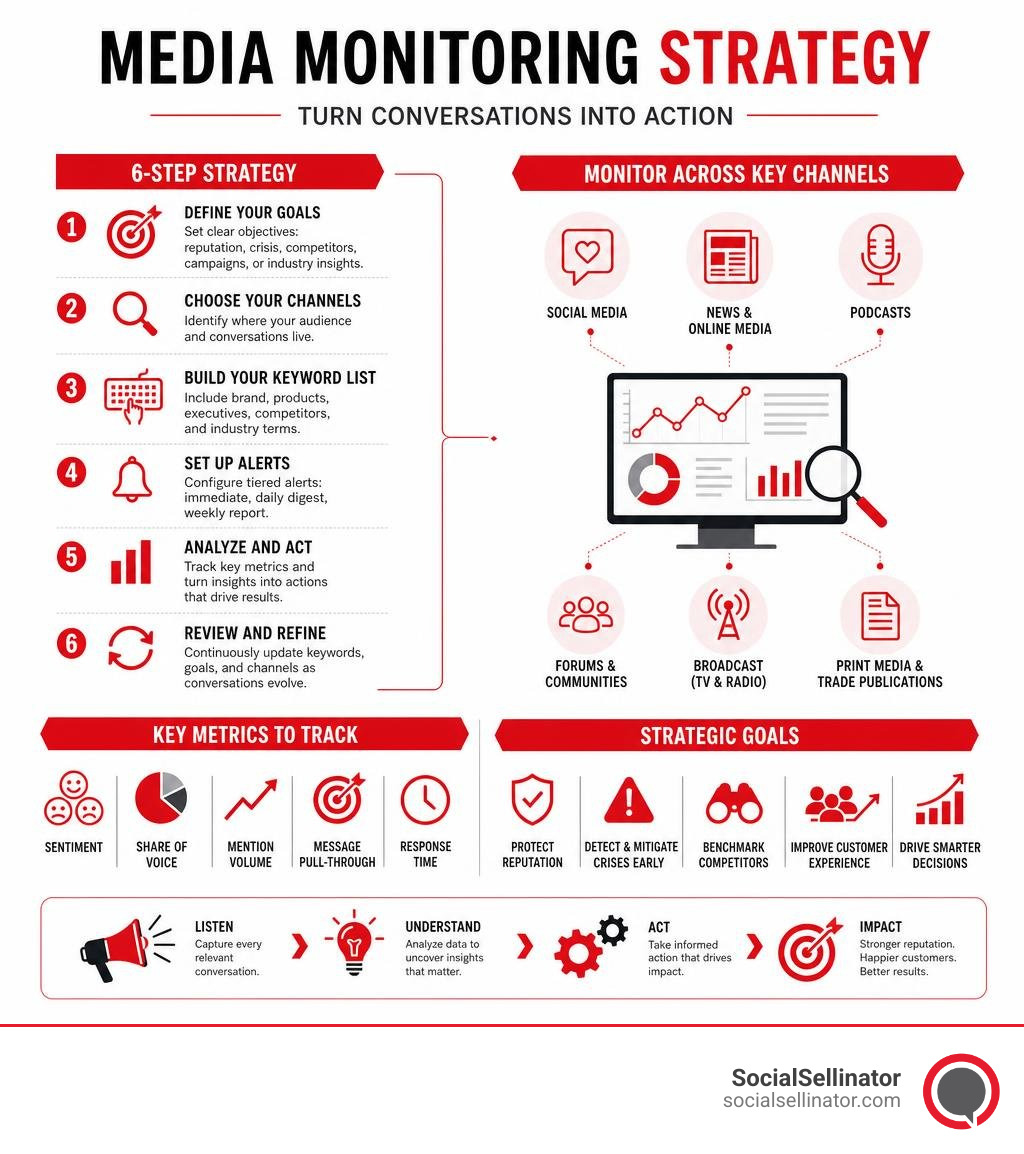
Here is what a media monitoring strategy involves, at a glance:
- Define your goals — reputation management, crisis detection, competitive intelligence, or campaign tracking
- Choose your channels — social media, news, podcasts, forums, broadcast, and print
- Build your keyword list — brand name, product names, executives, competitors, and industry terms
- Set up alerts — tiered by urgency (immediate, daily digest, weekly report)
- Analyze and act — track sentiment, share of voice, and message pull-through to guide decisions
- Review and refine — update keywords and goals regularly as trends shift
This is not a one-time setup. It is an ongoing process that turns raw data into decisions.
I’m Jock Breitwieser, and in this guide I’ll walk you through everything you need to build and run a media monitoring strategy that actually moves the needle for your brand.
Metadata: Format: PNG, Dimensions: 1200×800, File size: 185KB
Similar topics to media monitoring strategy:
What is Media Monitoring and How Does It Differ From Social Listening?
To build an effective defense and offense for your brand, we must first clear up a very common point of confusion. Many marketers use the terms “media monitoring” and “social listening” interchangeably. While they are close cousins, they serve different operational purposes.
Think of media monitoring as your tactical daily radar. It is a continuous, systematic search for specific brand mentions, executive names, product keywords, and competitor references across the entire media landscape. Media monitoring is highly action-oriented. It answers the question: Who is talking about us right now, where are they saying it, and do we need to respond immediately?
On the flip side, Social Listening is your big-picture, strategic telescope. Instead of just gathering individual data points and reacting to alerts, social listening looks at the aggregate data over time. It analyzes the underlying mood, cultural context, and industry-wide trends. If media monitoring tells you that a customer is complaining about a broken zipper on your new jacket, social listening tells you that consumers are shifting their preferences toward sustainable outerwear across your entire industry.
Crucially, modern media monitoring goes far beyond social media networks. A comprehensive strategy scans online news sites, traditional print publications, broadcast TV, radio, digital forums like Reddit, and rapidly growing audio formats like podcasts.
One of the biggest blind spots for brands is ignoring untagged mentions. On the web and social media, a vast majority of users talk about your company without using your official handle (e.g., writing “that new software from the Silicon Valley startup” instead of tagging @YourBrand). If your team only looks at direct notifications, you are missing the vast majority of the conversation.
Why a Media Monitoring Strategy is Essential for Modern Brands
In 2026, brand reputation is highly volatile. A single unaddressed issue can scale from a minor forum thread to a mainstream news headline in a matter of hours. This is why having a formalized media monitoring strategy is no longer a luxury for enterprise corporations—it is a survival requirement for businesses of all sizes, from local shops in Boston to high-tech firms in San Jose.
At its core, monitoring is the ultimate unsolicited feedback loop. It feeds directly into your Voice of the Customer (VoC) analytics. Instead of relying solely on structured surveys (which customers rarely fill out unless they are extremely angry or exceptionally happy), monitoring captures raw, honest, and unfiltered opinions in real-time.
When you actively listen to this feedback, you can dramatically improve your overall customer experience. For example, if we notice multiple users on a regional Chicago forum complaining about a confusing checkout step on our website, we can immediately pass that insight to our web development team. By resolving the friction point before it impacts more users, we turn a potential drop-off in sales into a win for customer retention.
Proactive reputation management is directly tied to your bottom line. Research shows that 71% of customers will buy less from companies they distrust, while 93% are more loyal to brands they trust. By implementing a system that monitors and actively guides your brand perception, you are directly Managing Your Online Reputation and protecting your future revenue.
Key Benefits of a Proactive Approach
When you move from a passive, “we’ll look at it when we have time” approach to an active, structured media monitoring strategy, your business gains several distinct advantages:
- Real-Time Competitive Intelligence: You can monitor your competitors’ product launches, customer complaints, and marketing campaigns. If customers of a rival brand in Dallas are complaining about a sudden price hike or a service outage, your sales team can step in with targeted messaging to capture those frustrated prospects.
- Early-Stage Crisis Prevention: Very few corporate crises happen without warning. Usually, there are early-warning signals—a slow build-up of negative comments on a niche subreddit or a critical blog post by an industry influencer. Real-time alerts let you address the spark before it becomes a raging fire.
- Proactive Lead Generation: People frequently ask for recommendations online without tagging brands. By tracking phrases like “looking for a reliable digital marketing agency in Austin” or “best commercial real estate firm in Charlotte,” you can find warm leads who are actively looking for your exact services.
- Identifying Brand Advocates: Monitoring helps you discover the creators, journalists, and everyday customers who are genuinely singing your praises. You can reach out to these advocates, build relationships, and collaborate on content marketing efforts to amplify your reach.
How to Build and Implement Your Media Monitoring Strategy
Setting up a media monitoring strategy that works requires more than just signing up for a basic alert tool and calling it a day. Without a structured process, you will quickly find your inbox flooded with thousands of irrelevant notifications, leading to alert fatigue and eventual abandonment of the program.

Metadata: Format: JPG, Dimensions: 800×600, File size: 95KB
To prevent this data overload, we recommend a methodical, five-step setup process designed to isolate the most valuable insights while filtering out the noise.
Step 1: Define Goals and Objectives for Your Media Monitoring Strategy
The very first rule of media monitoring is to choose a goal that survives contact with reality. If you try to track absolutely everything for every possible department all at once, you will end up seeing nothing. We advise our clients to select one primary objective and one secondary objective to start.
Here are the most common goals to consider:
- Brand Health and Sentiment Tracking: Is the overall public perception of our brand positive, neutral, or negative? How is that sentiment trending month-over-month?
- Campaign Impact Measurement: Did our latest PR push or social media campaign achieve the reach and message pull-through we expected?
- Competitive Share of Voice (SOV): What percentage of the industry conversation is focused on our brand versus our top three competitors in the Denver or Portland markets?
- Crisis Readiness and Risk Mitigation: Do we have an early-warning system in place to detect negative spikes in sentiment or potential legal threats?
Once you have defined your goals, you can build your core keyword list. This list should be structured in four distinct layers:
- Brand Keywords: Your exact company name, product names, key executive names (like your CEO), and common misspellings or variations.
- Competitor Keywords: The names of your direct competitors and their key products.
- Category/Industry Keywords: Broader terms related to your industry (e.g., “b2b lead generation,” “local SEO strategies,” “paid search management”).
- Risk/Crisis Keywords: Your brand name combined with words like “scam,” “broken,” “lawsuit,” “outage,” or “worst.”
To keep your results clean, use Boolean search logic (AND, OR, NOT). For example, if your brand name is “Apple Blossom Retail,” a simple search for “Apple” will flood your dashboard with consumer tech news. By using a query like "Apple Blossom" NOT "iPhone" NOT "MacBook", you isolate only the conversations that are relevant to your business.
Step 2: Establish a Process and Response Framework
A media monitoring tool is only as good as the human habits behind it. The brands that succeed are not those with the most complex software, but those with clear, repeatable workflows to act on the data.
First, you must assign clear ownership. Who is responsible for checking the dashboard daily? For complex organizations, we recommend establishing a 3-Tier Alert System to route information to the right people without clogging everyone’s inbox:
- Tier 1: Immediate Alerts (High Priority): These are triggered by severe negative sentiment spikes, potential crises, or major press mentions. These alerts should route directly to your PR and leadership team via SMS or dedicated Slack channels so they can execute a rapid Social Media Crisis Response within the golden first hour.
- Tier 2: Daily Digests (Medium Priority): A curated summary of routine brand mentions, customer reviews, and general competitor updates. This is ideal for your social media managers and customer support leads to review every morning before 9:00 AM.
- Tier 3: Weekly/Monthly Reports (Low Priority): High-level aggregate data showing sentiment trends, share of voice, and campaign reach. These reports are designed for executive stakeholders to guide long-term strategic planning.
When a mention requires a response, your team should follow a standardized triage workflow:
Key Metrics and Tool Features to Measure Success
To prove the ROI of your media monitoring efforts to your board or leadership team, you must move away from outdated vanity metrics. For decades, PR agencies relied on Advertising Value Equivalent (AVE)—a fictional metric that calculated what an earned editorial mention would cost if it were a paid advertisement. In 2026, the global communications industry (led by AMEC) has completely rejected AVE because it does not measure genuine business impact.
Instead, your strategy should focus on metrics that truly reflect brand health and business outcomes:
- Sentiment Trajectory: Tracking the ratio of positive to negative mentions over time. A downward trend in sentiment among trade publications is often an early indicator of a positioning problem before it impacts your sales pipeline.
- Message Pull-Through: Are the media and your customers actually repeating the key messages, value propositions, and campaign themes you designed?
- Share of Voice (SOV): How much of the total public conversation in your industry is dedicated to your brand compared to your competitors?
- Referral Traffic and Backlinks: Using web analytics to track how many users click through to your website from earned media articles, blogs, or forum discussions. This is a direct measure of how your public relations efforts support your broader Social Media Analytics for Business and digital marketing goals.
Essential Features to Look For in Monitoring Software
When selecting a platform to anchor your media monitoring strategy, look for these advanced, modern capabilities:
- AI-Powered Natural Language Understanding (NLU): Older keyword tools only look for exact matches and often label sarcastic comments incorrectly. Modern AI can detect nuance, sarcasm, and complex emotions (like frustration versus anger), increasing sentiment analysis accuracy by up to 25%.
- Visual Listening: A huge portion of online conversations now happen via images and vertical videos on platforms like TikTok and Instagram. Visual listening uses image recognition technology to detect your brand logo, products, or packaging in photos and video frames, even if your brand is never mentioned in the text caption.
- Comprehensive Podcast and Broadcast Coverage: Approximately 40% of spoken-word listening now occurs on podcasts, yet many basic tools completely ignore audio files. Ensure your tool uses automated speech-to-text technology to scan podcasts, TV, and radio.
- Automated De-duplication: A single press release can get syndicated across hundreds of local news sites, cluttering your dashboard. Good software automatically groups these identical articles together so you can see the true reach without the data clutter.
Common Mistakes to Avoid in Your Media Monitoring Strategy
Even with the best tools, it is easy to fall into common operational traps. Here are the top mistakes we see brands make, and how you can avoid them:
Want to learn more about how we can help you with Social Media Management?
Click here for a quick overview of our programs.
- Drowning in Alert Fatigue: If you route every single minor mention to your entire team’s email inbox, they will quickly start ignoring the alerts. Segment your feeds based on urgency and relevance.
- Ignoring Untagged and Off-Platform Conversations: Do not limit your monitoring to your official social media profiles. Unfiltered customer feedback lives on alternative platforms, local forums, and niche review sites.
- Relying on a Single Media Type: Some brands only monitor social media, while others only track traditional news. A true 360-degree strategy must span digital, print, broadcast, and audio channels to protect your brand comprehensively.
- Treating Monitoring as a Passive Archive: If your team only compiles reports at the end of the month to file them away, you are missing the point. Media monitoring is an active feedback loop meant to drive daily micro-decisions and real-time adjustments.
Frequently Asked Questions about Media Monitoring
To help you implement your media monitoring plan seamlessly, we have compiled a comparison of how different tracking systems look at your brand’s performance:
| Metric Category | Media Monitoring Focus (Tactical/External) | Social Listening Focus (Strategic/Macro) |
|---|---|---|
| Primary Data Source | Specific brand mentions, executives, products, and direct competitor names. | Broad industry keywords, cultural trends, and consumer behavior patterns. |
| Analysis Window | Real-time to short-term (hours to days). | Long-term historical data (months to years). |
| Key Output | Immediate alerts, daily digests, crisis detection, and customer support tickets. | Market research, product development insights, and brand repositioning strategies. |
| Measure of Success | Response time, sentiment trajectory, message pull-through, and resolved issues. | Share of voice growth, emerging trend discovery, and brand affinity shifts. |
What is the difference between media monitoring and social media monitoring?
The difference lies entirely in the scope of the sources tracked.
Social media monitoring is strictly limited to conversations happening within social media networks (such as Facebook, Instagram, LinkedIn, TikTok, and X).
Media monitoring is a much broader, all-encompassing strategy. It tracks mentions across the entire media landscape, including online news publications, physical print newspapers and magazines, broadcast television networks, local and national radio stations, podcasts, public forums, and industry-specific review sites. If your business operates in highly regulated sectors or relies heavily on earned media and PR, social-only monitoring leaves a massive gap in your visibility.
How does media monitoring help with SEO and AI search visibility?
This is one of the most exciting developments in modern digital marketing. In 2026, search engine behavior has dramatically shifted. Users are increasingly getting their answers directly from AI search engines (like ChatGPT, Gemini, Perplexity, and Google’s AI Overviews) without ever clicking through to a traditional website. This shift is known as Generative Engine Optimization (GEO).
So, how does AI decide which brands to recommend in these conversational answers?
Studies show that between 89% and 94% of citations in AI-generated search summaries come from earned media—blogs, news articles, reviews, and forum discussions across the open web. When your media monitoring strategy helps you find, track, and secure untagged mentions on authoritative sites, you are feeding the exact training data and live search indexes that AI engines use to build their answers.
Furthermore, consistent unlinked brand mentions across the web strengthen your brand’s authority, directly supporting Google’s E-E-A-T (Experience, Expertise, Authoritativeness, and Trustworthiness) ranking factors.
How often should we review our media monitoring keywords?
We recommend a formal review of your media monitoring setup at least once a quarter, with minor adjustments made monthly.
Keyword lists are not static. Your business will launch new campaigns, retire old products, hire new executives, and face new competitors over time. Regular keyword maintenance ensures that you are constantly refining your search queries to eliminate new sources of irrelevant noise while adapting your filters to capture emerging industry trends.
Conclusion
Building a modern media monitoring strategy is no longer just about clipping press mentions to show your board; it is about actively listening to the market, protecting your hard-earned reputation, and finding new avenues for business growth. When you combine automated AI tools with a clear human workflow, you turn raw data into a genuine competitive advantage.
At SocialSellinator, we understand that managing this constant stream of information can feel like a full-time job. That is where we come in. As a comprehensive digital marketing agency, we help businesses across the country align their brand listening with active, measurable growth strategies. Whether you need to boost your organic search footprint through cutting-edge SEO, drive immediate leads with targeted PPC campaigns, or build a highly engaged community with expert social media management and high-quality content creation, our team has the tools and expertise to make it happen.
Are you ready to stop guessing what the world thinks about your brand and start taking control of your narrative? Explore our Social Media Management Services to see how we can help you monitor, engage, and grow.
Headquartered in San Jose, in the heart of Silicon Valley and the San Francisco Bay Area, SocialSellinator proudly provides top-tier digital marketing, SEO, PPC, social media management, and content creation services to B2B and B2C SMB companies. While serving businesses across the U.S., SocialSellinator specializes in supporting clients in key cities, including Austin, Boston, Charlotte, Chicago, Dallas, Denver, Kansas City, Los Angeles, New York, Portland, San Diego, San Francisco, and Washington, D.C.
- About the Author
- Latest Posts

Jock Breitwieser is a marketing thought leader, founder of SocialSellinator, Arcserve VP and has 20+ years’ experience in digital marketing & PR. He’s led communications at TriNet (IPO), Dell SonicWALL, CallidusCloud, and top agencies like (Edelman, Havas, Hoffman).
Named a Top 100 Social Selling Influencer, Jock contributes to outlets like Grit Daily, Marketer Magazine, DevX, Euro News, Hootsuite, Morning Lazziness, BacklinkBuilding.io, Under30CEO, and many others. Jock drives $1M+ client revenue outcomes, mentors startups, and lectures at SJSU and UC Berkeley Extension.


