
Steal Market Share with Better Google Ads Competitor Analysis
Competitor vs. Competitive Intelligence: Identifying Your True Paid Search Rivals
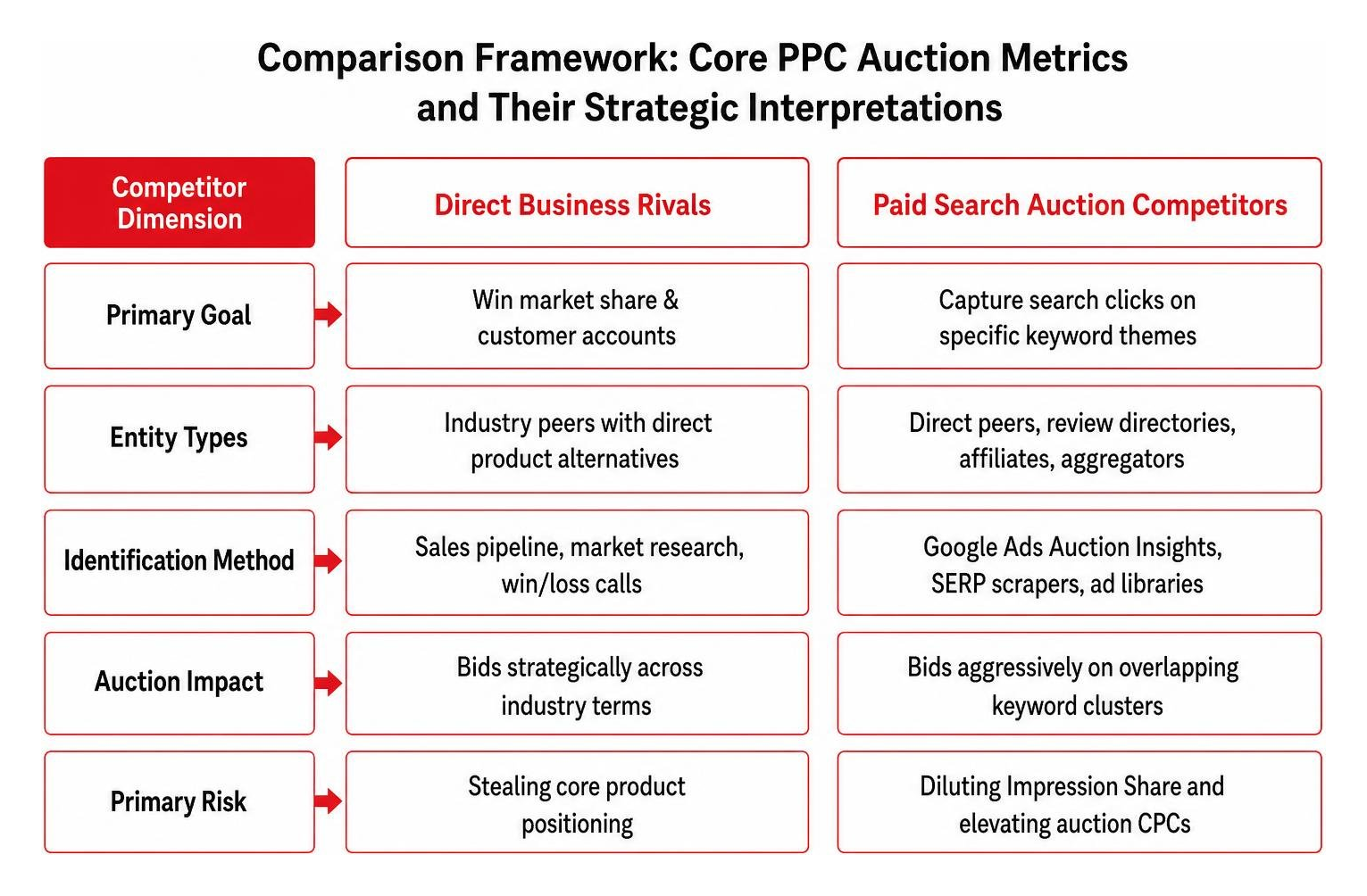
When running paid search campaigns, we often assume our biggest business rivals are the same accounts driving up our cost-per-click (CPC). In reality, the Google Ads auction ecosystem behaves quite differently. A traditional competitor provides a similar product or service to yours. An auction competitor, however, is any domain bidding on the exact queries, intents, or audiences you are targeting. Effective google ads competitor analysis starts with recognizing that the domains competing for your clicks are not always the brands competing for your customers.
Understanding this distinction prevents wasted budget. If an enterprise software provider bids on high-intent transactional terms, their auction competitors might not only be other enterprise software suites. They might also find themselves competing against software review directories, affiliate review blogs, job boards, and broad-match retail aggregators. Each participant claims ad inventory, alters your average CPC, and splits prospective customer attention.
| Competitor Dimension | Direct Business Rivals | Paid Search Auction Competitors |
|---|---|---|
| Primary Goal | Win market share & customer accounts | Capture search clicks on specific keyword themes |
| Entity Types | Industry peers with direct product alternatives | Direct peers, review directories, affiliates, aggregators |
| Identification Method | Sales pipeline, market research, win/loss calls | Google Ads Auction Insights, SERP scrapers, ad libraries |
| Auction Impact | Bids strategically across industry terms | Bids aggressively on overlapping keyword clusters |
| Primary Risk | Stealing core product positioning | Diluting Impression Share and elevating auction CPCs |
Direct Brand Competitors vs. Auction Competitors
Direct brand competitors share your target customer profile, offer equivalent solutions, and compete for the same bottom-line revenue. However, on the search engine results page (SERP), auction disruptors often hijack valuable real estate.
Aggregators and review sites frequently outbid single brands because their business model thrives on monetizing aggregate user traffic across multiple vendors. Similarly, affiliate marketers may target high-intent search terms to capture referral commissions. If we focus our competitive analysis exclusively on named industry peers, we miss the third-party platforms quietly siphoning our high-intent traffic.
Want to learn more how we can help you with Google Ads?
Click here for a quick overview of our Google Ads programs.
Google Ads Auction Insights requires an impression share threshold (typically at least 10% for the selected timeframe) to populate competitor domain data. By consistently auditing this report, we identify not only direct peers but also emerging SERP disruptors entering the auction space before they completely erode our visibility.
Essential Metrics for Google Ads Competitor Analysis
To benchmark account performance accurately against auction rivals, we monitor five core metrics inside Google Ads:
- Impression Share (IS): The percentage of total available impressions your ads received divided by the estimated number of impressions you were eligible to receive. It highlights overall market penetration.
- Overlap Rate: How often a competitor’s ad received an impression in the same auction where your ad also showed. High overlap indicates intense, head-to-head keyword targeting.
- Outranking Share: How often your ad ranked higher in the auction than the competitor’s ad, or showed when their ad did not. A rising outranking share indicates that your ad rank and bidding strategy are outperforming that domain.
- Position Above Rate: How often the competitor’s ad appeared above yours when both ads were shown at the same time. This reveals who holds the upper hand in top-of-page ad rank.
- Top of Page Rate: How often your ad (or a competitor’s ad) appeared at the top of the search results page, above organic listings.
The 5-Step Framework for Google Ads Competitor Analysis
Executing a thorough audit requires moving past surface-level observations. Leveraging modern search ads intelligence, we use a structured, 5-step competitive framework designed to systematically extract, evaluate, and translate raw SERP data into high-converting campaigns.
1. Mining Keyword Strategies and Coverage Gaps
Uncovering competitor keyword patterns is the foundation of competitive intelligence. Rather than guessing which search queries drive conversions for industry rivals, we isolate their active paid footprints to identify high-value search terms and negative keyword opportunities.
To do this effectively, we review paid search visibility to compare our active keyword portfolios against industry benchmarks. We pay specific attention to two categories:
- Missing Keywords: Search queries where multiple competitors maintain strong ad visibility, but our campaigns have zero active bids.
- Untapped Keywords: High-volume, high-intent phrases targeted by a single competitor that our team can easily capture with dedicated landing pages.
Every keyword cluster discovered must be bucketed by buyer psychology:
- Problem-Aware Queries: Users searching for fixes to specific bottlenecks (e.g., how to lower customer acquisition cost).
- Solution-Aware Queries: Users actively comparing product categories (e.g., enterprise PPC automation software).
- Decision-Stage Queries: Transactional, high-converting searches comparing pricing, reviews, and specific brand differentiators (e.g., vendor pricing, alternative to brand X).
Mining keyword coverage also involves aggressive negative keyword hygiene. When reviewing competitor ad copy and live search queries, we identify unqualified modifier terms (e.g., free, open source, jobs, login) and immediately append them to our shared account-level negative lists. This keeps ad spend focused on revenue-generating clicks, supporting our comprehensive digital marketing strategies across paid and organic channels.
2. Dissecting Ad Copy and Creative Angles
Reviewing live ad copy reveals how competitors position their value proposition, handle price resistance, and drive clicks. We look past headline aesthetics and focus on the psychological mechanics of the copy.
Using the Google Ads Transparency Center, we inspect all active creatives associated with a competitor’s verified domain across Search, Display, YouTube, and Shopping. The primary public proof signal of an effective ad is creative run length. If an ad variation has been actively running for 90, 180, or 300+ days, it has clearly passed the competitor’s internal performance and return-on-ad-spend (ROAS) thresholds. Conversely, creatives that vanish after two weeks usually represent failed tests.
When breaking down competitor ad copy, we catalog four critical elements:
- Value Propositions & Offers: Are they leading with price discounts, speed of delivery, ease of onboarding, or risk-reversal guarantees (e.g., free 30-day trial, money-back guarantee, no credit card required)?
- Emotional Hooks & Angles: Does the ad target fear of falling behind, frustration with legacy software, or the desire for rapid operational scale?
- Proof Assets & Trust Signals: Do they highlight G2/Trustpilot ratings, industry certifications, customer counts (e.g., Trusted by 10,000+ Teams), or proprietary awards?
- Ad Assets (Extensions): How effectively are they using sitelinks, callouts, structured snippets, and promotion assets to monopolize SERP screen space?
By identifying recurring themes across a competitor’s long-running ads, we find gaps in their positioning. If every competitor leans heavily into generic “discount” angles, we differentiate our ad copy by highlighting superior white-glove onboarding, robust compliance, or personalized customer support.
3. Reverse-Engineering Competitor Landing Pages and CRO
A search ad is only as effective as the post-click experience behind it. Once a user clicks an ad, the landing page must maintain message match and guide them toward conversion with minimal friction. Analyzing competitor landing pages allows us to reverse-engineer their conversion rate optimization (CRO) strategies.
The Message-Match Audit
We evaluate whether the primary promise made in the ad headline directly mirrors the H1 headline and value proposition on the destination URL. If a competitor advertises “Enterprise Custom Integration” but sends traffic to a generic homepage, they suffer from high bounce rates and lower Quality Scores—creating an immediate opportunity for us to win with an intent-matched landing page.
DevTools Network & Tech-Stack Inspection
Using standard browser Developer Tools (Network and Sources tabs), we audit competitor landing pages to map out their conversion tracking and marketing technology stack:
- Attribution & Pixels: We verify whether they run advanced conversion tracking (such as Meta CAPI, Google Ads Enhanced Conversions, or LinkedIn Insight tags), indicating sophisticated multi-touch attribution.
- CRO & Personalization Tools: We check for active A/B testing scripts or dynamic text replacement software that alters page copy based on the user’s search query.
- Behavioral Tracking: We note the presence of session-recording tools, revealing that the competitor is actively optimizing that specific page layout.
Friction & Form Analysis
We analyze the friction points within their conversion funnels. Are they using a single-step long form that asks for 10 form fields, or a gamified multi-step form that captures contact details incrementally? Do they offer social sign-on (Google/LinkedIn) for SaaS registration, or interactive pricing calculators? Identifying where their funnel feels cumbersome allows us to build streamlined landing experiences that capture higher conversion rates from the same search traffic.
4. Segmenting by Campaign Type: Search, Shopping, and Performance Max
A generic competitor analysis treats all PPC campaigns identically. To generate actionable insights, we segment our audit across specific campaign types:
Brand Search Campaigns
We monitor whether competitors are bidding directly on our branded search terms (brand conquesting). If a rival bids on our brand, their ad appears directly above our organic listing, siphoning off high-intent prospects. We evaluate:
- Our absolute top impression share on core branded terms (aiming for >90%).
- The ad copy angles competitors use when conquesting our name (e.g., comparing their pricing directly against ours).
- Opportunities for ethical counter-conquesting on competitor brand terms using factual, non-trademark-infringing comparison landing pages.
Non-Brand Search Campaigns
Non-brand search captures active, in-market problem solvers. We break down non-brand competitor strategies by grouping them into thematic ad groups. This helps us see which product categories our competitors support with dedicated ad spend and which categories they neglect.
Shopping & Product Listing Ads (PLAs)
For e-commerce, Google Shopping campaigns and Product Listing Ads demand feed-level competitive audits. We inspect:
- Pricing Competitiveness: Are competitors consistently undercutting our retail price, offering bundle discounts, or advertising free shipping thresholds?
- Product Title Structure: How do rivals format product titles (e.g., Brand + Model + Size + Color + Material) to rank higher in Google Shopping feeds?
- Promotional Badges: Are competitors utilizing Merchant Center promotions (e.g., Sale, Special Offer, Price Drop) to earn visual callouts on the SERP?
Performance Max (PMax) Campaigns
Because Performance Max operates across Search, Display, YouTube, Discover, Gmail, and Maps without keyword-level reporting, competitive analysis for PMax requires an asset-first approach. We use the Google Ads Transparency Center to track video, image, and headline combinations deployed by competitors across Google’s broader inventory, uncovering the creative styles and audience appeals powering their automated campaigns.
5. Tracking Spend Estimates and Bidding Dynamics
While Google does not publicly share exact competitor budgets or real-time maximum CPC bids, we can infer competitor bidding sophistication and spend patterns through auction trends over time.
Identifying Smart Bidding vs. Manual Strategies
We track competitor impression share fluctuations across devices and hours of the day. If a competitor maintains stable impression share 24/7 across all devices, they may be using automated Smart Bidding strategies (Target CPA or Target ROAS) with algorithmic dayparting. Conversely, if a competitor’s visibility drops off entirely after 5:00 PM local time or disappears on weekends, they are likely using rigid manual scheduling—leaving evening and weekend auction inventory available at lower average CPCs.
Analyzing Auction Inflation and Volatility
Sudden spikes in market CPCs often point to an aggressive competitor scaling up budgets or a new venture-backed brand entering the auction. By correlating our internal CPC trends with Auction Insights overlap metrics, we identify exactly which domain is driving up auction pressure.
When an aggressive competitor enters the space with unsustainably high bids, we avoid entering a bidding war. Instead, we improve our ad relevance and landing page experience to increase our Quality Score, securing premium ad placements at a fraction of our competitor’s cost-per-click.
Strategic Execution: Turning Data into Campaign Actions Without Blind Copying
Collecting competitive intelligence is only valuable if it produces measurable improvements in pipeline, revenue, and customer acquisition cost (CAC). Marketers often fall into the trap of analysis paralysis—or worse, blindly duplicating a competitor’s campaign structure.
Avoiding the Trap of Copying Losing PPC Strategies
The biggest danger in competitive analysis is assuming that your competitors know what they are doing.
Want to learn more about how we can help you with Google Ads?
Click here for a quick overview of our programs.
A competitor running aggressive ads across broad, expensive keywords might not be scaling a profitable strategy. They may simply be burning venture capital, mismanaging their account, or operating with broken conversion tracking. If you copy their keyword list, you inherit their wasted ad spend.
To prevent costly mistakes, we filter competitor insights through an evidence validation matrix:
- Never copy ad copy word-for-word: Use competitor messaging to identify the market standard, then craft copy that directly challenges or improves upon their weaknesses.
- Evaluate economic fit: A venture-backed enterprise rival may be comfortable with a $250 CAC on a low-ticket product to capture logo share. If your business model requires immediate payback profitability, copying their bids will quickly hurt margins.
- Validate through controlled testing: Isolate competitor-inspired adjustments into dedicated campaign experiments with clear key performance indicators (KPIs) before rolling them out account-wide.
Turning Google Ads Competitor Analysis into High-ROI Campaign Tests
To turn competitive data into revenue, we use a structured testing methodology:
- Formulate a Test Hypothesis: Example: “Competitors are capturing high-intent clicks on ‘pricing’ queries with generic demo pages. By launching a dedicated interactive pricing calculator page, we can increase conversion rate by 25%.”
- Deploy High-Relevance Ad Groups: Build tightly themed ad groups that align keyword intent with unique, benefit-driven ad copy.
- Track Offline Conversions and Revenue: Wire Google Click Identifiers (GCLID) directly into your customer relationship management (CRM) system. Rather than measuring campaign success purely on clicks or surface-level form fills, track net-new closed-won revenue and customer lifetime value (LTV) generated from conquesting campaigns.
- Incorporate Holistic Marketing Insights: Pair paid search intelligence with targeted search engine optimization to build a unified strategy. Keywords that prove too costly in paid search auctions can be routed to your long-term organic content roadmap.
Monitoring Cadence: Establishing a Repeatable PPC Intelligence System
Competitive intelligence should not be a one-off audit. Market dynamics, seasonal inventory demands, and competitor bidding algorithms evolve continuously. To maintain an edge, we recommend establishing a consistent, time-efficient operational cadence:
The 20-Minute Weekly SOP
- Review Auction Insights: Check account-level and campaign-level Auction Insights for new domains exceeding 10% impression share or significant shifts in position-above rates.
- Search Terms Report Audit: Filter the search terms report for new competitor brand mentions, extracting conquesting opportunities and adding non-converting navigational terms to negative keyword lists.
- Ad Transparency Spot-Check: Scan the Google Ads Transparency Center for your top 3 rivals to identify new seasonal creative variations, pricing tests, or promotional assets.
Monthly Deep Dives
- Keyword Gap Re-Assessment: Run comparative gap analyses to discover newly indexed paid terms and rising search queries across the market.
- Landing Page Teardowns: Audit top competitors’ primary landing pages for changes to offers, form structures, pricing tiers, or software integrations.
- Quality Score Diagnostics: Check component-level Quality Scores (Expected CTR, Ad Relevance, Landing Page Experience) across core keywords to spot areas where competitors may be out-optimizing your campaigns.
Quarterly Strategic Reviews
- Macro Market Share Analysis: Map quarterly impression share trends against historical benchmarks to measure overall market-share capture.
- Cross-Channel Media Alignment: Connect Google Ads insights with broader campaigns across Meta, LinkedIn, and display channels to maintain consistent messaging across the entire buyer journey.
- Budgets and Unit Economics: Recalibrate bidding strategies, target CPA thresholds, and campaign-level budget allocations based on verified customer acquisition costs and pipeline velocity.
Frequently Asked Questions About Google Ads Competitor Analysis
How can you tell if a competitor’s Google Ad is actually profitable?
You cannot view a competitor’s internal Google Ads dashboard, margin data, or conversion rates directly. However, creative run length and persistence serve as the most dependable public indicators of profitability.
If a competitor maintains an active ad creative and landing page for several months while consistently winning top-of-page impression share, that campaign is almost certainly driving a positive return on investment. Unprofitable ad tests are typically modified or paused within a few weeks to prevent budget waste.
Is it legal and policy-compliant to bid on competitor brand names?
Yes. According to Google Ads Trademark Policy, bidding on a competitor’s trademarked brand name as a keyword is fully permissible in most regions (including the United States).
However, strict rules apply to the ad copy itself: you cannot use a competitor’s trademarked brand name within your ad headlines, descriptions, or display URLs in a way that misleads users or causes brand confusion. The only standard exception is for legitimate resellers, distributors, or informational review sites providing factual comparative details.
How often should I update my competitor analysis in Google Ads?
A high-performing competitive analysis system follows a multi-tiered schedule:
- Weekly (15–20 minutes): Monitor Auction Insights for sudden shifts in impression share, new auction entrants, and ad copy updates in the Transparency Center.
- Monthly: Perform keyword gap audits, check Quality Score trends, and review landing page tests.
- Quarterly: Conduct a strategic review of overall market-share growth, update negative keyword lists, and recalibrate bidding strategies against closed-won revenue data.
Conclusion
Conducting a strategic Google Ads competitor analysis is not about copying someone else’s playbook. It is about understanding the auction environment, identifying market gaps, and deploying data-driven campaigns that capture profitable market share. By monitoring Auction Insights, dissecting long-running ad creatives, optimizing post-click landing experiences, and connecting campaign data to real business revenue, you can outsmart high-spending competitors and maximize your advertising ROI.
Scaling modern paid search campaigns requires deep technical expertise, continuous optimization, and an integrated full-funnel approach. Partnering with a dedicated agency helps you turn complex auction data into predictable, scalable business growth. Explore our expert Google Ads management services to find out how our data-driven frameworks can scale your pipeline and lower acquisition costs.
Headquartered in San Jose, in the heart of Silicon Valley and the San Francisco Bay Area, SocialSellinator proudly provides top-tier digital marketing, SEO, PPC, social media management, and content creation services to B2B and B2C SMB companies. While serving businesses across the U.S., SocialSellinator specializes in supporting clients in key cities, including Austin, Boston, Charlotte, Chicago, Dallas, Denver, Kansas City, Los Angeles, New York, Portland, San Diego, San Francisco, and Washington, D.C.
- About the Author
- Latest Posts

Jock Breitwieser is a marketing thought leader, founder of SocialSellinator, Arcserve VP and has 20+ years’ experience in digital marketing & PR. He’s led communications at TriNet (IPO), Dell SonicWALL, CallidusCloud, and top agencies like (Edelman, Havas, Hoffman).
Named a Top 100 Social Selling Influencer, Jock contributes to outlets like Grit Daily, Marketer Magazine, DevX, Euro News, Hootsuite, Morning Lazziness, BacklinkBuilding.io, Under30CEO, and many others. Jock drives $1M+ client revenue outcomes, mentors startups, and lectures at SJSU and UC Berkeley Extension.


