
Modern SEO Optimization Strategies That Actually Deliver Sustainable Growth
Introduction
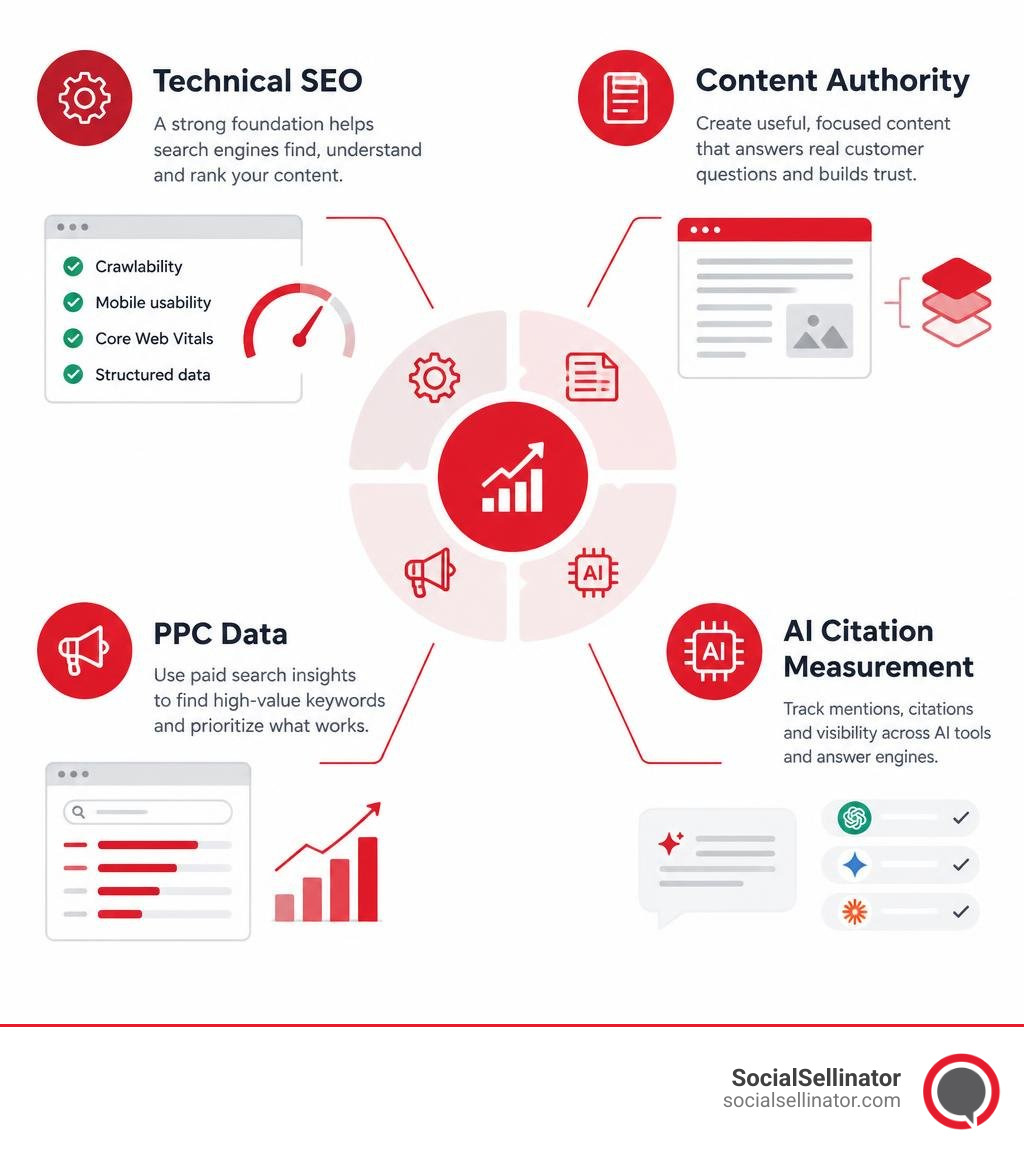
The best SEO optimization strategies in 2026 combine four priorities: make your site easy to crawl and fast to use, publish the most useful content on a topic, earn credible mentions and links, and format key answers so search engines and AI tools can understand them.
- Fix indexation, mobile usability, Core Web Vitals, and structured data.
- Build content clusters around customer problems and buying intent.
- Use PPC search-term and conversion data to prioritize organic opportunities.
- Track rankings, qualified leads, assisted conversions, AI citations, and branded-search growth.
This matters because a high ranking is no longer the only path to visibility. AI Overviews, ChatGPT, and Perplexity can answer questions before someone clicks a result. Nearly 60% of searches now end without a website click, so sustainable growth requires visibility across classic results, AI answers, local listings, and trusted third-party publications.
The fundamentals still win: useful pages, clear site architecture, genuine expertise, strong technical health, and earned authority. The difference is that modern teams must connect these efforts to revenue, not just traffic.
I’m Jock Breitwieser, and I’ll walk you through a practical system for turning search visibility into measurable business growth.
Understanding modern search engine dynamics means recognizing that the user journey has fractured. Google alone processes an estimated 8.5 billion searches per day, yet the way users engage with those results has shifted dramatically. Only 40.3% of Google searchers clicked on a traditional organic result in March 2025, down from 44.2% the previous year. Furthermore, AI Overviews trigger a 34.5% decrease in click-through rates when they appear, compelling brands to look beyond traditional blue links.
To succeed in this environment, our approach must treat search optimization not as a disconnected list of tricks, but as a full-funnel digital ecosystem. By integrating on-page excellence, deep technical foundations, multi-platform digital PR, and direct paid search intelligence, we can secure brand visibility across every digital touchpoint where modern buyers make decisions.
Foundational SEO Optimization Strategies for Modern Search Engines
The era of publishing isolated, shallow blog posts targeting single keywords has been replaced by semantic search systems. Modern search engines evaluate digital domains as cohesive knowledge hubs rather than disconnected libraries of individual articles. To capture dominant search positions and maintain consistent visibility, organizations must cultivate undeniable topical authority across their core areas of expertise.
Topical authority represents a search engine’s algorithmic evaluation of how deeply, accurately, and thoroughly a website covers an entire subject. Rather than analyzing single URLs in isolation, modern algorithms map the semantic relationships, contextual depth, and expertise demonstrated across your entire domain. When a brand provides comprehensive answers to every primary, secondary, and tertiary question within a market niche, search engines recognize that domain as an industry authority.
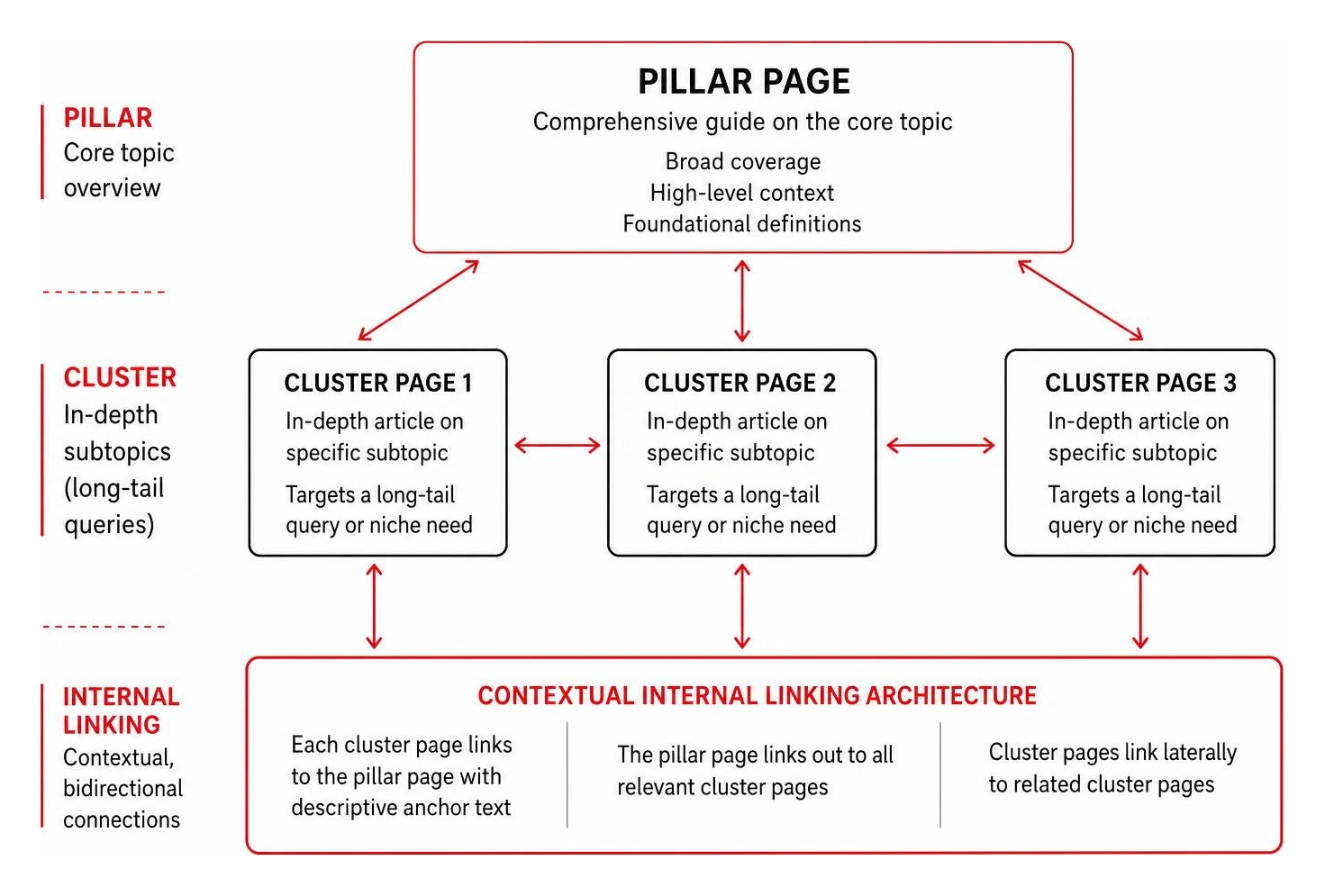
Structuring topical authority effectively requires deploying a deliberate pillar-and-cluster content architecture:
- Comprehensive Core Pillar Pages: High-level cornerstone assets that cover broad industry subjects thoroughly, establishing definitions, foundational principles, and structured overviews.
- In-Depth Supporting Cluster Content: Specialized sub-articles focusing on specific long-tail queries, technical subtopics, and granular buyer questions that branch naturally from the primary pillar.
- Contextual Internal Linking: Strategic, bidirectional hyperlinks that connect cluster pieces back to their parent pillar and link related cluster articles together using descriptive, natural anchor text.
Developing an effective SEO content strategy enables marketing teams to map every piece of content directly to buyer awareness stages. Entity mapping plays a critical role in this process. Modern search engines analyze real-world entities—distinct people, organizations, concepts, and technologies—and evaluate the contextual connections between them. By explicitly defining relevant entities and connecting them logically across topic clusters, your website reinforces its semantic relevance and algorithmic clarity.
Technical SEO Optimization Strategies and Core Web Vitals
Even high-quality content will struggle to rank if search engine spiders encounter technical barriers during crawling, rendering, and indexing. Technical health serves as the foundation upon which all content marketing and on-page optimization efforts depend.
Conducting a thorough technical SEO analysis allows engineering and marketing teams to audit infrastructure, eliminate crawl waste, and optimize server communication:
- Crawl Budget and Indexation Management: Ensuring
robots.txtfiles permit access to critical resources, resolving 404 response errors, fixing broken redirect chains, managing parameter handling, and submitting clean XML sitemaps to webmaster consoles. - Canonicalization and URL Structuring: Applying self-referential canonical tags correctly across faceted navigation and parameter-heavy URLs to prevent duplicate content dilution.
- Shallow Site Architecture: Keeping important commercial landing pages and core resources within three clicks of the homepage to ensure link equity flows efficiently throughout the domain hierarchy.
- Mobile-First Responsiveness: Optimizing layout elements, touch targets, and typography for mobile viewports, ensuring identical content accessibility across all screen sizes.
Beyond basic crawling mechanics, user experience signals remain vital ranking considerations. Pages that meet established Core Web Vitals benchmarks experience significantly lower bounce rates and higher engagement. The core page experience metrics include:
- Largest Contentful Paint (LCP): Measures perceived visual loading speed. High-performing pages ensure primary hero images or headline text blocks render within 2.5 seconds of user initiation.
- Interaction to Next Paint (INP): Evaluates overall page responsiveness to user inputs, requiring interaction latency to remain below 200 milliseconds across all interactive elements.
- Cumulative Layout Shift (CLS): Gauges visual stability during page load, requiring layout shifts to stay under 0.1 to prevent unexpected content jumps that disrupt user interaction.
Furthermore, implementing structured data is essential for modern search visibility. Implementing comprehensive schema markup and structured data allows search engine algorithms to extract structured information effortlessly. Applying JSON-LD schema for organizations, articles, FAQs, products, breadcrumbs, and local businesses provides search engines with explicit context, making your site eligible for rich snippets and interactive SERP features.
Building Authority Through High-Impact Link Acquisition
While technical optimization and content quality establish relevance, earned domain authority dictates competitive search positioning. Backlinks remain core algorithmic trust signals, but modern ranking systems prioritize contextual relevance, referring domain authority, and editorial integrity over raw link volume.
Low-quality directory links and automated link schemes are disregarded or penalized by search algorithms. Today’s search engines evaluate the thematic alignment and real-world trust of every referring domain. A single contextual link from a respected industry publication or academic institution carries substantially more ranking equity than hundreds of low-quality directory citations.
To build lasting authority, marketing teams should implement proven off-page SEO link building strategies:
- Proprietary Research and Industry Benchmarks: Publishing original survey data, benchmark studies, and annual industry reports naturally attracts high-tier editorial citations from analysts and journalists.
- Targeted Digital PR Campaigns: Providing expert quotes, industry commentary, and unique perspectives to trade publications, generating earned media coverage and high-authority backlinks.
- Unlinked Brand Mention Outreach: Identifying web mentions of your company name, executive leadership, or proprietary frameworks and reaching out to request functional reference links.
- Broken Link Building: Finding broken reference links on authoritative industry websites and offering your comprehensive, updated resources as high-quality replacements.
- Strategic Guest Contributions: Authoring in-depth thought leadership pieces for prominent trade journals to showcase subject matter mastery and earn contextual editorial links.
Securing consistent, high-quality backlinks reinforces your domain authority, shields your rankings against algorithm volatility, and drives qualified referral traffic directly to your conversion funnels.
Evolving Beyond the SERP: Generative Engine Optimization (GEO)
Search engine results pages have transformed from static lists of links into dynamic, conversational answer interfaces. With the expansion of Google AI Overviews and modern conversational search tools, brand visibility now requires optimizing for both organic blue links and generative AI summaries.
AI summaries now appear on a substantial portion of informational and commercial queries, particularly for complex long-tail searches containing four or more words. Broad industry analyses indicate that up to 40% of top-of-funnel informational searches are answered directly by generative AI systems without requiring the user to navigate to a third-party website.
Generative Engine Optimization (GEO) is the practice of structuring, fact-checking, and publishing digital assets so large language models (LLMs) and retrieval-augmented generation (RAG) engines can parse, synthesize, and cite your brand as an authoritative entity.
Notably, AI citation algorithms operate under different heuristics than standard organic rankings. Research into AI search citations indicates that only about half of the sources cited within generative answers appear in the top ten standard organic search results. Furthermore, different AI platforms frequently cite diverse sets of reference domains, underscoring the necessity of a broad, multi-platform optimization footprint.
While zero-click generative summaries satisfy basic informational inquiries, visitors who do click through from AI citations exhibit exceptional commercial intent. Users interacting with AI citations have already reviewed synthesized summaries and are actively seeking deeper analysis or implementation partners, resulting in conversion rates that substantially outpace general organic traffic.
Generative Engine and AI SEO Optimization Strategies
To ensure your content is routinely extracted and cited by generative models, your pages must be formatted for machine readability, high information density, and factual clarity.
Key on-page techniques for AI citation include:
- Concise Answer Capsules: Place 120–150 character summary blocks directly beneath major H2 and H3 question headers to allow automated crawlers to extract direct answers quickly.
- High Information Gain: Generative engines prioritize original facts, verifiable statistics, step-by-step frameworks, and direct expert insights over generic, redundant summaries.
- Technical Delivery Speed: Rapid server response times and First Contentful Paint (FCP) speeds under 0.4 seconds improve crawler efficiency, facilitating prompt inclusion in generative indexes.
- Nested Semantic Schema: Deploying structured schema markup across your web pages provides explicit machine-readable context, increasing the likelihood of brand citations in AI responses.
- Data Tables and Ordered Lists: Structuring complex comparisons, workflows, and technical parameters into clean HTML tables and numbered steps facilitates direct quotation by RAG systems.
Leveraging professional SEO content creation services ensures that every article, case study, and technical guide maintains the editorial depth, factual rigor, and structural formatting required for prominence in generative search environments.
Multi-Property Presence and Digital PR for AI Ingestion
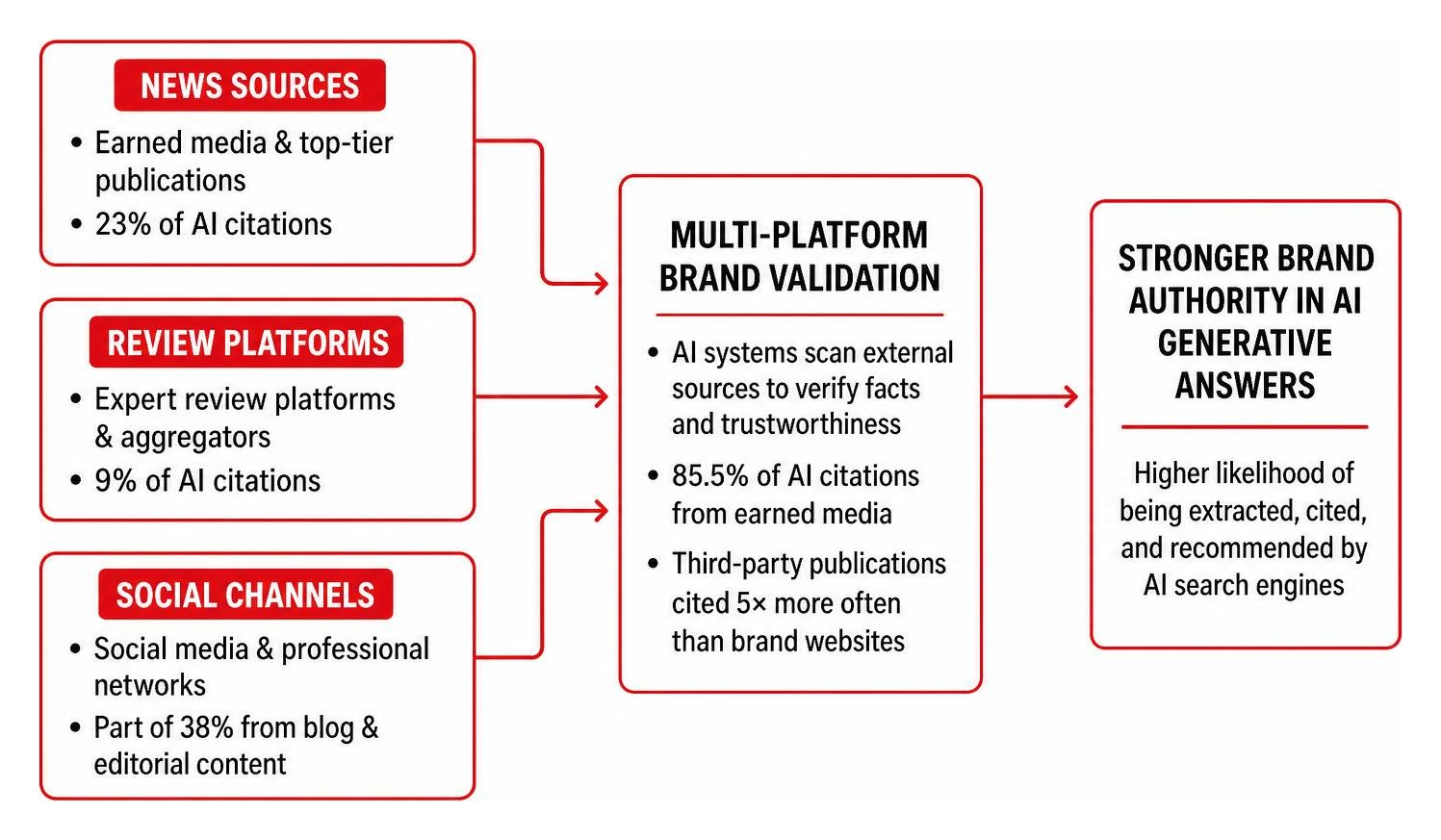
Generative engines do not evaluate your website in isolation. AI systems continually scan external publications, industry directories, trade blogs, and digital review platforms to corroborate brand claims and evaluate external consensus.
Industry data shows that a vast majority of AI citations stem from earned media publications, trade journals, and third-party authority websites. Because generative models rely heavily on external verification, establishing a presence across third-party media outlets is just as critical as optimizing your internal website.
To build a multi-property digital footprint that generative engines trust:
- Distribute Strategic Press Releases: Share announcements regarding proprietary data studies, company milestones, and industry partnerships across reputable news distribution networks that search engines index continuously.
- Cultivate Thought Leadership and Media Mentions: Secure executive bylines and expert quotes in reputable trade publications to build strong entity associations around your core solutions.
- Maintain Verified Third-Party Profiles: Keep accurate, verified profiles on leading industry directories, software evaluation platforms, and business review sites to establish cross-platform consistency.
- Engage in Industry Community Discussions: Actively contribute thought leadership in prominent industry forums and professional social networks where search models gather sentiment signals.
By executing a holistic content marketing for SEO program, you create a widespread digital footprint that reinforces your brand authority whenever search engines or AI systems evaluate your market category.
Maximizing Efficiency Through Unified SEO and PPC Integration
Operating organic search (SEO) and paid search advertising (PPC) as isolated marketing silos is an inefficient approach that leads to duplicated effort and missed revenue opportunities. When paid and organic teams work independently, companies frequently bid on keywords they already dominate organically, fail to share conversion intelligence, and duplicate keyword research investments.
A unified search strategy bridges this operational divide, driving significant cost efficiencies and improving overall campaign return on investment. Case studies show that coordinating paid and organic strategies can drastically reduce paid acquisition costs while enhancing organic conversion rates through shared audience data and cohesive messaging.
When search teams collaborate closely, organic technical and content improvements directly enhance paid advertising performance:
- Improved Quality Scores: Enhancing page load speeds, user experience, and semantic content relevance raises Google Ads Quality Scores across key landing pages.
- Reduced Cost-Per-Click (CPC): Higher Quality Scores lower the bid amounts required to win competitive ad placements, stretching your advertising budget further.
- Complete SERP Real Estate Domination: Owning top sponsored placements alongside prime organic rankings and AI overview citations establishes brand authority and maximizes overall click capture.
- Shared Negative Keyword Insights: Identifying irrelevant paid search queries allows organic content creators to refine intent targeting and eliminate low-converting organic traffic.
Understanding the impact of search engine marketing on online performance enables organizations to combine organic search and paid advertising into an integrated customer acquisition engine.
Utilizing PPC Search Query Data to Accelerate Organic Content
Traditional organic keyword research often relies on search volume metrics and difficulty scores that fail to indicate actual buyer intent. In contrast, paid search campaigns provide real-time, empirical data regarding which specific queries result in closed deals and revenue.
By analyzing high-converting search query reports from PPC campaigns, marketing teams can uncover:
- Granular long-tail keyword phrasing that consistently triggers form fills, demo requests, and inbound phone inquiries.
- Commercial modifiers and pain points used by decision-makers at the bottom of the sales funnel.
- Emerging seasonal trends and language shifts weeks before standard organic research tools register changes in search volume.
- High-performing ad copy headlines and value propositions that can be adapted into organic meta titles and H1 tags to improve organic click-through rates.
Once a specific search query demonstrates consistent commercial conversion value in paid campaigns, organic teams can immediately develop dedicated pillar pages and supporting topic clusters around those validated themes. Understanding how to transition from keywords to conversions ensures that your organic content production resources focus strictly on topics with proven revenue potential.
Measuring Performance and Avoiding Costly SEO Mistakes
In an era shaped by generative AI summaries, dynamic SERP layouts, and multi-touch customer journeys, measuring organic success solely through keyword rankings and raw page impressions is insufficient. When a significant portion of searches conclude without an immediate website click, tracking website sessions alone fails to capture total brand impact.
A comprehensive performance framework evaluates both direct organic conversions and full-funnel brand influence across digital search channels:
- AI Overview Share of Voice: Measuring how frequently your brand, executive insights, and proprietary data points are cited within AI Overviews and conversational answer engines for target industry prompts.
- Branded Search Growth: Tracking increases in brand-name queries, executive searches, and product inquiries over time, reflecting strong brand awareness generated by zero-click visibility.
- Multi-Touch Pipeline Attribution: Evaluating how organic touchpoints contribute to pipeline creation, lead nurturing, and final deal velocity within attribution models.
- Search Impression Share and Rich Snippet Ownership: Monitoring total impressions and featured snippet acquisitions in webmaster consoles to gauge aggregate brand visibility.
- Assisted Organic Conversions: Analyzing how initial organic discovery visits influence subsequent conversions through direct, paid, or referral channels across the buyer journey.
Adopting a sophisticated framework for evaluating the ROI of SEO services aligns organic marketing investments directly with pipeline growth, reduced customer acquisition costs (CAC), and increased customer lifetime value.
Navigating Common Pitfalls in Modern Search Strategy
Many businesses struggle to build organic momentum because they rely on outdated tactics that conflict with modern search algorithms. Avoiding these common strategic errors is essential for maintaining sustained search growth.
Critical mistakes to avoid include:
- Keyword Cannibalization: Publishing multiple uncoordinated articles targeting identical search intent, forcing search engines to choose between competing pages on your domain and diluting ranking equity.
- Neglecting Mobile Experience and Page Performance: Maintaining desktop-centric designs that render poorly on mobile devices or ignoring Core Web Vitals thresholds, which increases bounce rates and harms crawl efficiency.
- Publishing Low-Value, Derivative Content: Producing repetitive, generic articles that lack original research, personal experience, or actionable frameworks, leading to demotions by helpful content evaluation systems.
- Creating Isolated Content Silos: Failing to implement contextual internal links between blog articles, core pillar pages, and commercial service offerings, stranding link equity and complicating crawler navigation.
- Over-Optimizing for Outdated Metrics: Focusing exclusively on exact-match keyword density while ignoring structured data markup, clear answer capsules, and earned media citations that drive AI search visibility.
- Ignoring Technical Infrastructure Health: Allowing 404 response errors, broken redirect chains, unmanaged URL parameters, and indexation bloat to consume crawl budget and impair page discovery.
If your website experiences stagnant organic traffic or unexpected ranking drops, utilizing proven methodologies to find what is wrong with your SEO and fix it enables your team to diagnose crawl barriers, resolve technical anomalies, and regain search momentum quickly.
Frequently Asked Questions About SEO Strategy
How do SEO strategies change when optimizing for AI Overviews and traditional SERPs?
Optimizing for both AI Overviews and traditional search results does not require two separate technical systems; rather, it requires a unified strategy that emphasizes structural clarity and factual density. Traditional SEO focuses on earning top rankings in organic blue links by satisfying search intent, building page authority, and maintaining pristine crawlability.
Generative Engine Optimization builds directly upon that technical foundation by formatting content so AI algorithms can parse and synthesize answers instantly. This involves placing clear, 120–150 character answer capsules directly beneath question headers, implementing structured JSON-LD schema (such as Article and FAQPage), and maximizing information gain through original data and expert quotes. Because AI models evaluate third-party consensus, building earned media citations across industry news outlets and review platforms is essential for securing frequent AI citations.
How long do modern SEO strategies take to generate measurable ROI?
The timeline for realizing a measurable return on investment from an SEO strategy depends on site history, competitive landscape, and technical starting point:
- Weeks 1 to 4: Technical remediation—such as resolving crawl errors, fixing broken redirects, and optimizing Core Web Vitals—can yield immediate indexing improvements and higher click-through rates on existing rankings.
- Months 3 to 6: Implementing structured content clusters and optimizing on-page intent alignment routinely produces measurable growth in non-branded keyword rankings, AI answer appearances, and qualified organic traffic.
- Months 9 to 12: As domain authority compounds through digital PR, earned backlinks, and comprehensive topic coverage, businesses experience substantial pipeline growth, lower blended acquisition costs, and significant revenue impact.
For a detailed breakdown of budget planning and timeline expectations, review our guide on evaluating the ROI of SEO.
Why is keyword density no longer an effective ranking signal?
Modern search engines utilize advanced Natural Language Processing (NLP) and transformer-based machine learning models to understand the semantic meaning, context, and intent behind a query. Repeating an exact phrase multiple times to hit an arbitrary keyword density percentage is outdated and actively harms readability.
Instead of tracking keyword frequency, search algorithms evaluate how thoroughly a page answers the user’s primary query, resolves logical follow-up questions, and contributes original information. Pages that provide comprehensive answers, incorporate related industry entities, and offer high information gain consistently outperform thin pages loaded with repetitive keywords.
What role does structured data play in modern organic search visibility?
Structured data formatted in JSON-LD serves as an explicit translator between your website content and search engine algorithms. By annotating key elements—such as organization details, author expertise, product specifications, how-to instructions, and FAQ sections—structured schema markup removes ambiguity during automated parsing.
This structured code directly powers rich SERP enhancements, including visual star ratings, price indicators, FAQ drop-downs, and breadcrumb navigation paths. Moreover, structured data significantly enhances your eligibility for inclusion in generative AI summaries, as machine learning models rely on structured schema entities to verify facts and attribute quotes accurately.
Conclusion
Building a modern search presence requires a holistic strategy that unites technical excellence, structured topical authority, generative engine visibility, and cross-channel paid intelligence. By breaking down internal silos and connecting organic search efforts directly to commercial conversion goals, businesses can achieve scalable, long-term growth across both classic search engines and modern AI discovery platforms.
Partnering with an experienced team ensures your organization executes every aspect of modern search optimization flawlessly. Explore how our expert search engine optimization services can elevate your brand visibility and drive sustainable revenue growth.
Headquartered in San Jose, in the heart of Silicon Valley and the San Francisco Bay Area, SocialSellinator proudly provides top-tier digital marketing, SEO, PPC, social media management, and content creation services to B2B and B2C SMB companies. While serving businesses across the U.S., SocialSellinator specializes in supporting clients in key cities, including Austin, Boston, Charlotte, Chicago, Dallas, Denver, Kansas City, Los Angeles, New York, Portland, San Diego, San Francisco, and Washington, D.C.
- About the Author
- Latest Posts

Jock Breitwieser is a marketing thought leader, founder of SocialSellinator, Arcserve VP and has 20+ years’ experience in digital marketing & PR. He’s led communications at TriNet (IPO), Dell SonicWALL, CallidusCloud, and top agencies like (Edelman, Havas, Hoffman).
Named a Top 100 Social Selling Influencer, Jock contributes to outlets like Grit Daily, Marketer Magazine, DevX, Euro News, Hootsuite, Morning Lazziness, BacklinkBuilding.io, Under30CEO, and many others. Jock drives $1M+ client revenue outcomes, mentors startups, and lectures at SJSU and UC Berkeley Extension.


