
Mastering Modern Media with Proven Digital Content Examples
Digital Content Creation Examples That Drive Real Business Goals
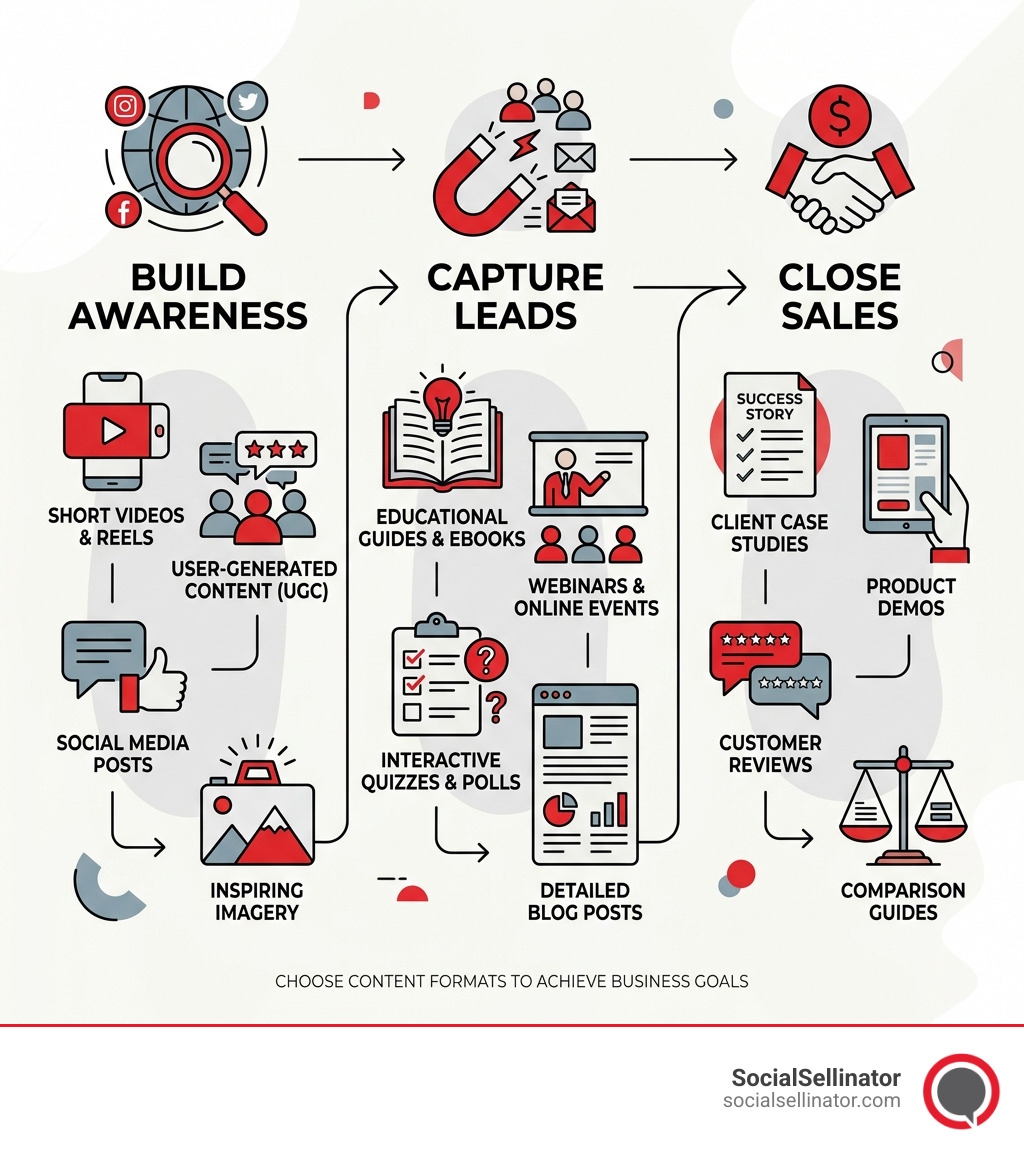
The best digital content creation examples match a clear goal with a format your audience already uses. Short videos and user-generated content can build awareness, guides and webinars can capture leads, and case studies, product demos, and customer reviews can help close sales.
For a practical starting mix, choose:
- Educational content: Blog posts, how-to videos, infographics, and webinars for trust and search visibility.
- Engagement content: Reels, polls, quizzes, and customer posts for reach and conversation.
- Conversion content: Case studies, comparison pages, demos, and lead magnets for pipeline growth.

Digital content creation is the planned production of useful online text, visuals, audio, video, and interactive experiences. It matters because people now spend close to eight hours each day with digital media, according to digital media use research. But attention is limited. A strong content program does not mean posting everywhere. It means creating helpful, distinct work for the right people, then measuring whether it earns attention, leads, and revenue.
In this guide, I am Jock Breitwieser, and I will show how to choose, create, reuse, and measure content that supports real marketing results.
Core Frameworks of Modern Digital Content Strategy
Creating digital media without a clear, documented framework leads directly to team burnout, disjointed messaging, and wasted marketing spend. An enterprise-grade content framework aligns every individual asset with distinct organizational objectives, target buyer personas, and specific stages of the modern customer journey.
To build a scalable publishing engine, high-growth organizations structure their production around content pillars. A content pillar is a comprehensive, authoritative core theme that encapsulates a brand’s primary subject matter expertise. From a single well-researched pillar asset, creative teams can spin off dozens of interconnected cluster assets, including deep-dive technical articles, bite-sized social carousels, video teasers, and downloadable lead generation materials.
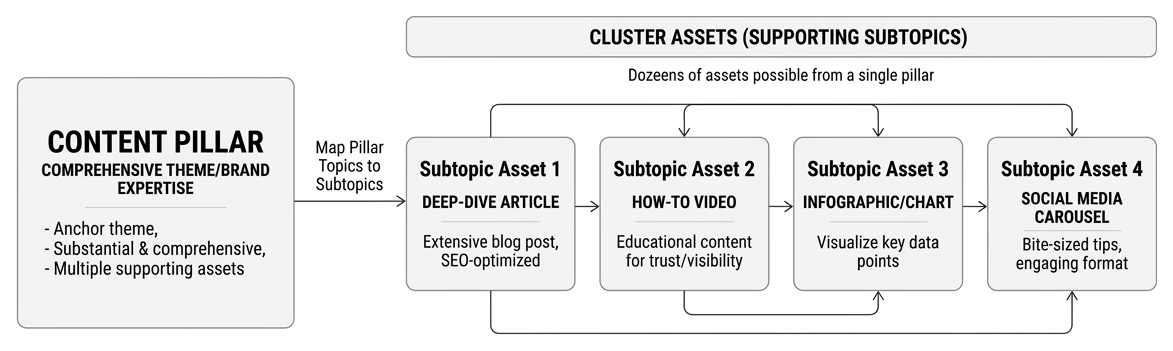
Organizing production into thematic pillars streamlines editorial planning and gives creative teams clarity on what to produce, where to distribute it, and how to track downstream results. Integrating comprehensive blog writing and content marketing into this workflow ensures that organic search engines and target buyers receive consistent, authoritative value across every digital touchpoint.
| Content Goal | Ideal Formats | Funnel Stage | Key Performance Indicators (KPIs) |
|---|---|---|---|
| Brand Awareness | Short-form vertical video, motion infographics, thought leadership essays | Top of Funnel (Attract) | Impressions, reach, video completion rate, social shares, branded search volume |
| Audience Engagement | Interactive polls, episodic podcasts, carousel breakdowns, community livestreams | Middle of Funnel (Engage) | Comments, saves, click-through rate (CTR), average watch time, newsletter signups |
| Lead Generation | Research reports, downloadable templates, industry whitepapers, gated webinars | Middle/Bottom of Funnel (Nurture) | Form fills, cost per lead (CPL), landing page conversion rate, MQL volume |
| Sales Conversion | Product comparison matrices, interactive ROI calculators, detailed case studies | Bottom of Funnel (Convert) | Sales qualified leads (SQLs), pipeline velocity, closed-won revenue, customer win rate |
Audience Research and Channel Alignment
Digital content performance is governed by platform-audience fit. Attempting to maintain an aggressive presence across every emerging platform quickly dilutes messaging and exhausts internal creative teams. Successful marketing teams identify precisely where their ideal buyers spend their professional and personal time, designing platform-native assets tailored to community expectations.
Customer interview transcripts, sales call recordings, social listening data, and search intent analysis reveal the operational hurdles, regulatory shifts, and everyday questions prospective buyers face. For example:
- B2B Decision-Makers: Seek rigorous analysis, peer-reviewed data, and pragmatic operational frameworks on professional networks like LinkedIn or specialized industry portals. They prioritize risk mitigation, cost optimization, executive consensus, and measurable return on investment.
- B2C Consumers: Respond to authentic visual storytelling, unscripted product demonstrations, behind-the-scenes founder footage, and relatable short-form video on channels like Instagram, TikTok, and YouTube. They value immediacy, social validation, frictionless purchasing, and brand community.
Focusing on the channels where prospective customers are actively seeking answers allows organizations to craft high-impact, contextual assets rather than pushing generic announcements across the web.
Content Repurposing and Lifecycle Maximization
Treating high-value content as a single-use production is one of the costliest errors in digital marketing. Sophisticated marketing teams run an agile repurposing flywheel, multiplying the impact of cornerstone creative investments across multiple touchpoints.
For example, a single in-depth technical webinar or flagship industry benchmark study can easily be transformed into:
- A long-form search-optimized cornerstone guide capturing targeted organic search traffic.
- Three detailed visual carousels distilling key statistical findings and operational takeaways for LinkedIn.
- Five vertical short-form video clips highlighting compelling insights for YouTube Shorts, Instagram Reels, and TikTok.
- An interactive email newsletter series delivering focused lessons directly to subscribers over several weeks.
- Standalone audio clips and discussions repurposed for an episodic podcast feed.
- Pragmatic sales enablement battle cards, objection-handling one-pagers, and pitch deck slides for account executives.
This systematic approach ensures that every creative investment continues to deliver compounding returns over quarters and years rather than disappearing after an initial social media blast.
Inspiring Digital Content Creation Examples Across Key Channels
Examining practical executions illustrates how smart creative strategy translates into measurable business growth. Modern digital content blends storytelling, visual polish, and direct utility to educate, entertain, and persuade audiences across inbound and outbound channels.
Distributing these diverse formats requires coordinated cross-channel execution. Pairing high-quality creative assets with targeted social media management ensures that branded media reaches the prospective buyers who are most likely to engage, subscribe, and purchase.
Video and Visual Digital Content Creation Examples
Video remains the dominant medium for capturing buyer attention across digital ecosystems. Because dynamic visual media communicates complex ideas quickly, it consistently outperforms static text in social feeds and promotional campaigns.
- Short-Form Problem-Solving Tutorials: Dynamic 30-to-60-second vertical videos that showcase immediate solutions to common customer pain points. Software platforms and consumer brands use rapid before-and-after walkthroughs to capture attention in fast-scrolling feeds, demonstrating product utility in seconds.
- Behind-the-Scenes Cultural Storytelling: Humanizing a company by highlighting engineers, designers, product craftsmen, and workplace culture. Giving prospective buyers an unvarnished look at product development builds authentic trust that traditional corporate ads cannot replicate.
- Data-Driven Motion Graphics and Interactive Infographics: Transforming complex data sets, survey results, and industry trends into visually captivating, animated charts. Simplifying dense concepts makes technical information highly shareable, memorable, and linkable for digital PR.
- Studio-Quality Narrative Animations: Utilizing advanced digital animation and visual modeling tools to craft immersive brand narratives. Modern creative teams can storyboard, render, and deploy studio-grade visual stories rapidly, helping brands stand out in crowded digital marketplaces.
- Executive Livestreams and Feature Teardowns: Real-time broadcasts where subject matter experts and product leaders host interactive Q&A sessions, answer customer objections, and demonstrate advanced platform workflows live on camera.
B2B vs. B2C Digital Content Creation Examples
While compelling narratives engage both B2B and B2C audiences, their core decision-making criteria require distinct content formats and messaging angles.
B2B Content Examples: Logic, Risk Reduction, and Authority
B2B buyers face multi-stakeholder approval cycles involving finance, procurement, IT security, and department heads. As a result, enterprise digital media must focus on authority, compliance, operational efficiency, and demonstrable financial return:
- Interactive Industry Benchmark Portals: Replacing static PDF downloads with interactive, web-based digital experiences. These portals allow users to filter proprietary benchmark data by company size, sector, and geographic region, boosting dwell time and generating highly qualified inbound sales opportunities.
- Customized Year-in-Review Client Reports: Delivering personalized data dashboards directly to existing clients. Demonstrating exact time saved, cost reductions achieved, or revenue generated drives contract renewals, cross-sell opportunities, and account expansions.
- Comprehensive Whitepapers and Strategic Playbooks: Authoritative, data-dense publications that break down regulatory changes, supply chain disruptions, or technical frameworks, positioning the publishing brand as an indispensable industry advisor.
- Interactive Total Cost of Ownership (TCO) and ROI Calculators: Self-serve financial modeling tools embedded directly on landing pages where prospective buyers can input their unique business metrics to quantify potential cost savings and efficiency gains.
Distributing these authoritative resources through targeted LinkedIn lead generation campaigns allows B2B enterprises to put high-value research directly before C-suite leaders and senior procurement professionals.
B2C Content Examples: Emotion, Community, and Speed
Consumer audiences make faster, emotion-driven purchasing choices. B2C content prioritizes lifestyle integration, peer validation, and immediate gratification:
- User-Generated Content (UGC) Showcases: Encouraging everyday customers to submit unedited videos, unboxing clips, and lifestyle photos featuring products in action. Authentic customer testimonials provide powerful social proof that routinely converts at higher rates than polished studio advertisements.
- Interactive Personality and Product-Finder Quizzes: Engaging shoppers with playful quizzes that match their specific tastes, skin types, or style preferences with curated product selections, capturing valuable first-party email data for targeted follow-up flows.
- Community Challenge Campaigns: Launching themed hashtag challenges that encourage audiences to create and share their own content, transforming casual customers into active brand advocates across social networks.
- Augmented Reality (AR) Try-On and Placement Filters: Interactive mobile camera experiences that let shoppers virtually preview how furniture fits into their living space or test cosmetics before completing an online checkout.
The AI Transformation in Digital Content Production
Artificial intelligence has transformed modern marketing operations. Marketing teams increasingly rely on AI platforms to accelerate research, topic ideation, media transcription, and multi-format production workflows.
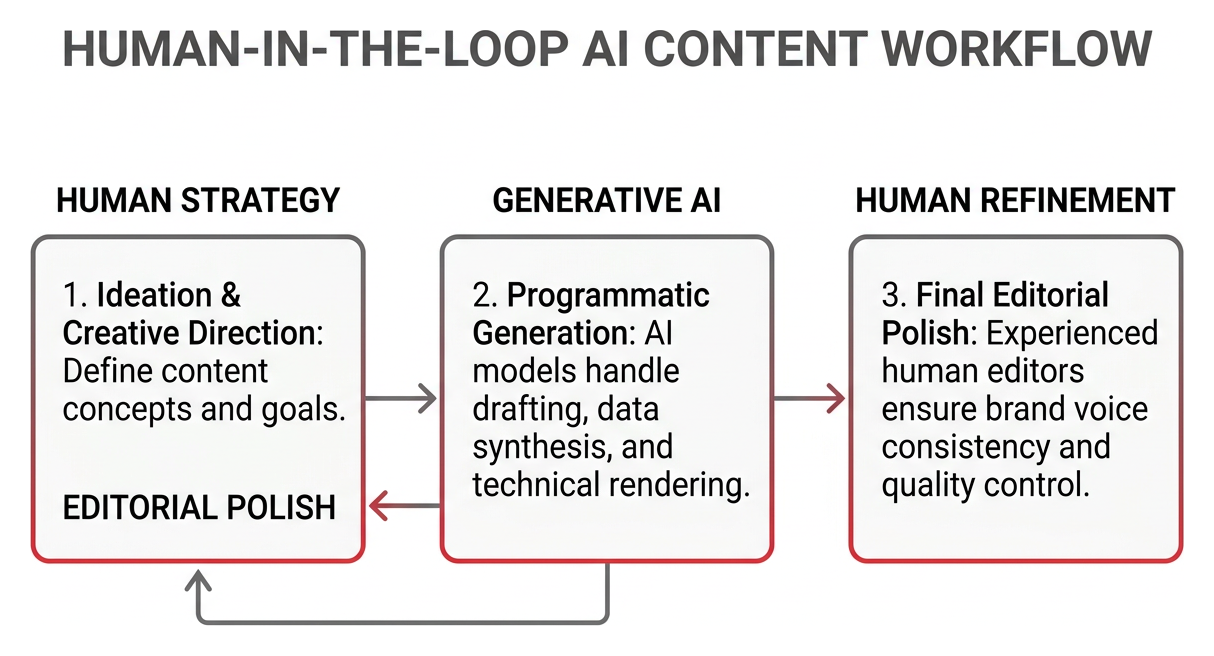
However, top-performing marketing programs do not use automated tools to replace human judgment. Instead, they implement a collaborative human-in-the-loop production workflow. Under this model, generative algorithms handle data synthesis, initial drafting, and automated formatting, while experienced creative strategists provide narrative vision, brand voice consistency, empathetic storytelling, and rigorous editorial oversight.
Autonomous Workflows and Video Orchestration
Modern media production has advanced from basic copy generation to multimodal production pipelines. Sophisticated automation workflows now execute complex creative sequences with minimal manual friction:
- Automated Research Ingestion: Scanning customer support tickets, sales transcripts, and search query trends to surface emergent customer concerns, market sentiment shifts, and content topic clusters.
- Programmatic Video Assembly: Using modular code-based templates and automated rendering pipelines to script, assemble, and render personalized video variations at scale.
- Voice Synthesis and Multilingual Localization: Generating studio-quality voiceovers and dynamically translating video scripts into regional languages, expanding global reach without requiring separate production teams in every target market.
- Intelligent Visual Reformatting: Automatically analyzing horizontal master footage to crop, center, and reformat scenes into vertical video formats with dynamic captions optimized for mobile consumption.
These automated processes compress content turnaround times from several weeks to a few hours, giving agile marketing teams the power to test creative angles rapidly while maintaining high production standards.
Ethics, Brand Authority, and Algorithmic Visibility
As generative tools lower the barrier to publishing, digital channels are flooded with generic, automated content. Maintaining brand authority, intellectual property standards, and search visibility requires strict quality governance.
- Fact-Checking and Accuracy: AI-assisted drafts must be thoroughly checked against primary research, expert commentary, and verified business data. Publishing inaccurate information erodes buyer trust and damages brand credibility.
- Intellectual Property and Transparency: Brands must respect copyright boundaries, adhere to ethical data practices, and clearly disclose synthetic media when required, maintaining transparent relationships with audiences.
- Search Quality and Experience Guidelines: Search algorithms prioritize content that showcases genuine subject-matter expertise, first-hand experience, authoritative insights, and trustworthiness (E-E-A-T). Generic, purely automated articles are increasingly devalued in organic search.
Executing enterprise SEO strategies ensures that published assets remain technically sound, strategically organized, and visible across both standard organic search results and emerging AI search interfaces.
Measuring Content ROI and Overcoming Creative Fatigue
Building an effective content marketing program requires continuous performance analysis paired with realistic operational planning. Publishing high volumes of creative assets without tracking bottom-line financial impact leads to exhausted teams and stagnant campaigns.
To understand the true commercial return of your media investments, track key performance indicators across every stage of the customer lifecycle:
- Top-of-Funnel Visibility: Organic search impressions, unique website visitors, referral traffic, branded search growth, social reach, and video completion rates.
- Middle-of-Funnel Engagement: Average dwell time, scroll depth, resource downloads, email open and click rates, webinar attendance, and return visit frequency.
- Bottom-of-Funnel Revenue: Sales qualified leads, assisted conversion paths, pipeline contribution, customer acquisition costs (CAC), and customer lifetime value (LTV).
Effective measurement systems connect multi-channel interactions to tangible business outcomes rather than analyzing each marketing channel in a silo. A prospective buyer may first discover your brand through an educational blog article, revisit the site after clicking a retargeting ad, download an industry whitepaper, and finally request a sales consultation after reviewing a detailed customer case study. If your attribution model only credits the final touchpoint, you risk cutting the early-stage educational assets that built trust in the first place.
Marketing teams should combine website analytics, CRM tracking, paid advertising data, and direct customer feedback to map the full buyer journey. Start by identifying which content formats consistently introduce new prospects, which assets nurture buying intent, and which materials accelerate deal closures. Comparing the production cost of each format against its direct pipeline impact clarifies where to allocate future marketing resources across SEO content, PPC landing pages, video explainers, and sales collateral.
To prevent internal creative burnout, establish a manageable publishing schedule. Publishing two or three well-researched, deeply insightful assets per week builds far greater compounding authority than publishing daily, surface-level articles that fail to engage readers. Regular qualitative reviews, such as analyzing heatmaps, reader feedback, and sales team conversations, help teams refine high-performing assets while sunsetting underperforming formats.
Creative fatigue also affects audience engagement. When an audience is repeatedly exposed to identical visual styles, messaging hooks, and calls to action, response rates inevitably decline. Marketing teams should systematically rotate angles, highlight fresh customer stories, experiment with new multimedia formats, and repurpose proven core concepts for new distribution channels. Maintaining a healthy balance between structured consistency and creative experimentation keeps operations efficient while sustaining high audience interest over the long term.
Frequently Asked Questions About Digital Content Creation
How do businesses measure the true ROI of digital content?
Measuring the true return on investment of digital content requires looking beyond superficial vanity metrics like likes, shares, and raw pageviews. Organizations should establish multi-touch attribution frameworks that trace how different content touchpoints assist conversions throughout the entire buyer journey.
By integrating website analytics with your customer relationship management (CRM) platform, you can monitor pipeline contribution, lead velocity, and closed-won revenue tied directly to specific articles, video series, and downloadable assets. Calculating customer acquisition cost (CAC) and customer lifetime value (LTV) across content campaigns reveals which formats deliver the highest net return on investment.
What is the ideal balance between AI automation and human creativity?
The most effective content operations use AI tools for computational heavy lifting, such as data mining, initial topic ideation, content outlining, transcript summarization, and multi-format resizing. However, strategic narrative direction, authentic emotional resonance, nuanced brand voice, and final editorial quality control must remain firmly in human hands.
Generative algorithms cannot replicate genuine lived experience, empathetic customer understanding, or authentic brand perspective. Combining automated production speed with human creative judgment ensures every published asset remains high-quality, legally compliant, and aligned with company goals.
How often should small teams publish content to stay competitive?
Consistency and high editorial quality consistently outperform sheer publishing volume. For small marketing teams, maintaining a predictable cadence of two to three high-impact assets per week—such as one in-depth pillar article or educational video paired with repurposed social carousels and newsletter summaries—builds sustainable authority without causing team burnout.
Teams should focus on dominating one or two primary distribution channels where their target buyers are most active before attempting to expand across additional platforms. Building strong community engagement on a single platform generates far greater commercial returns than spreading thin, generic content across many channels.
Conclusion
Building a high-performing digital presence requires much more than chasing fleeting internet trends. It demands a deliberate, disciplined content strategy that pairs compelling creative formats with thorough audience research, structured production workflows, and continuous performance measurement.
Whether developing interactive enterprise benchmark portals, producing engaging short-form video series, or building search-optimized knowledge hubs, the brands that achieve sustainable growth are those that deliver undeniable value to their target audience at every stage of the customer journey.
At SocialSellinator, we help ambitious businesses transform their creative marketing vision into measurable revenue. From strategic planning and high-impact copywriting to comprehensive social distribution, search engine optimization, and paid advertising campaigns, our team delivers custom marketing solutions designed to accelerate growth. Explore our expert digital marketing and content creation services to start building a high-performing media engine that elevates your brand and outpaces the competition.
Headquartered in San Jose, in the heart of Silicon Valley and the San Francisco Bay Area, SocialSellinator proudly provides top-tier digital marketing, SEO, PPC, social media management, and content creation services to B2B and B2C SMB companies. While serving businesses across the U.S., SocialSellinator specializes in supporting clients in key cities, including Austin, Boston, Charlotte, Chicago, Dallas, Denver, Kansas City, Los Angeles, New York, Portland, San Diego, San Francisco, and Washington, D.C.
- About the Author
- Latest Posts

Jock Breitwieser is a marketing thought leader, founder of SocialSellinator, Arcserve VP and has 20+ years’ experience in digital marketing & PR. He’s led communications at TriNet (IPO), Dell SonicWALL, CallidusCloud, and top agencies like (Edelman, Havas, Hoffman).
Named a Top 100 Social Selling Influencer, Jock contributes to outlets like Grit Daily, Marketer Magazine, DevX, Euro News, Hootsuite, Morning Lazziness, BacklinkBuilding.io, Under30CEO, and many others. Jock drives $1M+ client revenue outcomes, mentors startups, and lectures at SJSU and UC Berkeley Extension.


